
Marketers are not short on AI tools. They are short on a way to make those tools work together. A typical content team now runs a writer in one tab, an image generator in another, a social scheduler, an SEO checker, and a reporting dashboard that none of the others talk to. The subscriptions add up while the output stays disconnected.
This guide takes a different route. Instead of dropping three dozen products on you, it groups the best AI marketing tools by the job they do, shows how they connect into one content-to-campaign workflow, and hands you a way to choose based on your team size and budget. Every price here was checked against published vendor pricing in 2026, and every statistic is sourced.
How these picks were chosen
The tools below were selected on four practical tests: does the product solve a distinct job in the content-to-campaign pipeline, does it hold up in day-to-day marketing use rather than a demo, is its pricing transparent enough to plan around, and does it connect to the rest of a stack instead of trapping your work inside one app. Products that only repackaged a general chatbot without adding real workflow value were left out.
Pricing was read from each vendor's public pricing page in 2026 and reflects the lowest paid tier, billed annually where that option exists. Plans change often in this category, so treat every figure as a starting point and confirm the current number before you buy.
The state of AI in marketing right now
Adoption has moved from side experiment to standard practice. Salesforce's State of Marketing research tracked generative AI use in at least one workflow climbing from 51% in early 2024 to 87% in early 2026. In under two years, the marketer who avoids AI became the outlier.
You can read the full Salesforce State of Marketing report for the underlying survey detail.
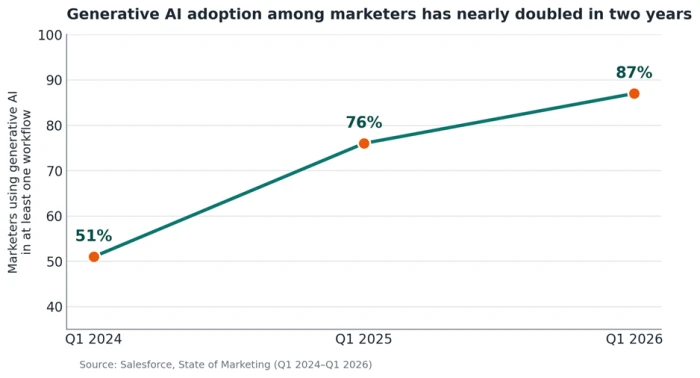
Figure 1. Generative AI adoption among marketers, Q1 2024 to Q1 2026. Source: Salesforce, State of Marketing.
The pull becomes obvious once you look at cost. Improvado's analysis put the median cost of an AI-generated article at $0.12, against roughly $150 for a freelance draft. Email send-time optimization, meanwhile, lifts open rates by 8 to 15%. Economics like that explain why HubSpot's 2026 State of Marketing report found 80% of marketers already using AI for content creation and 92% using automation for data analysis and reporting.
There is a catch, and it is the reason this guide exists. Zapier's research on AI spending found 86% of professionals expected their AI budgets to rise, while 26% already named overlapping tools as a barrier to getting value. BCG has reported that around 74% of companies still struggle to turn AI into business results. The lesson across all of it is blunt: more tools has not meant more output. Connected tools has. (HubSpot publishes its figures in the State of Marketing report.)
What “content and campaigns” actually means for tool choice
Most “best AI marketing tools” lists treat every product as a standalone gadget. That framing falls apart the moment you run a real campaign, because content and campaigns sit at two ends of the same pipeline. Content is what you make. A campaign is how that content reaches people, gets measured, then improves.
Read that way, your stack has five jobs to cover:
• Ideation and research: topics, briefs, angles, and audience insight
• Creation: copy, visuals, video, and voice in a consistent brand voice
• Optimization: making content rank in search and get surfaced by AI answer engines
• Distribution: social, email, paid ads, and every other channel
• Measurement: tracking what worked and feeding it back into the next round
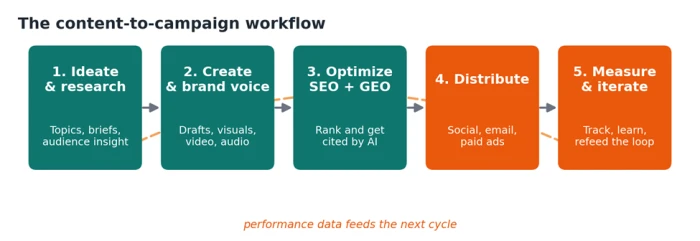
Figure 2. The content-to-campaign workflow these tools plug into.
The sections that follow move through that order. As you read, keep one question in mind: does this tool replace a step you do by hand, or does it just add another subscription?
Best AI tools for content creation
This is where most teams begin, and where the market is most crowded. The right pick depends on the writing you do most often.
Best for long-form and brand voice: Jasper
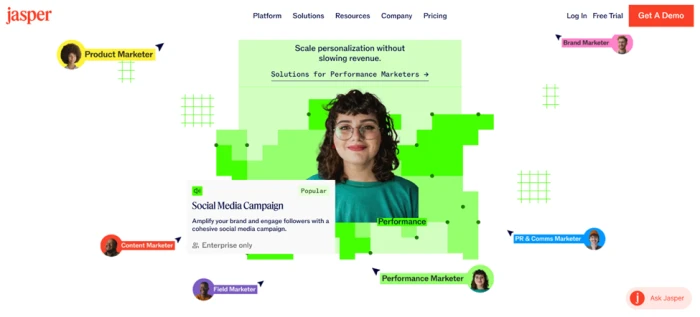
Jasper is built for marketing teams rather than general users. Its Brand Voice feature learns your tone and terminology from samples you upload, then holds that voice across blog posts, landing pages, campaign copy, and product pages. Setup takes patience, but once it is trained, it cuts the editing load on longer drafts. Pro pricing starts near $59 per month billed yearly. Best suited to agencies and content teams running several brands at once.
Best all-purpose drafting: ChatGPT and Claude
For a single strategist or founder, a general assistant often does more per dollar than a dedicated platform. ChatGPT remains the most widely used, handling everything from ad concepts to survey analysis. Claude has become the pick for longer reasoning and cleaner first drafts that need less cleanup. Both offer working free tiers, with paid plans starting near $20 per month. The tradeoff is that you design the process around them, rather than the tool bringing a process with it.
Best for short-form and conversion copy: Copy.ai
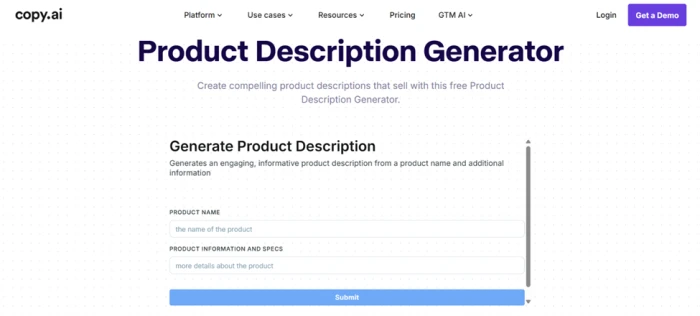
Copy.ai performs best on small, high-volume pieces: subject lines, ad variations, product descriptions, and calls to action. In 2026 it leans toward go-to-market and sales work, so it fits revenue teams better than social-first ones. Confirm the current plan tiers before buying, since the pricing was restructured this year.
Set brand voice once. Before you judge any writing tool, feed it three or four of your best existing pieces and a short style note. Almost every complaint about “generic AI copy” traces back to skipping this step.
Best AI tools for SEO and content optimization
Drafting text is only half the work. Getting it found is the other half, and it is where a draft turns into an asset that earns traffic month after month.
Optimization tools score your content against pages that already rank, flag missing subtopics, then build briefs your writers can follow. Three lead the category:
| Tool | What it does best | Starting price |
|---|---|---|
| Surfer SEO | Real-time on-page scoring as you write | ~$99/mo |
| Clearscope | Detailed content briefs and shareable reporting | $129/mo |
| Semrush Content Toolkit | Ties drafting to live keyword and SERP data | From $117/mo (Semrush) |
Frase and MarketMuse round out the group for teams that want topic modeling and competitive gap analysis. The distinction that decides which one earns its cost: tools that generate text in isolation versus tools that tie writing to search data. For a page meant to rank, the second kind wins every time.
Pricing in this category also explains a common budgeting surprise. Writing assistants can cost as little as $9 to $20 per month, while SEO and optimization platforms sit far higher because they carry keyword databases and rank tracking behind them.
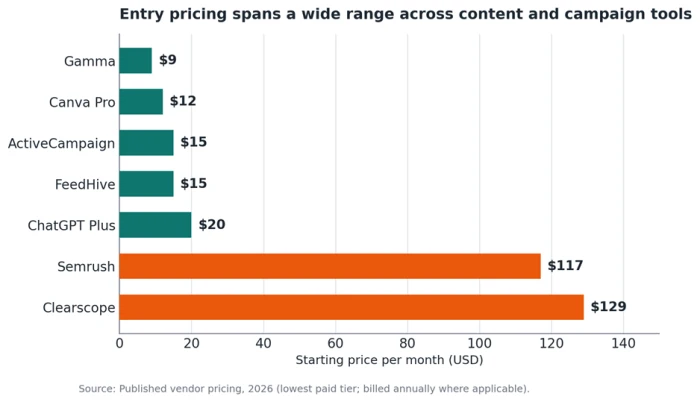
Figure 3. Entry pricing for a sample of content and campaign tools. Source: published vendor pricing, 2026.
Best AI tools for visual and video content
Campaigns live or die on how they look. Text-only tools leave a gap that a second class of products fills.
Image and design
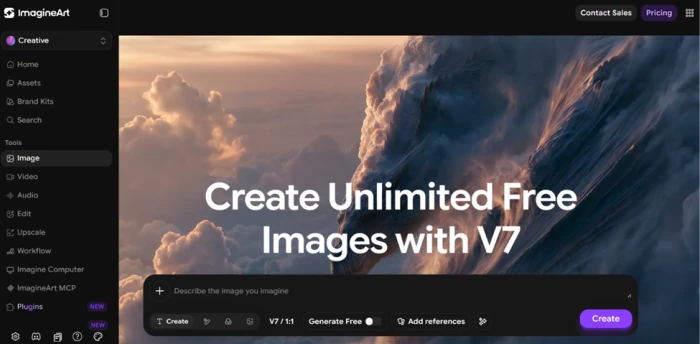
Canva is still the tool to hand anyone who is not a designer; its AI features cover text-to-image generation, background removal, and template creation. Midjourney produces the highest-fidelity images for teams that want a distinct, reusable visual style, and its style-reference system lets you match new images to existing brand assets. Adobe Firefly sits inside the Creative Cloud workflow for teams already living there.
Video and audio, plus slide decks
Runway and Descript solve two different video needs. Runway generates footage from prompts, while Descript lets you edit a video by editing its transcript, deleting words to cut the timeline. ElevenLabs covers voiceover with a library of thousands of AI voices. Gamma turns a prompt or a pasted document into a polished slide deck in minutes, which is handy for campaign plans and client updates.
Consistency beats novelty. A brand character or visual style you can reproduce across a whole campaign is worth more than one striking image you cannot repeat.

Best AI tools for campaign execution
Here is the half that most “best tools” lists skip. Creating content is upstream work. A campaign is what happens when that content meets an audience, and it needs its own set of tools.
Social media management
Sprout Social and FeedHive bring AI into scheduling, content recycling, and engagement. FeedHive's conditional posting measures how a post performs and then acts on that result, which turns publishing into something closer to a feedback loop than a one-way broadcast.
Email and lifecycle
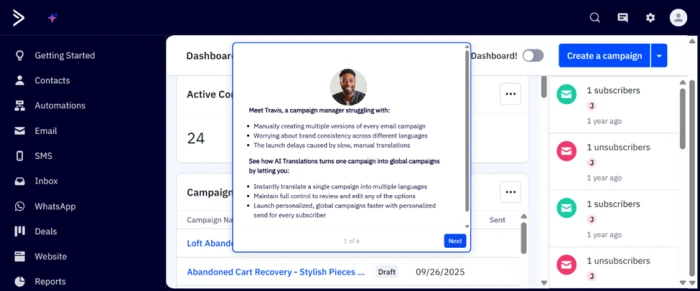
ActiveCampaign drafts a full email from a plain-English brief, including subject line and a starter automation, and its predictive sending learns each contact's open behavior instead of firing at one fixed time for everyone. Klaviyo and HubSpot's Breeze AI cover similar ground for ecommerce and CRM-centered teams.
Paid ads and optimization
Automated ad systems from Meta and Google adjust targeting, bidding, and creative rotation in real time based on live performance signals. Improvado's benchmarking found creative rotation and bidding automation delivering around a 3.3% lift in click-through rate within the first 90 days. The human job narrows to the brief: who the audience is and what the offer says. The system handles the rest.
Best AI tools for AI visibility (GEO and AEO)
A new job has appeared on the list, and it changes how content earns traffic. When someone asks ChatGPT, Gemini, Perplexity, or Google's AI answers for a recommendation, you want your brand named in the response. That is the aim of generative engine optimization and answer engine optimization.
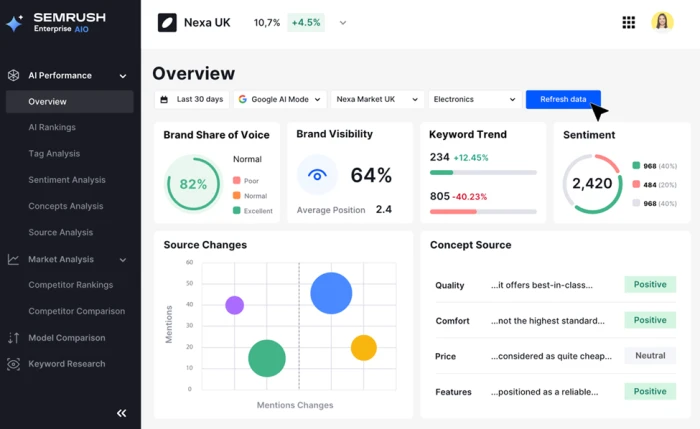
Tools here track whether AI engines mention you and where you are absent. Similarweb added AI visibility tracking that reports which prompts drive visits and which AI channels send the most traffic. Semrush's AI Toolkit monitors brand mentions across ChatGPT, Google AI, Gemini, and Perplexity against a large database of prompts, plus a site audit for AI readiness.
The practical takeaway for content is clear. Original data, clear structure, and named statistics are what language models reuse when they answer. The same qualities that make a page trustworthy to a human reader now decide whether an AI engine will cite it.
The glue: automation and orchestration
Every tool above is strong alone and stranded alone. Orchestration is what links them into the workflow shown earlier in Figure 2.
Zapier connects thousands of apps so a single trigger can run a chain: a lead arrives, AI scores and personalizes a follow-up, the record lands in your CRM, and your team gets a Slack ping. Make and n8n serve teams that want more visual or self-hosted control. This layer is also your strongest defense against tool sprawl, because it lets the tools you already pay for talk to each other instead of pushing you toward one more all-in-one platform.
Free versus paid: what “free” actually gets you
Free tiers are built for evaluation and light work, not for running an operation. Most limit you in at least one of these ways:
• Usage: a capped number of generations, posts, or credits each month
• Features: advanced functions locked behind a paid plan
• Output: watermarks or lower-resolution exports
• Seats: one user only, with no team collaboration
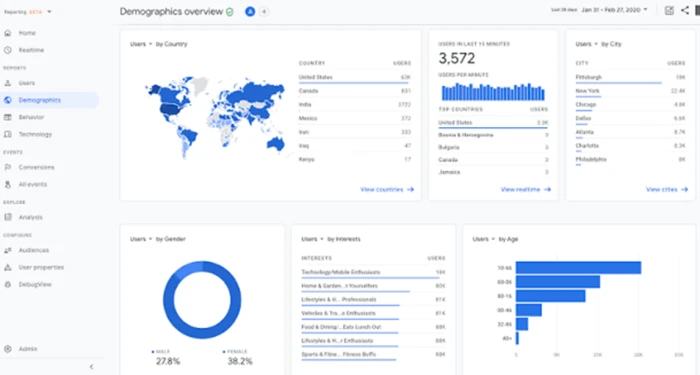
Some genuinely free options still do real work. Google Analytics 4 and Google Search Console cost nothing and anchor measurement and search insight. Canva's free plan covers many everyday design needs, and both ChatGPT and Claude ship usable free tiers. Use free plans to test whether a tool's output meets your standard, then pay only when volume or collaboration forces the upgrade.
How to choose (and how to avoid buying too much)
With the categories mapped, the question shifts from “what exists” to “what do I start with.” Begin with your biggest time sink, not the longest feature list.
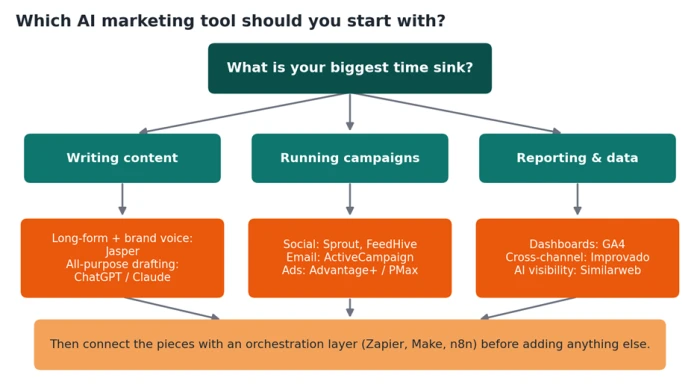
Figure 4. A simple starting-point decision guide for AI marketing tools.
Then match the stack to the size of your team rather than copying an enterprise setup you do not need:
| Team | Sensible starting stack |
|---|---|
| Solo or founder | ChatGPT or Claude, Canva free, GA4 |
| Small business | Add Jasper or Copy.ai, ActiveCampaign, Surfer SEO |
| Agency | Add a brand-voice platform, Sprout Social, Semrush |
| Enterprise | Add governance tooling, orchestration, AI visibility tracking |
Before adding any new tool, ask whether an orchestration layer could make two products you already pay for do the job together. With a quarter of professionals already citing overlapping tools as a barrier to value, consolidation is often the higher-return move than another purchase.
Measuring whether any of this is working
A tool that saves drafting time but creates review time has not helped anyone. Track four things so you can tell the difference:
• Time saved: hours per week returned to the team
• Output: volume of content and campaigns actually shipped
• Quality: engagement and conversion rates, not word count
• Business impact: leads and revenue you can attribute to AI-assisted work
Keep one honest check in view. If the output pile grows but customer actions do not, the workflow is producing motion rather than results, and it is time to change the process instead of adding another tool.
Where AI still needs a human hand
The risk with AI content is that it drifts toward the average. It produces work that is structurally fine and completely forgettable. Two guardrails keep the quality up.
First, keep a person in the loop on anything customer-facing. AI drafts; humans supply judgment, brand voice, nuance, and fact-checking. Second, vet data handling before you commit. Review each tool's retention and sharing terms, and lean on enterprise options with compliance certifications for regulated work.
The teams pulling real value from AI in 2026 are not the ones with the most tools. They picked a few, connected them into a workflow, then kept a human hand on the wheel. Start with one high-impact tool, learn it, wire it into the next, and let the system compound from there.
The Verdict
There is no single best AI marketing tool, and any list that crowns one is selling you something. The right answer depends on the job you are trying to close and the size of the team behind it.
If you take only one thing from this guide, make it this: buy for the workflow, not the feature list. A tool earns its place when it replaces a step you currently do by hand and connects to the next step in the pipeline. A tool that adds a login and a monthly charge without removing work is a cost, not an upgrade.
Here is the short version by situation:
● Solo marketers and founders: Start with a general assistant (ChatGPT or Claude), Canva's free tier, and Google Analytics 4. That covers drafting, design, and measurement for close to nothing. Add a paid tool only when volume forces it.
● Small businesses: Layer in one dedicated writer with brand voice (Jasper or Copy.ai), one email and lifecycle platform (ActiveCampaign), and one SEO optimizer (Surfer). Three well-chosen tools beat ten half-used ones.
● Agencies: Prioritize brand-voice control and scale. A brand-voice platform, Sprout Social for social, and Semrush for SEO and competitive work form a defensible core across multiple clients.
● Enterprise teams: Weight the decision toward governance, data handling, orchestration, and AI visibility tracking. Capability is table stakes at this level; control and compliance are what separate the options.
Two rules hold across every tier. First, connect before you add. If a workflow layer like Zapier can make two tools you already pay for talk to each other, that beats buying a third. With a quarter of professionals already naming overlapping tools as a barrier to value, consolidation is often the highest-return move on the table. Second, keep a human on anything customer-facing. AI gets you to a fast first draft; judgment, brand voice, and fact-checking are still yours to supply.
The teams winning with AI in 2026 are not the ones with the longest toolset. They picked a few tools, wired them into one content-to-campaign workflow, measured whether real business metrics moved, and kept a hand on the wheel. Start with your biggest time sink, prove the value on one workflow, then expand deliberately.
Discussion
Join the discussion and share your perspective.