
Yes, you can sell AI-generated images, and thousands of people already do it on Etsy, Redbubble, stock libraries, and their own stores. The catch is that legal to sell and legally yours are two different things. In the United States, an image produced by AI with no meaningful human input generally cannot be copyrighted, which means you can list it for sale but may have no way to stop someone else from copying it.
The 60-second version
Selling AI images is allowed on most platforms. Owning them is harder: pure AI output usually is not copyrightable in the US. Meaningful human editing strengthens any ownership claim. Etsy and the major stock sites require you to disclose AI use. The subject matter still matters, so real people, brand logos, and famous characters carry the same legal risk they always have. Sources referenced throughout: U.S. Copyright Office, federal court rulings, and current platform policies.
The short answer: yes to selling, maybe to owning
Most people asking this question are asking two things at once, and the honest answer splits along that seam. Nobody is going to fine you for listing an AI-generated print. What you cannot assume is that the image belongs to you the way a photo you shot or a painting you made would.
That distinction sounds academic until it costs you a sale. If your listing takes off and a competitor screenshots your bestselling design, re-uploads it under their own shop, and undercuts your price, your first instinct is to file a copyright claim. But if the image was pure AI output, there may be no copyright to enforce. The right to sell was never in doubt. The right to stop others is the part that was missing all along.
The three questions hiding inside one
Before you list anything, separate the question into its three real parts. Each one has a different answer, and the rest of this guide walks through them in order.
● Is it legal to sell? Almost always yes, with platform-specific conditions.
● Can you protect it from being copied? Often no, unless you added real human creative work on top.
● Could the underlying model expose you to legal trouble? Rarely for individual sellers, but the answer depends on what you generate and how.
Is it legal to sell AI-generated images?
There is no law anywhere that bans the act of selling an image because a machine helped make it. Selling is permitted by the terms of every major consumer AI image tool and by every large marketplace that matters for creators. The volume is enormous: entire Etsy shops run on AI printables, Redbubble stores stock AI t-shirt art, and stock portfolios carry AI-generated lifestyle scenes.
So the legality of the act is settled. What is not automatic is everything downstream: whether the marketplace lets you list without disclosure, whether the tool's licence covers commercial use on your plan, and whether the image itself steps on someone else's rights. Those are the conditions that trip sellers up, and they have nothing to do with whether selling AI art is legal in principle.
Do you own AI-generated images? The copyright reality in 2026
Copyright law was built around human authorship. That single idea explains almost everything about why AI images sit in a strange spot. If a human did not contribute the creative expression, there is nothing for copyright to attach to.
What the U.S. Copyright Office actually says
In March 2023 the U.S. Copyright Office issued guidance stating that a work must have human authorship to be registered, and that any more-than-trivial AI-generated material has to be disclosed. In January 2025 it went further in Copyright and Artificial Intelligence, Part 2: Copyrightability. The core finding: typing prompts, even detailed ones refined over many attempts, does not by itself make you the author of the output, because the system, not you, decides the composition, colour, and form.
There is an important flip side the headlines skip. The Office has registered hundreds of works that contain AI-generated material, protecting the human-authored parts. AI used as a tool inside a human creative process does not poison the whole work. The line falls between AI as a paintbrush and AI as the painter.
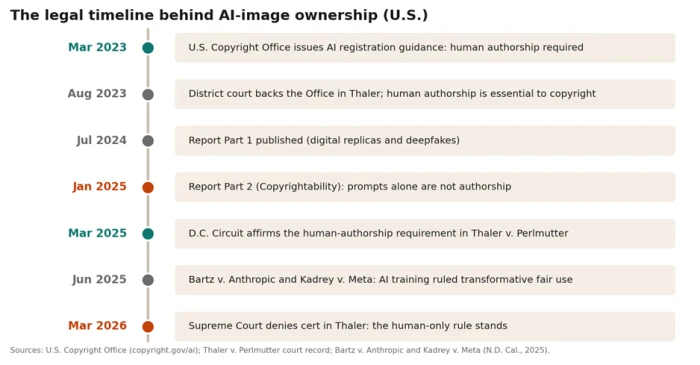
The sequence of guidance and rulings that fixed the human-authorship line in U.S. law.
The court rulings that settled it, and the one still open
The case that anchors everything is Thaler v. Perlmutter. Stephen Thaler tried to register an image his AI system generated on its own, listing the machine as author. A federal district court sided with the Copyright Office in 2023, the D.C. Circuit affirmed in March 2025, and on March 2, 2026 the Supreme Court declined to hear the appeal. That refusal leaves the human-authorship requirement standing as settled law: a work created entirely by AI, with no human creative contribution, cannot be registered.
One question is still live. In Allen v. Perlmutter, artist Jason Allen is challenging the refusal of his award-winning image Théâtre D'opéra Spatial, which he produced with hundreds of iterative Midjourney prompts. The Office held that the prompting did not give him enough control over the final expression. How that case resolves will refine exactly where 'enough human input' begins, but it will not remove the human-authorship requirement itself.
What 'meaningful human authorship' looks like in practice
This is the part you can act on. The path to a protectable image runs through what you do after the model hands you a draft. Consider three quick examples that show the spectrum.
● Raw output. You prompt 'a fox in a misty forest, watercolour' and sell the file untouched. Not protectable, and trivially reproducible by anyone with the same tool.
● Substantial editing. You take that fox, composite it with your own photographed background, repaint the lighting, and hand-adjust the composition. The human-authored parts can qualify for protection.
● AI as one ingredient. You build a layered illustration where AI elements are arranged and edited alongside your own drawing. The creative choices are yours, and that is what copyright protects.
Training-data risk versus output risk
Keep two worries separate. The lawsuits about how models were trained target the AI companies, not you. The risk that actually lands on a seller is the output: if what you publish copies someone's protected work, you can be liable no matter how the file was made. Courts made this explicit in 2025, holding that AI training can be fair use while stressing that users remain responsible for infringing outputs.
What AI tools' terms say about commercial use
Permission to use an image commercially and ownership of that image are different clauses in a licence, and tools treat them differently. Some grant broad commercial rights while keeping the copyright question untouched, because they cannot grant a copyright that may not exist. A few reserve commercial use for paid tiers. The table below summarises how the major tools generally handle it. Treat it as a starting point and read the current terms yourself, because these change often.
Tool-by-tool commercial rights
| Tool | Commercial use | Output ownership (per terms) | Notes |
|---|---|---|---|
| DALL·E / GPT Image (ChatGPT) | Yes | Assigned to the user | OpenAI lets users use and sell outputs, including commercially. |
| Midjourney | Paid plans | Assigned to paid subscribers | Free tier does not grant commercial rights; ownership tied to an active subscription. |
| Adobe Firefly | Yes | User, per Adobe terms | Trained on licensed/Adobe Stock content; enterprise plans include indemnification. |
| Stable Diffusion (self-hosted) | Yes | No restriction from a vendor | Running the open model yourself gives the widest freedom; you carry the risk. |
| Leonardo / Ideogram | Paid plans | Assigned to the user | Commercial rights generally tied to paid tiers; check current terms. |
| Bing / Copilot Image Creator | Yes (stated) | User use permitted | Microsoft's terms permit commercial use of outputs; verify before scaling. |
Note: The single most valuable clause to look for on paid and enterprise plans is indemnification, meaning the provider agrees to cover legal costs if a generated image is challenged. Free tiers almost never include it. Verify each tool's terms directly before building a business on it.
Where can you sell AI images? Marketplace rules in 2026
A tool saying yes does not mean the marketplace does. This is where sellers get caught, because platform rules changed sharply through 2025 and 2026 and they are enforced by automated systems as much as by human reviewers.
Marketplace policy at a glance
| Platform | AI content | Disclosure | Key restriction |
|---|---|---|---|
| Etsy | Allowed | Required | Must tick the AI checkbox and describe the deliverable accurately. |
| Redbubble / TeePublic | Allowed | Recommended | No copyrighted characters, logos, or celebrity likeness. |
| Adobe Stock | Allowed | Required | No reselling prompts; you must own rights to the output. |
| Shutterstock | Allowed | Required | Automated metadata scanning; only via its AI process. |
| Getty Images | Banned | N/A | Does not accept AI-generated content. |
| Merch by Amazon | Allowed | Per policy | Strict IP rules on characters, brands, and likeness. |
Etsy's 2026 crackdown: what to tick and what to avoid
Etsy does not ban AI art, but in 2026 it enforces disclosure hard, and sellers have had shops suspended and funds held for undisclosed AI listings. The rules were tightened in June 2025 to explicitly cover digital downloads.
● Check the 'I used AI-generative technology' box when the primary visual is machine-generated.
● Set the production dropdowns correctly and choose 'Designed by' rather than 'Made by' when AI produced the core image.
● Describe the deliverable plainly. Say it is a digital download or a physical print, and never imply hand-painted or officially licensed when it is not.
Disclosure does not have to sound apologetic. A line like “Created with AI-assisted generation, then edited and colour-checked by hand” tells the buyer the truth while showing your human work. Many Etsy shoppers search for AI art on purpose, so transparency can help conversion rather than hurt it.
Stock platforms and the honesty trap
Stock libraries have gone furthest on detection. Shutterstock's systems scan submissions for AI signatures in the metadata before a human ever sees them, including content credentials and tool tags. Adobe Stock requires disclosure and bans selling prompts as products. Getty rejects AI content outright.
Here is the trap: if your file carries AI metadata and you submit it as non-AI to dodge the rules, the automated check flags the mismatch and your account can take a strike. Stripping metadata to hide AI origin is the fastest way to lose a contributor account. Disclosure is not just the compliant move, it is the only one that survives detection.
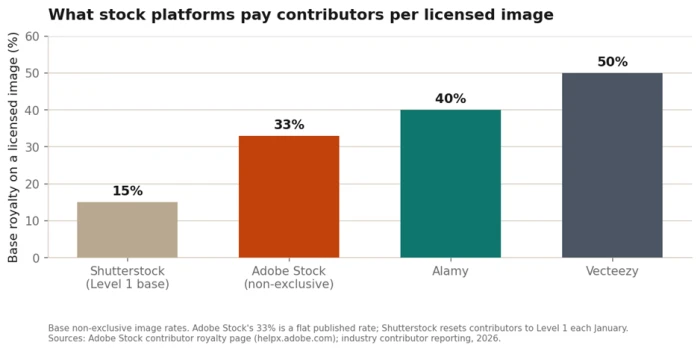
Base contributor royalty rates differ widely across stock platforms, which matters when you plan where to sell.
If stock is your channel, the payout structure shapes the math as much as the policy does. Adobe Stock pays a flat 33% on standard non-video licences, a rate it publishes openly, while Shutterstock's base subscription downloads sit lower and reset every January. Those differences add up across a large portfolio.
Print-on-demand: the rules AI does not exempt you from
Redbubble, TeePublic, and Merch by Amazon generally welcome AI designs. What they enforce strictly is the underlying intellectual property: a copyrighted character, a trademarked logo, or a recognisable celebrity is barred whether you drew it by hand or generated it. The machine origin neither adds risk here nor removes it, which leads straight to the risks that live in the subject itself.
The risks that exist no matter how the image was made
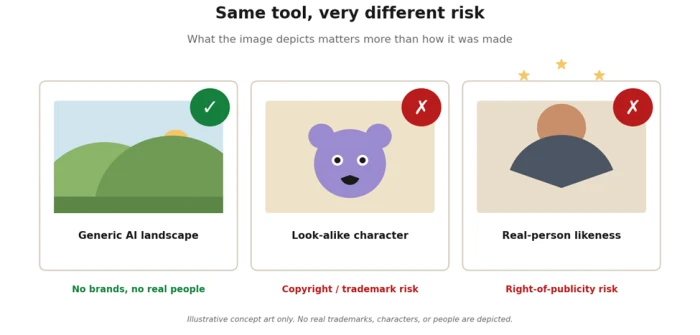
Some legal exposure has nothing to do with AI. It attaches to what the image depicts. These are the categories sellers underestimate most, because they assume 'I generated it myself' is a defence. It is not.
Real, recognisable people
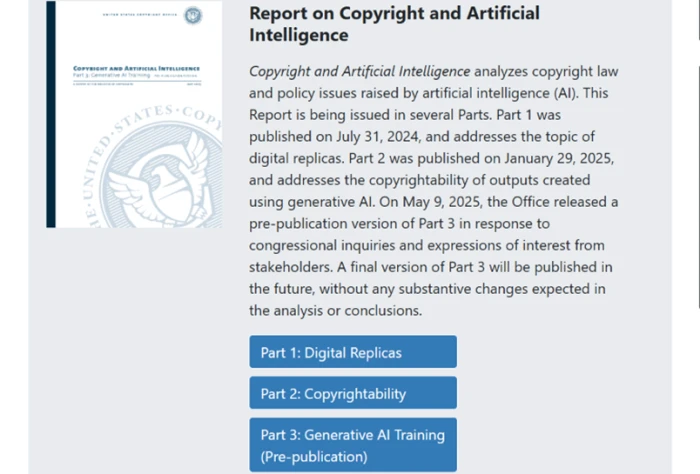
Using an identifiable person's face or likeness to sell something can violate right-of-publicity laws, even if the image is entirely AI-generated. This is separate from copyright and separate from whether the person is famous. The Copyright Office's first AI report specifically flagged digital replicas and deepfakes as an area needing new federal protection, which signals how seriously regulators treat synthetic likeness.
Copyrighted characters and trademarked brands
An AI image of a Disney or Marvel character, or one carrying a brand logo, is still infringement. Trademark law does not care that a model produced it. Prompting 'in the style of' a franchise does not launder the result. These rules predate AI and apply identically to it.
Copying a specific artist's style: the contested frontier
Style itself has never been cleanly copyrightable, but deliberately replicating a named living artist's signature work for commercial sale sits in actively litigated territory. Courts are examining AI-specific versions of this question right now. The safer posture is to use AI for original concepts rather than to clone a particular artist's identity.
The training-data lawsuits: do they affect you as a seller?
The lawsuits that make headlines are about how models learned, and they target the companies that built them. For an individual seller, the direct exposure is low. Still, the 2025 rulings are worth understanding because they set the frame everyone now works inside.
What the 2025 rulings established
In June 2025 two federal judges in the Northern District of California ruled within days of each other. In Bartz v. Anthropic, Judge Alsup called training on lawfully acquired books 'quintessentially transformative' fair use, but drew a hard line: downloading and keeping pirated copies was not excused. In Kadrey v. Meta, Judge Chhabria also found training to be fair use, while stressing that the authors lost partly because they had not proven market harm. Both courts underlined that using a model does not shield you from liability for an infringing output you publish.
Indemnification and reducing your exposure
Two practical levers follow from this. First, prefer tools that offer indemnification on their paid or enterprise plans, because that is where the provider agrees to stand behind the output. Second, do not build an entire catalogue on one free tool. If that tool quietly changes its commercial terms, every listing you built on it is suddenly in question. Diversifying tools is a business-continuity decision as much as a legal one.
Does this depend on where you live? US, UK, EU, and China
The answer is not uniform across borders, which matters because buyers and sellers are global. The United States takes the strictest line on human authorship. Other major jurisdictions diverge in ways that can change what you can protect.
| Jurisdiction | Human-authorship threshold | Labelling / disclosure trend |
|---|---|---|
| United States | Strict. Pure AI output is not protectable. | Disclosure required at copyright registration. |
| United Kingdom | More flexible; a computer-generated-works provision exists in law. | Policy under active review. |
| European Union | Human creativity required; varies by member state. | AI Act adds transparency labelling for synthetic content. |
| China | Courts have recognised protection where human input is substantial. | Emerging AI-labelling rules for generated content. |
The UK stands out: its Copyright, Designs and Patents Act has long included a provision for works 'generated by computer in circumstances such that there is no human author,' which is more protective of AI output than the US position. China's Beijing Internet Court has recognised copyright in AI-assisted images where a human made substantial creative choices, a line other Chinese courts have followed. The EU's AI Act does not create a new copyright framework, but its transparency rules push toward labelling AI-generated content, a duty that lands on anyone marketing AI visuals in the bloc.
The rise of AI-labelling rules
Separate from copyright, a labelling layer is arriving fast. The EU AI Act, new Chinese rules, and content-credential standards embedded by tools like Adobe Firefly all point the same way: disclosure of AI origin is becoming a legal duty in more places rather than a mere marketplace preference. Building disclosure into your workflow now saves rework later.
How to protect yourself when selling AI-generated images
Everything above turns into a short, repeatable routine. Run it before every listing and the legal and policy risk drops sharply.
The pre-listing compliance checklist
1. Read the specific tool's commercial-use terms, looking past the general terms to the clause on ownership and commercial rights on your plan.
2. Add meaningful human edits. Composite, repaint, or combine with your own work so there is human authorship to protect.
3. Disclose AI use where required, and word it in a way that shows your human contribution rather than apologising for the tool.
4. Avoid real people, brand logos, and famous characters unless you hold the rights, because that risk exists regardless of AI.
5. Keep your prompts and process records so you can show the creative steps if a platform flags you or you register the work.
6. Diversify your tools so a single terms-of-service change cannot sink your whole catalogue.
Build a creative audit trail
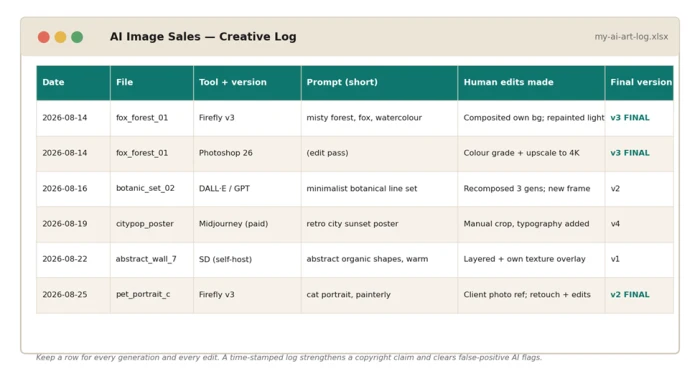
IP lawyers advising companies now recommend documenting the human contribution to AI-assisted work, and the same habit protects an individual seller. Keep a simple log for anything you might register or defend.
● The prompts and the number of iterations you ran.
● Every editing step: compositing, repainting, colour work, and the source of any assets you added.
● Dates and the tool versions used, so the record is time-stamped.
● Screenshots of your editing stages, which also help clear false-positive AI flags on platforms.
Make it a business, not a legal gamble
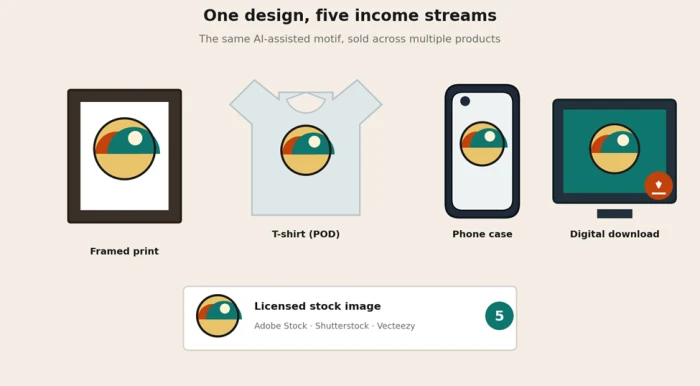
The deeper reason to add human work is competitive, not only legal. If anyone can reproduce your bestseller with a free tool and a five-word prompt, the image itself is not your moat. What can be yours is the curation: your niche, your editing style, and the audience you build. One edited image can also earn across several channels at once, listed as a digital download, a print-on-demand product, and a licensed stock file at the same time, which is how serious sellers scale without generating endlessly.
For the platform-by-platform mechanics of turning this into income, see a dedicated guide on how to sell AI art on Etsy and on choosing AI image tools with clear commercial licences. The legal groundwork here is what keeps that income durable.
The line that decides everything
If you remember one thing, make it this: the value of an AI image you sell tracks the human work you put into it. Selling is the easy part and always has been. Protecting what you sell, and building something a competitor cannot copy overnight, both come from the same source, which is the creative contribution only you add. Add it, disclose it, and document it, and the question stops being whether you can sell AI-generated images and becomes how well you can defend the ones worth defending.
Discussion
Join the discussion and share your perspective.