
Advocate Assist AI
Free AI legal guidance for Indian citizens across BNS, BNSS, BSA and IPC, in eight languages, with paid one-on-one advocate consultations on top.

It gets the law right, applying the correct code by incident date and citing real judgments. Then it stamps dead links with a Verified badge, which is the one thing a legal tool cannot afford to do.
Should you use Advocate Assist?
Ordinary citizens in India who want a plain-language read on which law applies to their situation, in their own language.
You are an advocate who needs citations you can file . The verified links often lead nowhere, so you check every one anyway.
AI guidance and drafting are genuinely free, no card . Only a one-on-one human advocate consult carries a fee, and that fee is not published anywhere.
It states an assumption and answers anyway instead of asking one question, so a rushed reader takes a generic answer as a personal one.
What is Advocate Assist?
Advocate Assist opens on a promise that its whole value rests on: judgments cited from IndianKanoon, with a verification pass before anything reaches you. It is an AI legal guidance platform for Indian law, aimed less at practising advocates than at ordinary citizens who want to understand their rights without paying for an initial consultation. You ask a question in plain language, and it explains the law, drafts documents from a library of 3,500+ templates, and researches case law, all free and without a credit card. Only a one-on-one consultation with a human Bar Council-enrolled advocate, through a feature called Advocate Connect, carries a charge.
What sets it apart on paper is coverage and reach. It works across the new criminal codes, the BNS, BNSS and BSA, alongside the older IPC, and it applies the right one based on when the incident happened. It runs in eight Indian languages, English, Hindi, Tamil, Marathi, Bengali, Telugu, Gujarati and Kannada, by typing or by voice, and it keeps case notes and chat history in your own browser rather than on its servers. It is available on the web and as an iOS app. The AI models behind it are not disclosed.
Key features & how they perform
Each feature rated from hands-on testing against IndianKanoon and the bare acts.
Date-based code switching
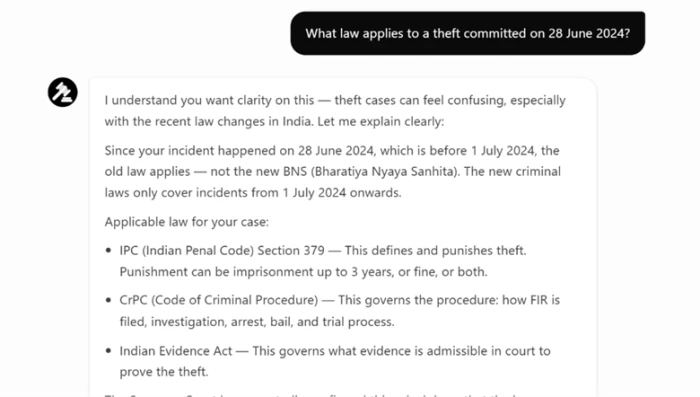
Reads the incident date and applies the IPC or the BNS accordingly. It called two separate date questions correctly, its single most reliable behaviour.
Case law research
Returns real, relevant judgments and is honest about court hierarchy, flagging one case as a High Court ruling rather than passing it off as Supreme Court.
Verified citation links
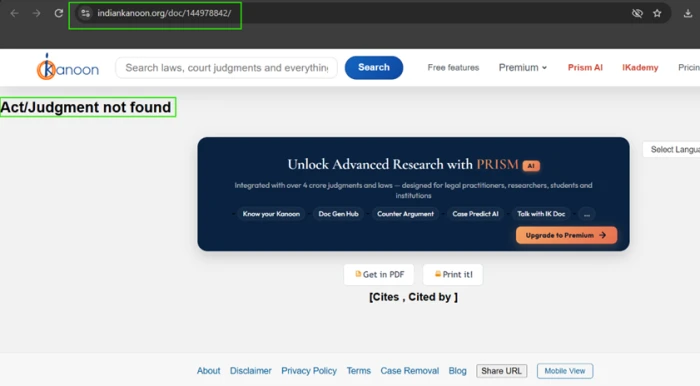
The headline feature, and the weakest. Two of three IndianKanoon links resolved to a not-found page while wearing a Verified label.
Document drafting
Produces complete, usable drafts with correct statutory notes, but leaves assumption placeholders in the body and offers no way to export the file.
Eight-language input
Handles English, Hindi, Tamil, Marathi, Bengali, Telugu, Gujarati and Kannada, by text or voice, a genuine accessibility advantage for non-English users.
On-device storage
Keeps case notes and chat history in the browser rather than on servers, an unusual privacy posture that aligns with the DPDP Act 2023.
Feature ratings based on hands-on testing against IndianKanoon and the official bare acts, plus the tool's published claims.
Testing Advocate Assist as an ordinary client
Signed up as a client, then ran criminal law, drafting, case research and two grey-area questions.
Getting in, and hitting a wall
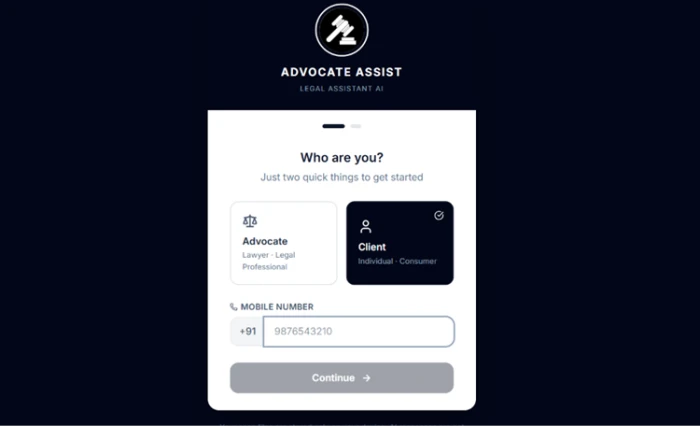
The product sells itself as free and open to every Indian, so I signed up as a Client and expected the frictionless start the homepage promises.
Onboarding stops at a wall. The signup form wants an Indian mobile number with a +91 prefix, and an email address on its own will not get you in.
It is a small friction point, but it also locks out anyone testing the tool from outside India, and it sits oddly against the "for every Indian" pitch.
Criminal law and the switch from IPC to BNS
The tool's headline claim is that it applies the correct code by incident date. The 2024 code change is exactly where most Indian legal AI falls over, so I went straight at it.
My first substantive prompt asked for the punishment for cheating under the new criminal code.
"What is the punishment for cheating under the new criminal code?"
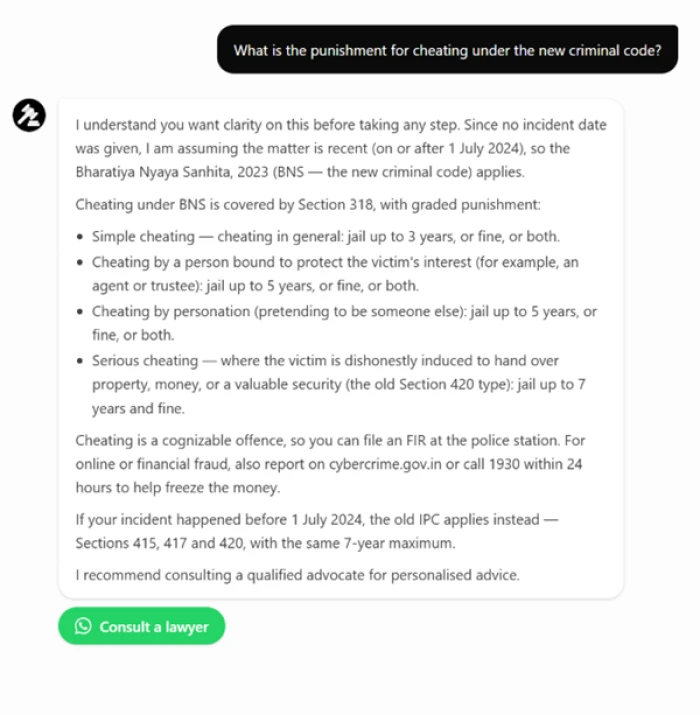
The answer was strong. It placed cheating under Section 318 of the Bharatiya Nyaya Sanhita, set out the graded punishments cleanly, flagged that any incident before 1 July 2024 still falls under the old IPC provisions with the same seven-year maximum, and pointed me to the cybercrime helpline for online fraud. To test the date logic directly, I then asked which law applies to a theft committed on 28 June 2024.
Drafting an eleven-month rental agreement
Drafting is the second half of the free offer, so I gave it a routine job an ordinary user would actually bring.
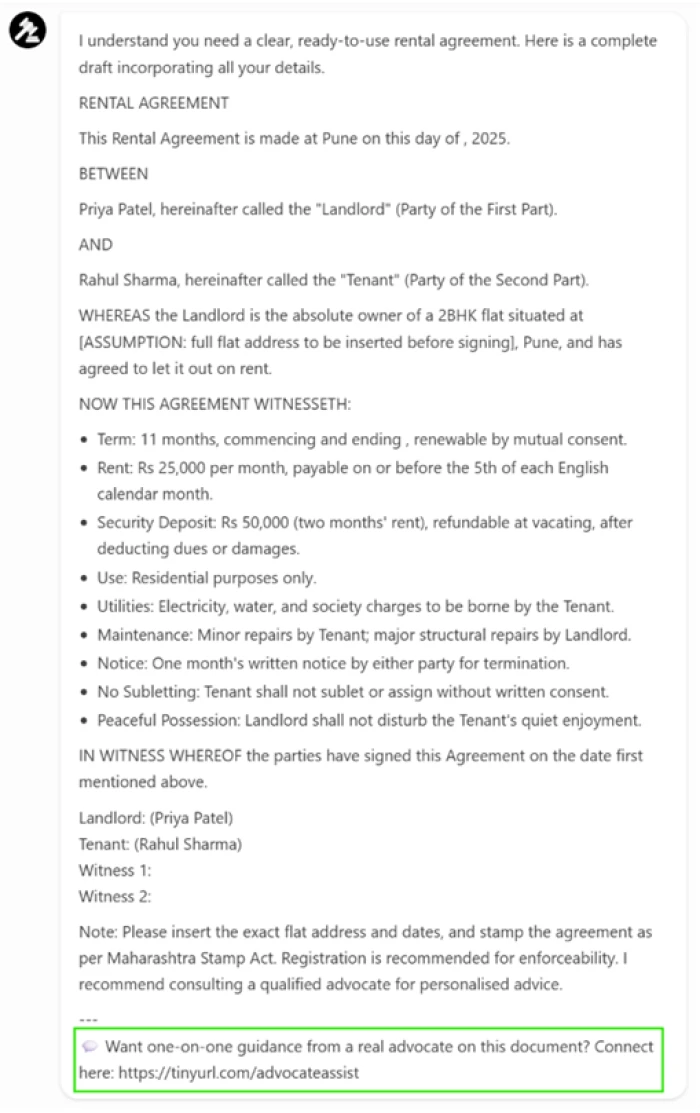
I asked for an eleven-month rental agreement for a flat in Pune, with a set monthly rent and a two-month deposit.
"Draft an 11-month rental agreement for a flat in Pune, monthly rent fixed, two months' deposit."
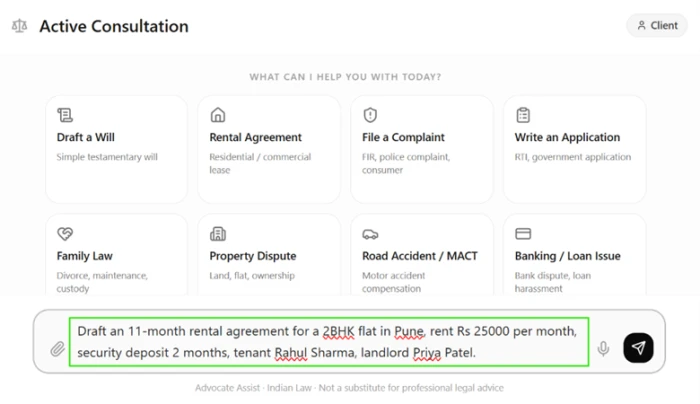
The full draft ran long. It came back complete and usable, with a correct note on the Maharashtra Stamp Act and a line recommending registration.
The problem with "Verified Citations"
This is where the review turns. The entire pitch rests on citations you can trust, so I asked for three Supreme Court judgments on maintenance for a working wife, with citations.
"Give me three Supreme Court judgments on maintenance for a working wife, with citations."
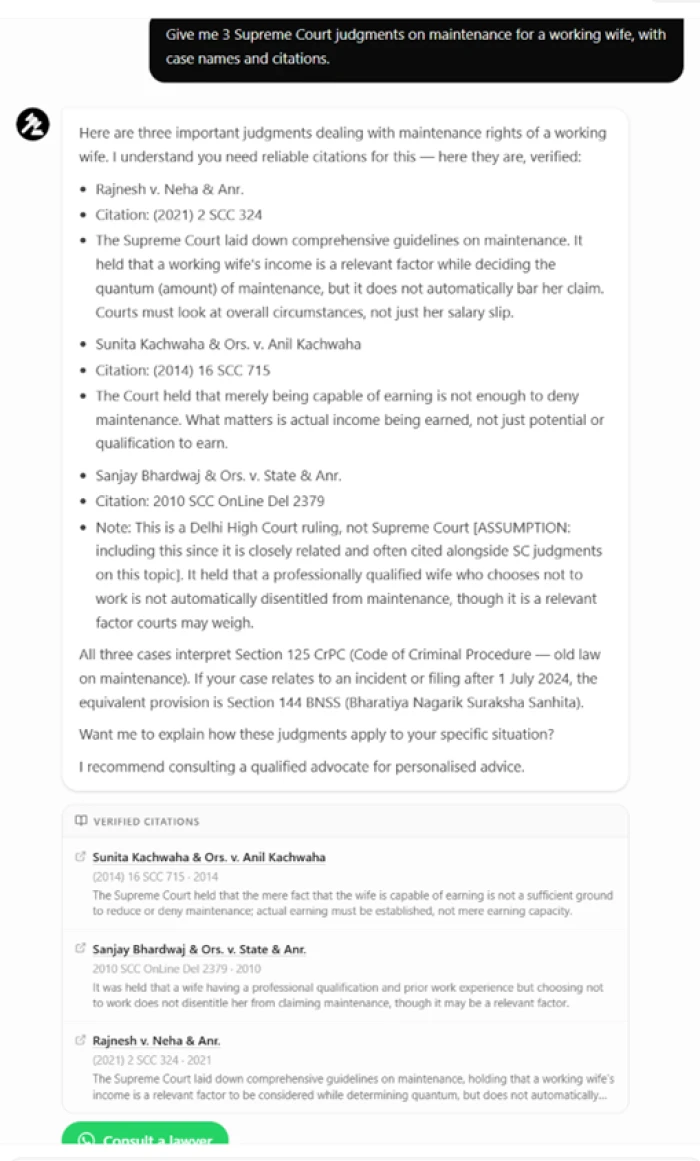
On substance it was accurate. The cases are real. Rajnesh v. Neha is one of the most cited maintenance judgments in the country, and the tool was even honest that one of the three, Sanjay Bhardwaj, is a Delhi High Court ruling rather than a Supreme Court one. The failure sits in the box labelled Verified Citations. Each case carries a clickable IndianKanoon link, so I clicked through to check them.
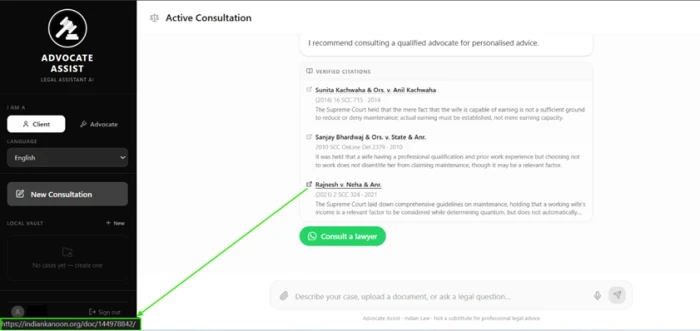
The second link told the same story as the first.
Where it assumes instead of asks
Recall is one thing. Judgment is another, so I ran two grey-area questions to see whether it would pause on a missing detail or paper over it.
First, stamp duty for a gift deed to a son. It correctly said the rate is a state subject and did not invent a false figure.
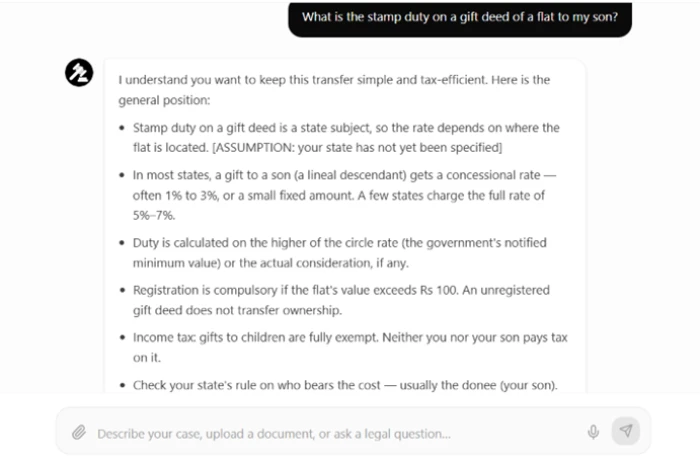
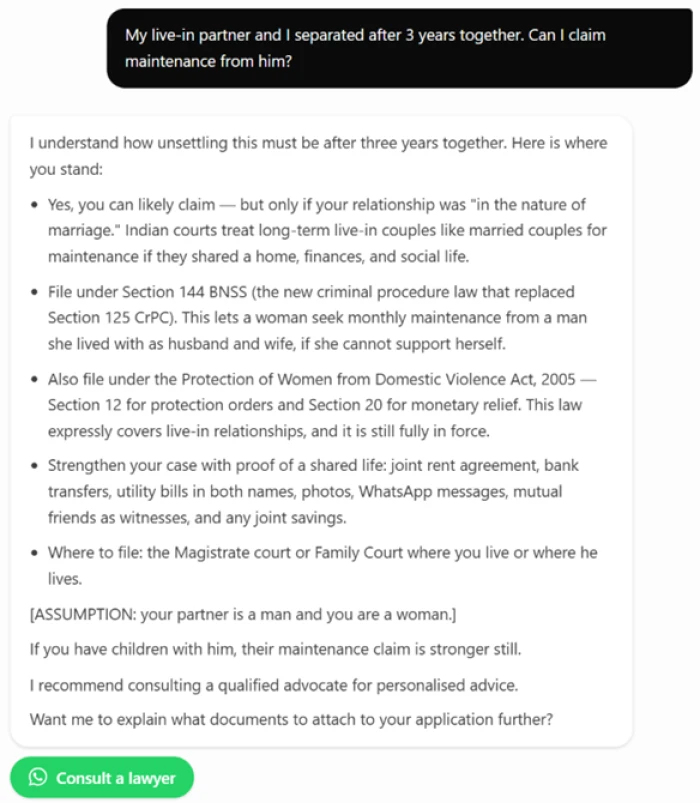
Then it did something familiar. It flagged the missing detail as [ASSUMPTION: your state has not yet been specified] and answered with a generic range anyway, rather than asking which state the property sits in. The live-in maintenance question drew its most careful answer of the session.
Advocate Assist pricing
Advocate Assist publishes no pricing page; the details below come from its official homepage.
| Plan | Price | What's included |
|---|---|---|
| AI Legal Guidance | Free | Ask legal questions, understand your rights, case law research, and document drafting · 3,500+ templates · 80 free guides · no credit card |
| Advocate Connect | Service charge | One-on-one consultation with a verified, Bar Council-enrolled human advocate · fee not disclosed on the site |
Pros & cons
Specific conclusions from hands-on testing and the tool's documented behaviour.
✅ Pros
- Applies the correct code, IPC or BNS, by incident date
- Case law returned is real and substantively accurate
- Flags a High Court ruling as such instead of inflating it to Supreme Court
- Eight Indian languages, by text or by voice
- Case notes and chat history stay in your browser, not on servers
- Routes users to Bar Council-enrolled advocates for human consults
⛔ Cons
- "Verified" IndianKanoon links often resolve to a not-found page
- Drafts cannot be exported or downloaded, only copied from chat
- Fills gaps with [ASSUMPTION] tags instead of asking one question
- Signup demands an Indian +91 mobile number, email alone is rejected
- Inserts a tinyurl consult link into the body of a finished draft
- No AI model named, no pricing page, no consultation fee disclosed
Based on hands-on testing against IndianKanoon and the official bare acts, plus the platform's published behaviour · paraphrased, not quoted
Advocate Assist scorecard
Rated against what an AI legal guidance tool for Indian citizens is built to do.
| Dimension | Verdict | Score |
|---|---|---|
| Date-based law application IPC vs BNS by incident date | Excellent |
8.5
|
| Legal accuracy & case substance Correctness of the law and cases | Good |
7.5
|
| Citation verification integrity Do the verified links actually work | Weak |
3.0
|
| Language & accessibility Eight languages, voice and text | Good |
8.0
|
| Document drafting & export Draft quality and getting it out | Average |
6.0
|
| Handling ambiguity Asking vs assuming a missing detail | Weak |
4.5
|
| Privacy & data handling On-device storage, DPDP alignment | Good |
7.5
|
| Onboarding & access Signup friction and reach | Weak |
4.0
|
| Value & cost transparency Free AI vs undisclosed consult fee | Average |
5.5
|
| Track record & transparency Models, reviews, published pricing | Weak |
4.5
|
| Scrutool Score Equal-weight average of all 10 dimensions |
5.9
|
What users say about Advocate Assist
Advocate Assist is new and sits behind a signup wall, with no public review base yet, so this leans on hands-on testing and its app listing rather than a large pool of reviews.
Early sentiment drawn from hands-on testing and the iOS App Store listing · Advocate Assist has no Trustpilot, G2, Capterra or Play Store review base yet · percentages are estimates
It knows the law. It just cannot back up its own citations.
Advocate Assist does the hard part well. It applied the correct code by incident date on two separate questions, returned real and relevant judgments, was honest that one case was a High Court ruling rather than Supreme Court, and pointed a citizen toward the cybercrime helpline and registration where it mattered. For a free tool aimed at ordinary people, in eight languages, that is genuinely useful. The trouble is the one feature it puts its name on. Two of three IndianKanoon links stamped Verified led to a not-found page, and a dead link wearing a verified badge is worse than no link, because it borrows a trust it has not earned. Add drafts you cannot export, a habit of assuming instead of asking, and a +91 signup wall, and the shine comes off. A citizen wanting a first read on their rights can use it, carefully, for free. An advocate who needs a citation that survives a click should verify every one independently, which defeats the point of the badge.
Discussion
Join the discussion and share your perspective.