
ChatGPT
The most capable consumer AI assistant, with cited live search, autonomous Deep Research and a much-improved image model. Powerful, but it states false facts with total confidence.

The most capable consumer AI assistant by feature count, with genuinely useful cited search and a much-improved image model, held back by confident answers that are sometimes flatly wrong.
Should you use ChatGPT?
Anyone who wants one assistant for everything : drafting, cited web search, image generation and, on Plus, autonomous Deep Research reports.
Your work cannot survive a confident wrong answer and you will not fact-check. It states false figures that look verified.
Free is usable but ad-supported in the US. Go is $8/mo , Plus $20/mo for Deep Research and GPT-6, Pro from $100.
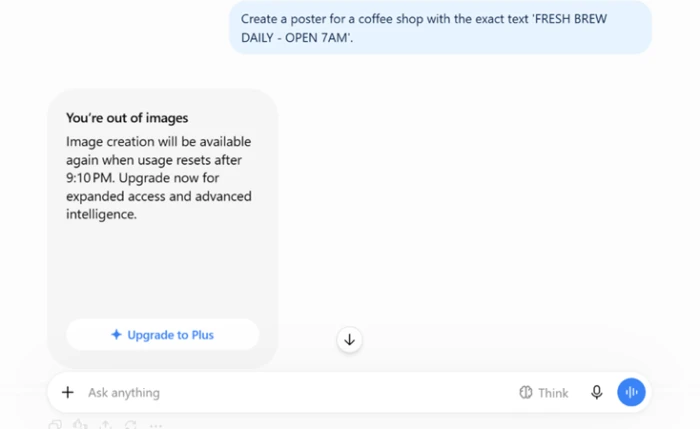
Free image generation runs a hidden daily quota that can start near empty, locking you out before you make a single image.
What is ChatGPT?
ChatGPT is the assistant most people picture when they hear the word AI, and it carries the widest feature set of any consumer tool in the category. The free tier runs GPT-5.6 Luna with unlimited text chat, while the paid plans layer on GPT-6 Astra, autonomous Deep Research, the Codex coding agent, projects, custom GPTs and unlimited image generation. It runs on the web, Windows, macOS and both mobile platforms, with history synced across all of them.
The thing that actually decides whether it fits your work is not capability, since it clearly has that, but trust. In testing it produced a confident, date-stamped pricing table that was wrong by nearly five-fold, with no refusal and no glitch to warn you. The US free tier now serves ads, and image generation sits behind a demand-based daily quota that can lock you out before you create anything. So the real questions are whether you will verify what it tells you, and whether the paid features earn their place in your week.
Key features & how they perform
Each feature rated from hands-on testing and aggregated review sentiment.
Live web search with citations
Current questions return real, clickable source cards from named outlets with publication dates, not a bare paraphrase.
Deep Research (Plus)
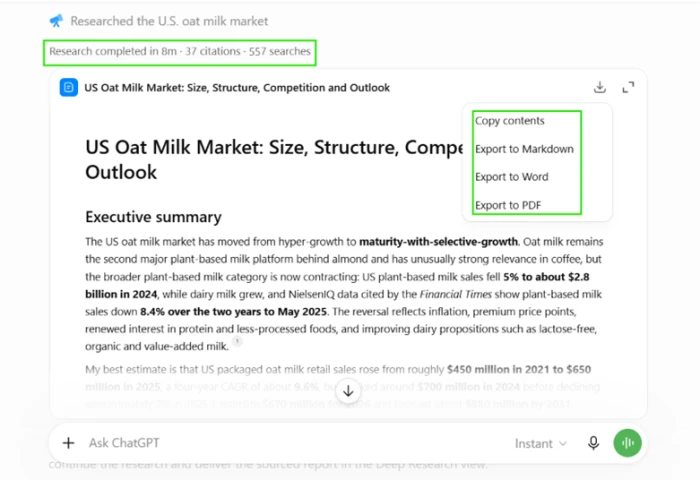
Runs autonomous multi-search reports in minutes, one test logging 37 citations from 557 searches in eight minutes.
Image generation
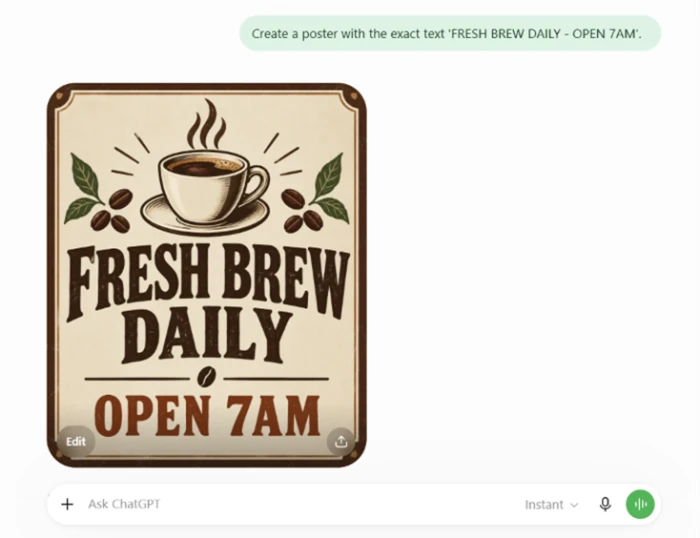
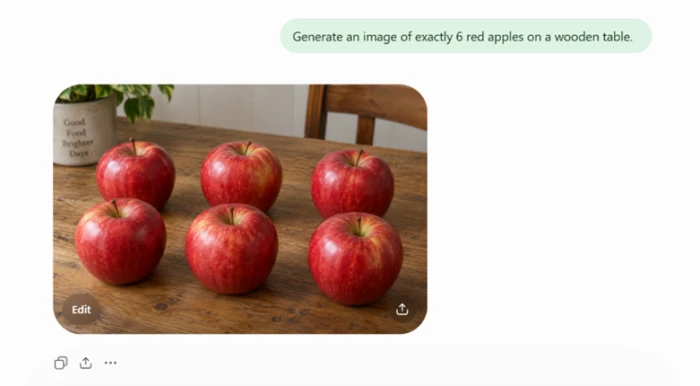
The old failures are mostly gone: it now spells requested text cleanly and counts objects correctly at small numbers.
Reasoning and multi-step work
GPT-6 Astra on Plus handles layered prompts and long context, with a 256K window on Go and 400K on Pro.
Writing and the Canvas editor
Drafts in a side-panel editor with varied sentence length, though the prose stays competent and oddly characterless.
Factual reliability
The weak spot: confident answers that read as verified but can be wrong, even on a live, web-connected session.
Feature ratings blended from Trustpilot, G2, Capterra, App Store & GeniusFirms review patterns + hands-on testing.
Running the same tasks across a free and a Plus account
Drafting, cited search, image generation, Deep Research, the free-tier walls, and the one result that should worry you.
Brainstorming and everyday drafting
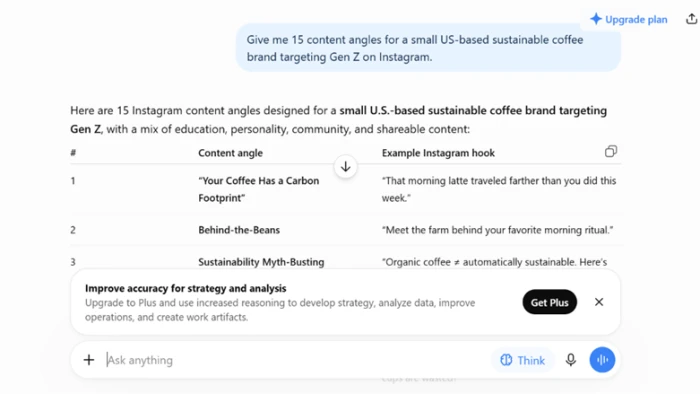
The most common reason people open ChatGPT is to turn a blank page into a first draft. I started there, on the free account.
This is also where the free tier reminds you it wants your money, with an upgrade card dropped straight into the answer.
"15 Instagram content angles for a small US sustainable-coffee brand aimed at Gen Z"
Live web search
ChatGPT can pull current information from the web and cite it, and this is where the free tier earns its keep. I asked for a roundup of the week's news to see how it sourced the answer.
"the biggest US tech stories of the week with sources"
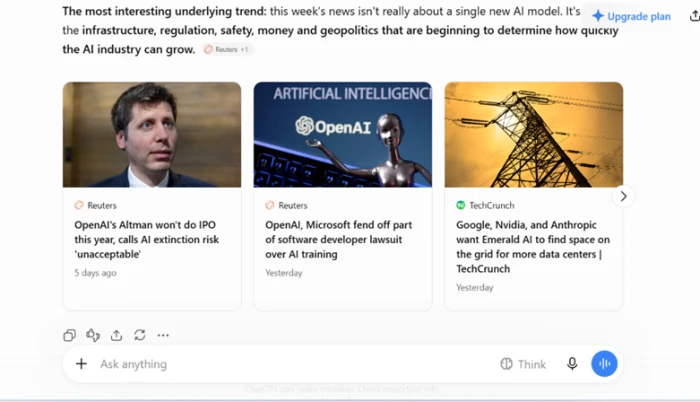
Image generation, on the two things it used to fail
Older image models were mocked for two specific failures: rendering readable text inside an image, and counting objects correctly. I tested both on Plus.
First, text on a poster.
a coffee-shop poster reading "FRESH BREW DAILY - OPEN 7AM"
Then the counting test, where the old models reliably added or dropped an object or two.
"exactly six red apples on a wooden table"
Deep Research on Plus
Deep Research is the Plus feature with no real free counterpart. Instead of one answer, it writes a research plan, asks you to approve it, then works on its own across hundreds of searches.
I set it a market question and kept a free account running in a second window to compare.
"research the US oat-milk market with sources"
The free-tier walls, and US ads
The free limits arrived sooner than I planned for, and not where I expected. A code-fixing prompt hit a reasonable cap. The image cap was the strange one.
The reliability problem
Here is the result that mattered most, and it happened on a paid, web-connected session where you would least expect it.
I asked a simple factual question about another product's pricing.
"what is Prezi's pricing?"
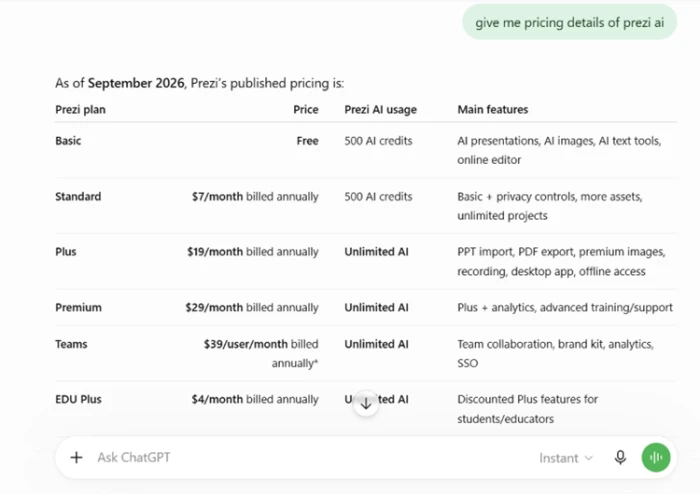
It produced a confident table stamped "As of September 2026," quoting Plus at $19 a month and Premium at $29. Then I opened Prezi's live pricing page.
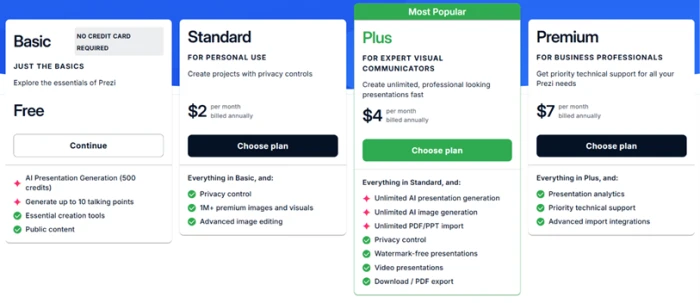
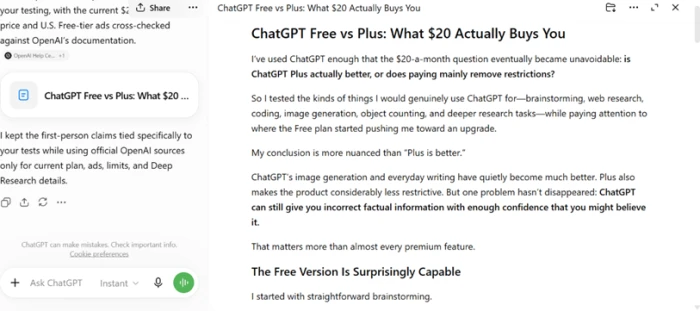
Letting it write the review
For the last test I handed the assignment back to the tool. I gave Plus a detailed brief built from these findings and asked it to draft this review.
"write this review at roughly 800 words from the findings above"
ChatGPT pricing
Figures taken from ChatGPT's official pricing page for individuals.
| Plan | Price | What's included |
|---|---|---|
| Free | $0 | Unlimited text chat on GPT-5.6 Luna · limited messages with uploads, image generation, voice, deep research, memory and Codex · ad-supported in the US |
| Go | $8 /mo | Everything in Free, plus more messages, uploads, image creation and voice chats · longer memory · 256K context window on reasoning models |
| Plus Popular | $20 /mo | GPT-6 Astra and GPT-5.6 · unlimited image creation · Deep Research · projects, scheduled tasks and custom GPTs · expanded Codex · full ChatGPT Work access |
| Pro | $100 /mo | From $100/mo · 5x more usage · GPT-5.6 Sol Pro · unlimited faster image creation · maximum deep research and memory · 400K context window |
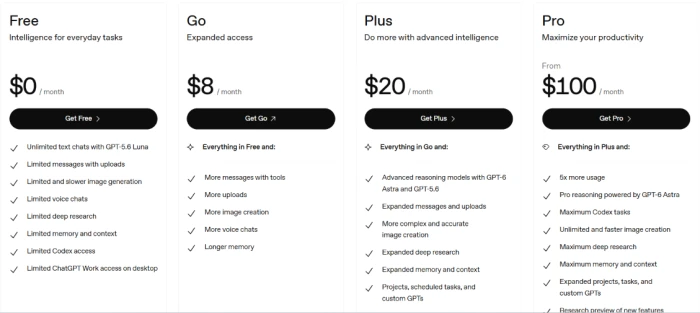
The individual plans as shown on ChatGPT's official pricing page.
Pros & cons
Specific conclusions from testing and real user reviews, not generic filler.
✅ Pros
- Live answers cite real, clickable sources with publication dates
- Image model now spells requested text and counts small object sets correctly
- Deep Research runs autonomous multi-search reports in minutes
- Widest feature set: Codex, custom GPTs, projects and scheduled tasks
- Runs on web, Windows, macOS, iOS and Android with synced history
- Canvas editor drafts inline with varied, readable sentence rhythm
⛔ Cons
- States false facts confidently, sometimes dressed with a date stamp
- Sycophantic: agrees with the user rather than challenging weak ideas
- OpenAI's own research shows newer models hallucinate more, not less
- Verbose by default, often needs a follow-up to reach the answer
- Weak on breaking news even with live search connected
- Its "new ideas" tend to recycle existing content, thin on originality
Synthesized from real reviews on Trustpilot, G2, Capterra, the App Store, Reddit & WebFX · paraphrased, not quoted
ChatGPT scorecard
Rated against what a general-purpose AI assistant is actually built to do.
| Dimension | Verdict | Score |
|---|---|---|
| Answer accuracy & reliability Whether the confident answer holds up | Average |
6.0
|
| Live web search & citations Current results with clickable source cards | Excellent |
8.5
|
| Reasoning & problem solving Layered prompts and long context | Good |
8.0
|
| Image generation Text rendering and object counting | Excellent |
8.5
|
| Deep Research (Plus) Autonomous multi-search reports | Excellent |
8.5
|
| Writing & drafting quality Canvas editor and prose voice | Good |
7.0
|
| Memory & long context Recall across a conversation | Good |
7.5
|
| Ease of use & availability Interface and reach across devices | Excellent |
9.0
|
| Free-tier value What you get before paying, US ads aside | Average |
6.0
|
| Value & limits transparency Hidden image quota and usage caps | Average |
6.0
|
| Scrutool Score Equal-weight average of all 10 dimensions |
7.5
|
What users say about ChatGPT
The themes reviewers raise most often, by share of analysed reviews.
% = share of analysed reviews mentioning each theme (Trustpilot, G2, Capterra, App Store, Reddit & WebFX)
The most capable assistant on the market, as long as you never take it at its word
ChatGPT does more, on more devices, than anything else in its class. Live search returns real cited sources, the image model has quietly fixed the text and counting failures it was mocked for, and Deep Research on Plus turns an eight-minute run into a sourced report that would take a person an afternoon. The interface stays the easiest in the category, which is why most people start here. The catch is the one thing an assistant most needs to get right. In testing it handed over a confident, date-stamped pricing table that was wrong by nearly five-fold, with nothing to signal the error, and that habit is the recurring complaint across user reviews alongside its tendency to flatter rather than push back. The free tier adds friction of its own, with US ads and an image quota that can lock you out before you begin. Use it as your default for drafting, search and research, lean on Plus if you research often, and verify every fact it states as current before you act on it.
Discussion
Join the discussion and share your perspective.