
Cheaterbuster AI
Paid web service that searches for someone's public dating profiles from a first name, age, location and photo, with weekly monitoring.

A well-built location and photo step inside a 13-screen suspicion quiz that returned blurred matches even for a name that does not exist.
Should you use Cheaterbuster?
Very few people. At most, someone with an exact first name, age and location who accepts that a blurred "match" may not point to a real profile.
You need an answer you can trust . A search for a made-up name still came back with blurred matches around Manhattan.
$19.99 plus tax per month for one person. A second person needs a second subscription, and add-ons are billed on top.
Trustpilot has suspended its rating over fake reviews , and the checkout frames a monthly charge as a weekly price under a countdown timer.
What is Cheaterbuster?
What Cheaterbuster hands you before payment is a map of your chosen city with a red radius circle, a few profile pins and a row of blurred faces, plus a card saying a profile was found. Everything that would tell you whether that profile belongs to the person you searched for sits behind a subscription. The service takes a first name, an age and a location, optionally a photo and social handles, and says it searches public dating profiles, then keeps rerunning the search every week while you stay subscribed.
It is built for people who suspect a partner of using dating apps, and the search flow is written for that mindset. It runs in the browser in English, Portuguese, Spanish and French. Beyond the core dating search, the site lists a FaceTrace photo search, a Following AI tool that watches social follows, checkers for the Tea app and "Are We Dating the Same Guy" groups, and reverse phone, email and address lookups. The site never names which dating apps it actually covers, and each subscription is tied to one person.
Key features & how they perform
Each feature rated from hands-on testing and aggregated review sentiment.
Dating profile search
Returns a map, pins and blurred thumbnails for real names and nonsense strings alike, so the pre-payment result tells you almost nothing.
Location pinning
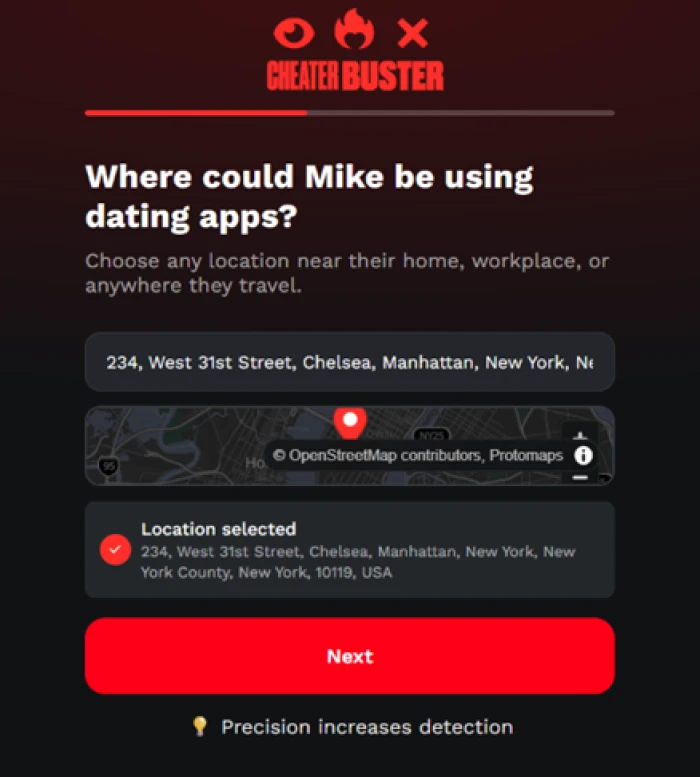
Resolves a typed street address to an exact map pin and ZIP code, and accepts a workplace or regular travel spot instead of a home.
FaceTrace photo search
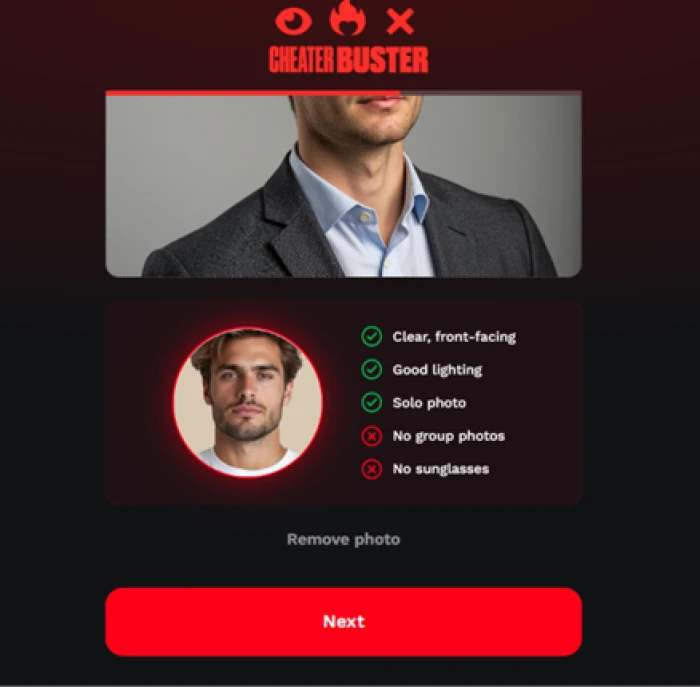
Clear upload guidance with five photo rules. Whether the face matching finds anything cannot be checked before paying, and users report mixed results.
Following AI social scan
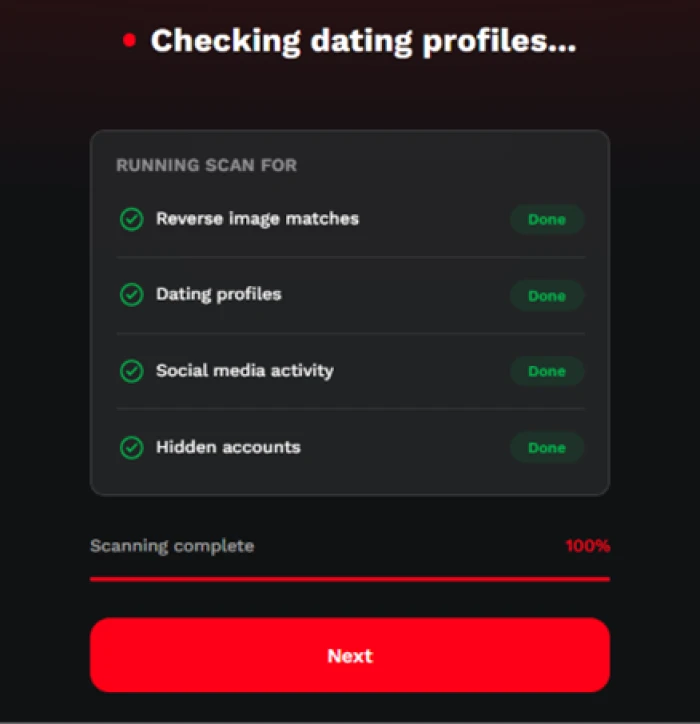
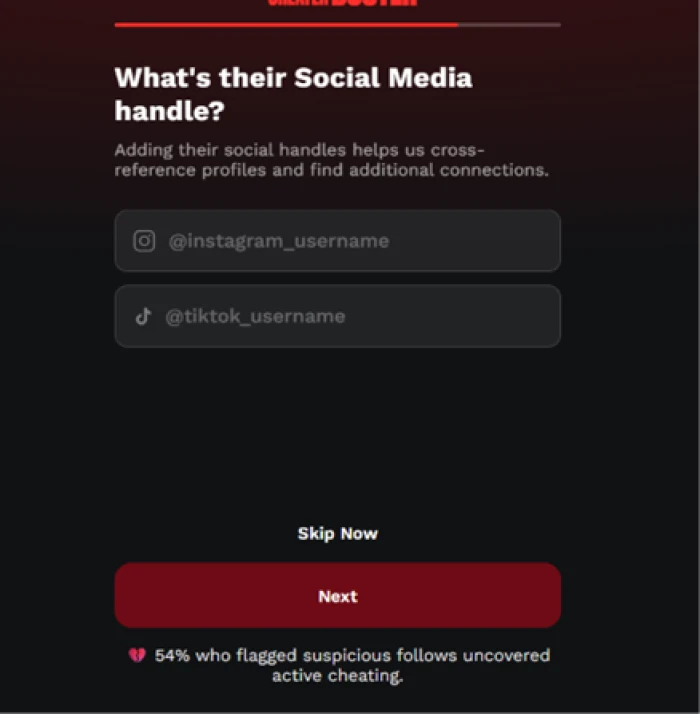
Promises alerts on follower spikes and private account interactions, but the scan marked social activity as checked before it knew which accounts to look at.
Weekly monitoring
Reruns the same search on a schedule and logs Last Sync and Last Change dates, which also keeps the subscription billing.
Extra lookup tools
Tea app, AWDTSG, username, phone, email and address lookups are listed, with no published coverage or accuracy detail for any of them.
Feature ratings blended from Trustpilot and independent review patterns + hands-on testing.
Thirteen screens to a paywall: my Cheaterbuster search for "Mike"
A full run for a 30-year-old named Mike in New York, then a second run for a name that does not exist.
Start with the promise on the homepage
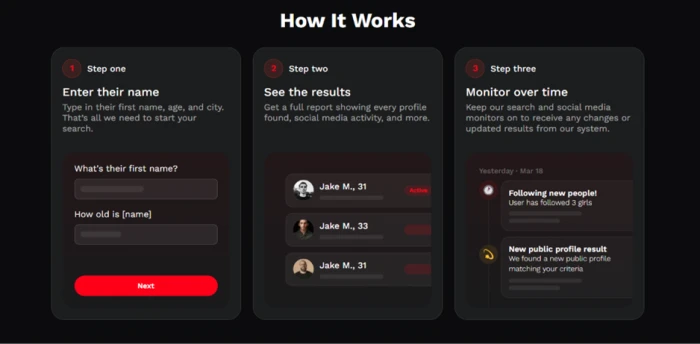
The homepage sets expectations with a three-step "How It Works" section, and it is worth reading closely because the rest of the flow is measured against it.
Step one asks for three details, a first name, an age and a city, and says those are all the site needs. Steps two and three promise a full report of every profile found, plus ongoing monitoring for new results.
Enter a first name, an age and a gender
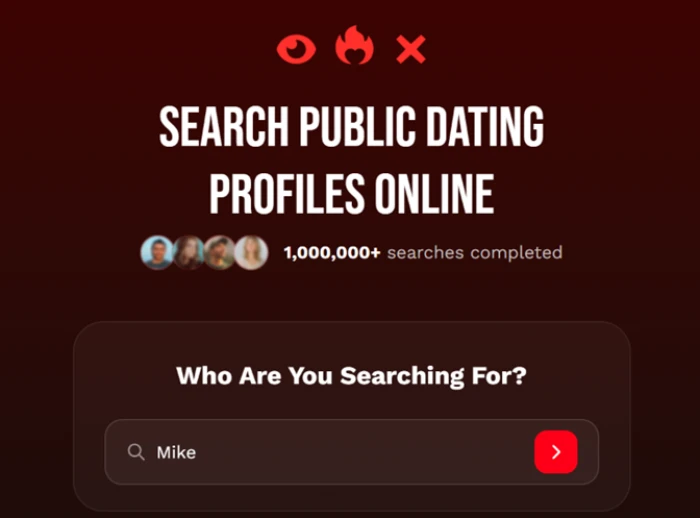
The search opens on a single box asking for a first name. The FAQ asks for first name only, with no last name or extra characters.
From here on, each screen carries a red progress bar, so you always know roughly how far along you are.
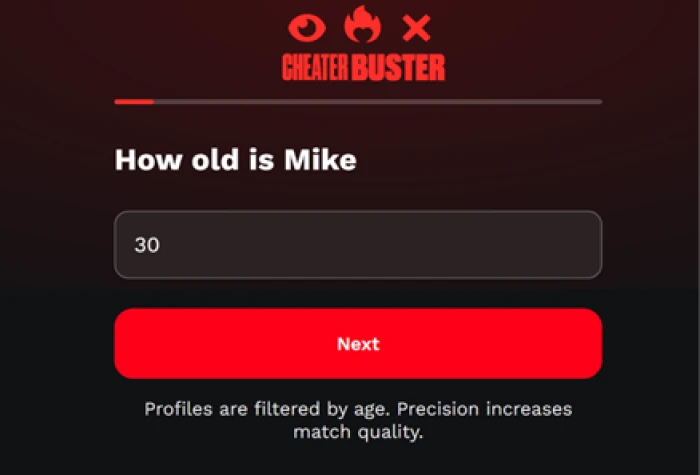
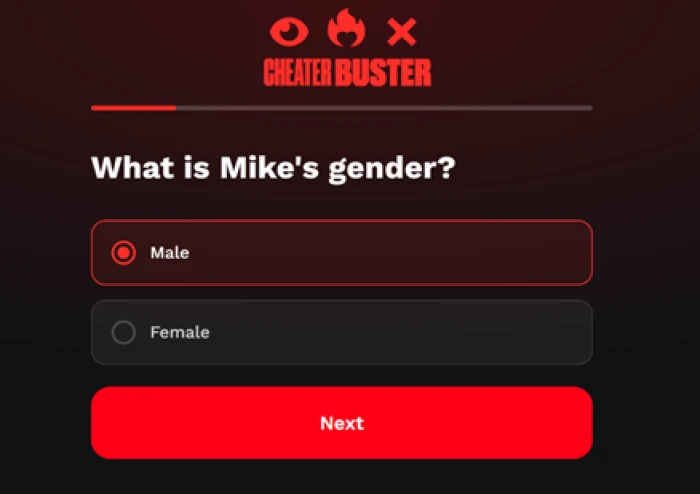
The next two screens ask for age and gender. Both have an obvious job in finding a dating profile.
Answer the questions that turn into a suspicion quiz
After gender, the flow stops asking who the person is and starts asking why you are worried about them.
Screen 4 asks about your relationship to the person, with five choices from Partner to Just curious. Screen 5 is a checklist of warning signs, such as a phone kept face-down or newly changed passwords.
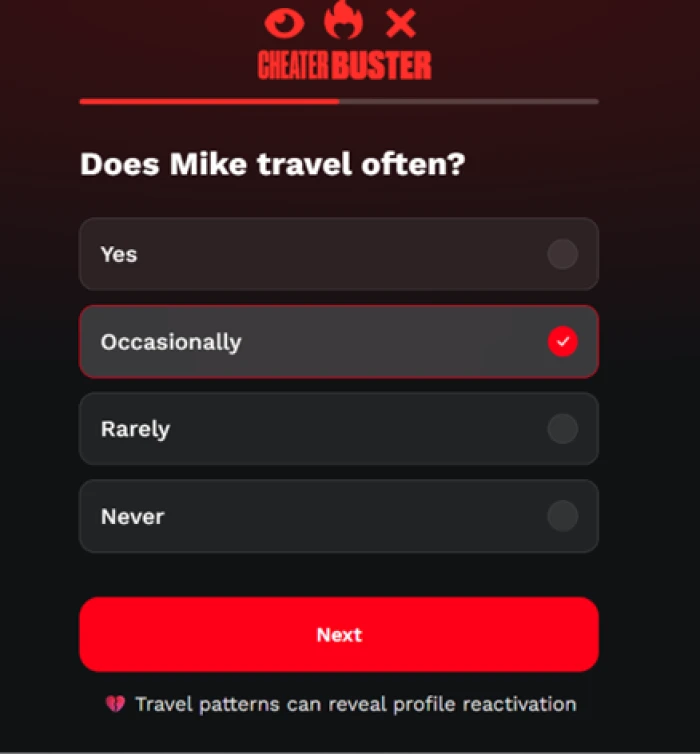
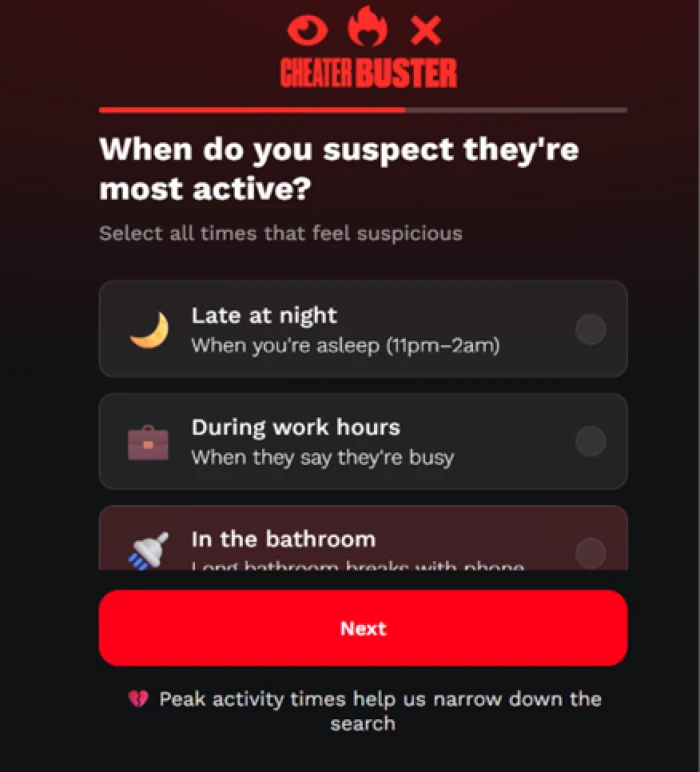
Each screen ends with a footer statistic about hidden activity. None of the answers has any bearing on where a dating profile lives.
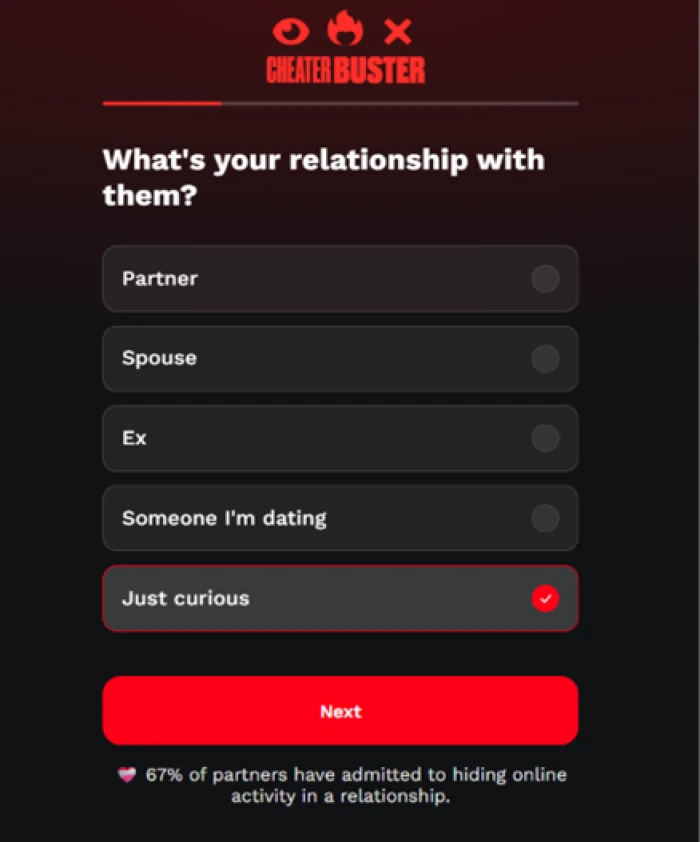
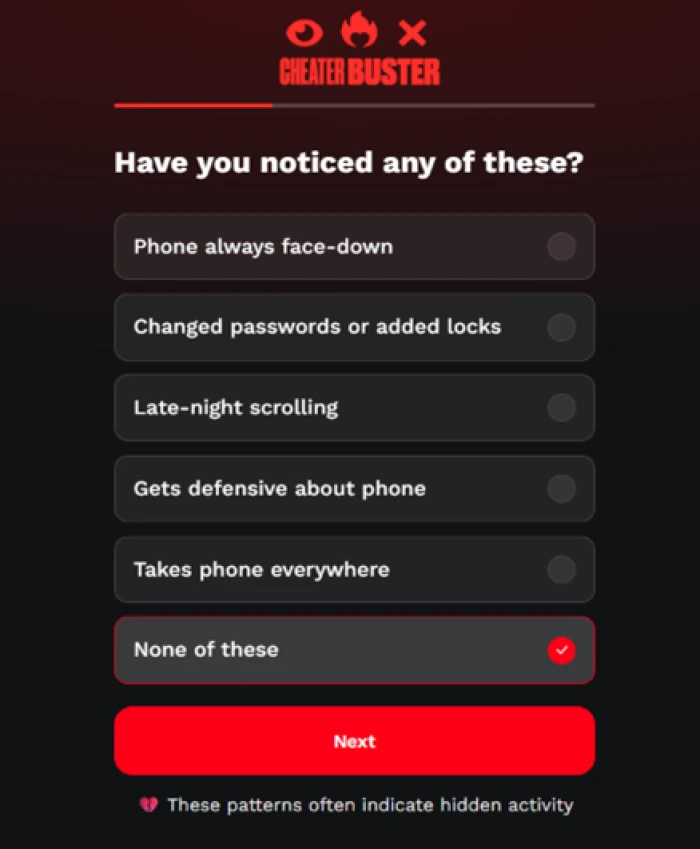
Screens 7 and 8 go further. One asks how often the person travels, the other when you suspect he is most active.
Pin a location and upload a photo
Screens 6 and 9 sit on either side of the quiz questions, and they are the two inputs that plausibly affect a search.
The location screen takes a typed address and places it on a map. The photo screen feeds FaceTrace, the site's face-matching search, and explains what kind of image it needs.
Watch the scan finish before it has the data
Screen 10 is an animated scan with four checks: reverse image matches, dating profiles, social media activity and hidden accounts.
Screen 11 then asks for the person's Instagram and TikTok handles so the site can cross-reference profiles. Compare the two screens side by side.
Reach the blurred results and the countdown
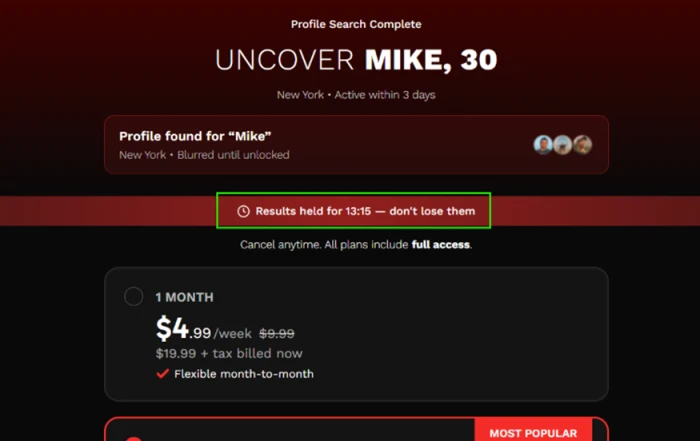
Screen 12 is the first time the site shows anything resembling a result. It is designed to look conclusive without revealing a single detail.
A "Search complete!" heading sits above a map of New York with a red radius circle and several profile markers. Below it is a row of blurred photo thumbnails.
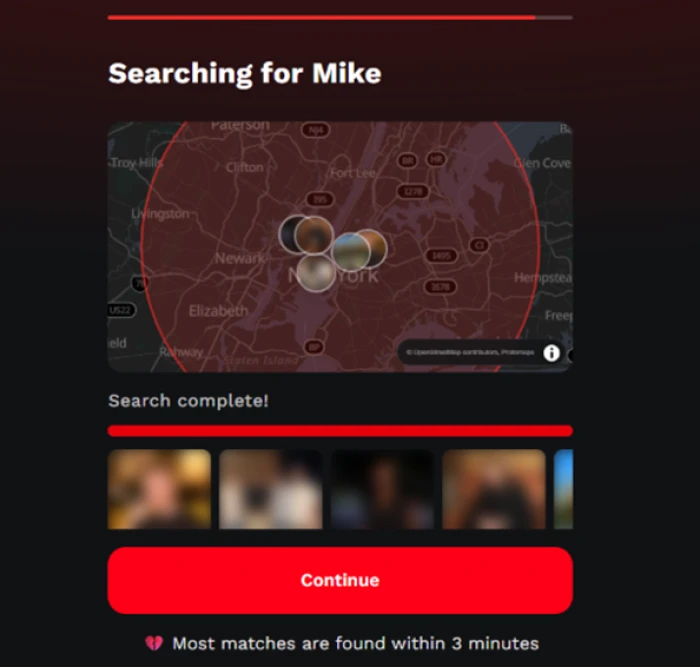
Clicking Continue leads to the paywall. Look at the timer banner and at the two different price lines on the plan card.
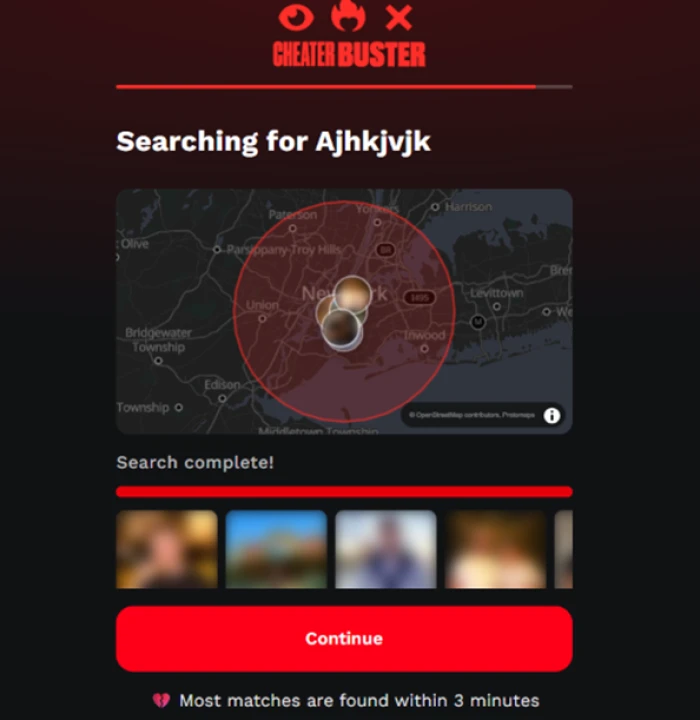
Search for a name that does not exist
To check whether those matches meant anything, I restarted the search with the name "Ajhkjvjk," a string typed by hitting random keys.
The location stayed in New York. A search for a name nobody has should return zero matches.
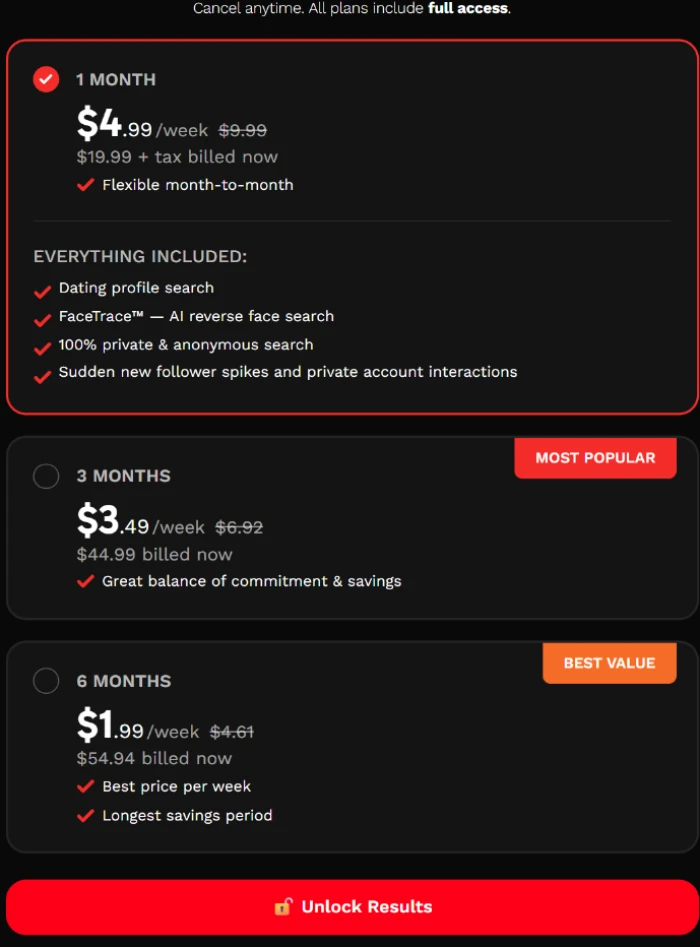
Cheaterbuster pricing
Figures taken from Cheaterbuster's checkout screen, shown after a search completes.
| Plan | Price | What's included |
|---|---|---|
| 1 Month | $19.99 /mo + tax · shown as $4.99/week | Month-to-month · dating profile search · FaceTrace reverse face search · follower spike and private account interaction alerts · one person |
| 3 Months Popular | $44.99 /3 mo shown as $3.49/week | Same features as 1 Month · works out to about $15.00/mo · one person |
| 6 Months | $54.94 /6 mo shown as $1.99/week | Same features as 1 Month · labeled Best Value · works out to about $9.16/mo · one person |
Pros & cons
Specific conclusions from testing and real user reviews, not generic filler.
✅ Pros
- FaceTrace can search by face instead of relying on a first name
- Weekly monitoring reruns the same search and logs the latest change
- Adds Tea app, AWDTSG and reverse phone, email and address lookups
- Interface available in English, Portuguese, Spanish and French
⛔ Cons
- Trustpilot suspended its rating and removed fake reviews for this company
- Users report identical results for two different people searched
- Users testing with their own live profiles say it missed them
- The site never names which dating apps it actually searches
- Runs face and social scans on people who never consented
- Company replies often dismiss negative reviews as suspicious or fake
Synthesized from real reviews on Trustpilot and independent reviews (Indie Hackers, Rain AI Services) · paraphrased, not quoted
Cheaterbuster scorecard
Rated against what a dating profile search service is actually built to do.
| Dimension | Verdict | Score |
|---|---|---|
| Result credibility Whether a match points to a real profile | Weak |
2.0
|
| Flow design & speed Layout, progress cues, screens to a result | Average |
5.5
|
| Location & photo inputs Address pinning, photo guidance | Good |
7.5
|
| Question relevance Asking only what the search needs | Weak |
3.0
|
| Scan honesty Whether progress claims match inputs | Weak |
2.0
|
| Pricing clarity Weekly framing versus actual charge | Weak |
2.5
|
| Billing & cancellation Recurring charges, add-ons, refunds | Weak |
2.0
|
| Monitoring & extra tools Weekly reruns, social and lookup tools | Weak |
4.5
|
| Reputation integrity Review platform standing, response to criticism | Weak |
1.5
|
| Privacy & consent Scanning someone who never agreed to it | Weak |
3.0
|
| Scrutool Score Equal-weight average of all 10 dimensions |
5.1
|
What users say about Cheaterbuster
The themes reviewers raise most often, by share of analyzed reviews.
% = share of analyzed reviews mentioning each theme (Trustpilot, Indie Hackers, Rain AI Services)
A suspicion quiz that ends in a subscription, not an answer
Cheaterbuster has one genuinely well-made piece: the location step pins an exact address and the photo step tells you precisely what makes a usable image. Almost everything around it works against the person paying. The homepage promises three questions and the flow asks ten, several of them about phone habits and bathroom breaks, each topped with an unsourced statistic. The scan declares social media checked before it asks for social handles, the results are a blurred map under a countdown, and a search for a string of random keys produced the same kind of blurred matches as a real name. The checkout leads with weekly prices while charging a monthly or multi-month total, one subscription covers one person, and Trustpilot has suspended the company's rating after removing fake reviews. There is also the person on the other end, whose face and social activity get scanned without their knowledge. If you have a precise first name, age and location and are willing to treat any result as unverified, it will take your money and show you something. Anyone who needs a trustworthy answer about a partner should skip it.
Discussion
Join the discussion and share your perspective.