Copyleaks AI
Copyleaks is a content integrity platform combining plagiarism matching, AI text and image detection, and LMS integrations for schools, publishers and enterprises.

A first-rate plagiarism engine with an AI detector bolted on that gave two machine-written paragraphs on the same topic opposite verdicts.
Should you use Copyleaks?
Institutions and publishers who need plagiarism matching first , inside Canvas, Moodle or Blackboard, with AI scores as a secondary signal.
You want a dependable AI verdict . Two machine-written paragraphs on the same topic came back at 0% and 100%.
25,000 characters scan free without an account. Regular use means Personal at $13.99/mo on annual billing , or $16.99 month to month.
Refunds are only issued within 10 days and with zero credits used , which one test scan is enough to void.
What is Copyleaks?
If you already run Turnitin, Copyleaks is the tool universities and publishers put next to it. It started in 2015 as a plagiarism checker and that heritage still shows: the similarity index reaches across trillions of web pages, more than 16,000 open-access journals and 20-plus code repositories, and it catches paraphrasing, character manipulation and translated reuse. The AI detector was added on top of that engine, not the other way round.
The product runs in a browser, in Chrome, Edge and Firefox extensions, inside Google Docs, and natively in Canvas, Moodle, Blackboard, D2L, Schoology, Sakai and Edsby. One scan returns AI detection and plagiarism matching in a single report, with an AI Logic panel that names the phrases behind a flag. Text detection covers 30-plus languages, plagiarism 100-plus, and there are separate detectors for images, video and deepfakes. Everything is metered in credits, where one credit buys 250 words or one image.
Key features & how they perform
Each feature rated from hands-on testing and aggregated review sentiment.
Plagiarism checker
The part of the platform that has had a decade of work behind it. Sources are ranked sensibly and matched lines are highlighted where they sit.
AI text detector with AI Logic
The AI Phrases panel is the clearest explanation any detector offers, and the verdicts it explains are the least stable part of the product.
AI image detector
Covers DALL-E, Midjourney, Imagen, Stable Diffusion and Flux, plus phone-level edits like Magic Eraser, with a visual overlay of suspect regions.
LMS and workflow integrations
Seven learning platforms, a Google Docs add-on, three browsers and a documented API. This is why it wins procurement conversations.
Unified reports and PDF export
One report covers both checks and exports cleanly, but a disabled feature still prints a large zero that reads like a finding.
Source code detection
Marketed for code governance and licensing checks across 20-plus repositories, and the weakest performer of anything tested here.
Feature ratings blended from Trustpilot, G2, Capterra, TrustRadius & Reddit review patterns + hands-on testing.
Two machine paragraphs, two opposite verdicts
Model text, a 1999 protocol spec, Python straight out of a chatbot, and two images.
Two opposite verdicts on one topic
The scanner takes pasted text or an upload and returns an AI percentage with the flagged sentences highlighted.
A sensitivity dial sits beside it, and the AI Logic panel lists the specific phrases that pushed the score.
The opening test was meant to be routine. I asked an AI model for a paragraph on urban heat and moved the output straight across without changing a word.
"a 120-word paragraph explaining why cities are hotter than the countryside around them, in a plain informative tone with no bullet points"
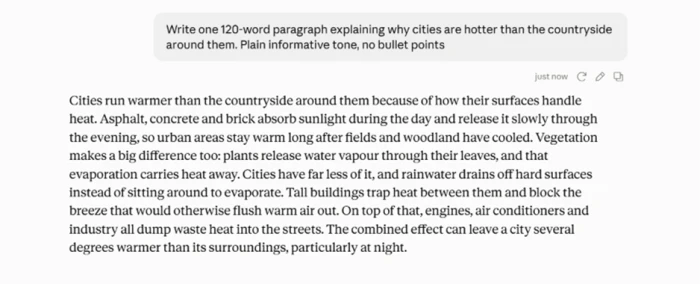
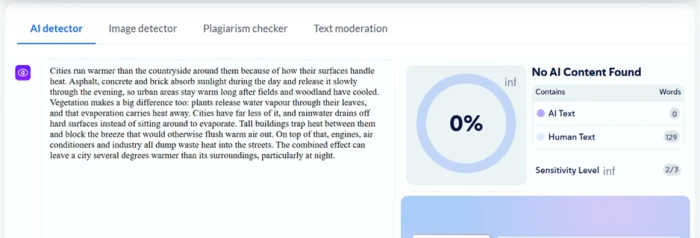
Copyleaks returned 0 percent. The panel read "No AI Content Found" and logged all 129 words as human text, with the sensitivity dial at 2 of 3.
I then generated a second paragraph on the same subject at the same length and scanned it with the dial untouched. The verdict flipped.
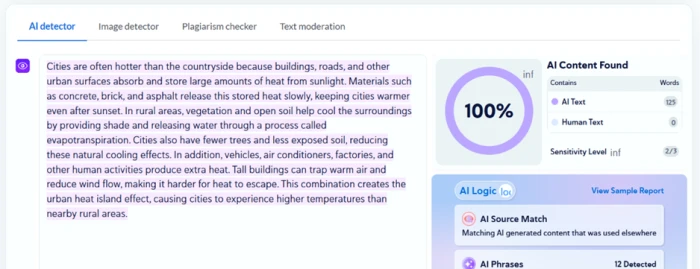
Reading them side by side points at what the detector is responding to. The flagged paragraph moves in the register people now associate with chatbot prose, with tidy connectives carrying each sentence into the next and a closing line that names the concept it has just explained.
The paragraph that passed is looser and more idiomatic. It spells vapour the British way and describes engines and air conditioners dumping waste heat into the streets. The information in both is identical. The voice is not.
Plagiarism detection was the strongest result
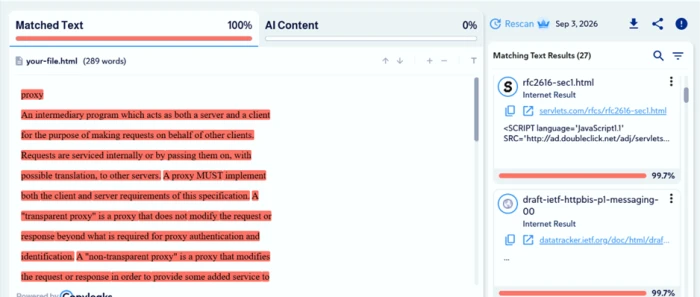
The similarity check runs against trillions of web pages, more than 16,000 open-access journals and a million internal documents, and it shares a report with the AI score.
Text published decades before any chatbot existed is also the fairest test of a false positive, so one submission answers both questions at once.
I pulled 289 words from RFC 2616, the HTTP/1.1 specification published in 1999.
Source code slipped through
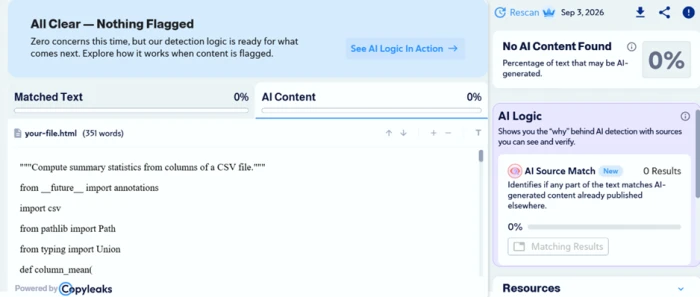
AI-generated code detection is a feature Copyleaks markets as its own, aimed at licensing compliance and code governance rather than essays.
The claim is that it can identify machine-written code even after it has been altered, so unedited output should be the easy case.
"a Python function that reads a CSV file and returns the mean of a numeric column, with a docstring and error handling"
The downloaded report needs careful reading
Reports export as a PDF covering both checks, which is the artefact that ends up attached to an academic integrity case or an editorial review.
That makes how it presents a null result more important than how it presents a positive one.
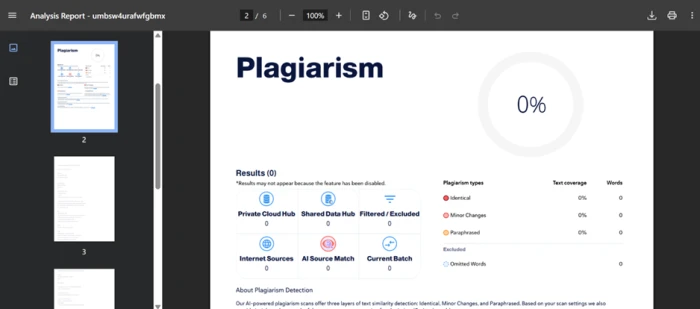
Image detection went two for two
The image detector is a separate product from the text scanner and works on forensic analysis rather than language patterns, returning an overlay of the regions it considers altered.
It checks for AI only. There is no image plagiarism matching, and one credit covers one picture.
I ran two through it, starting with an AI-generated photograph of a red bicycle leaning against a pink wall.
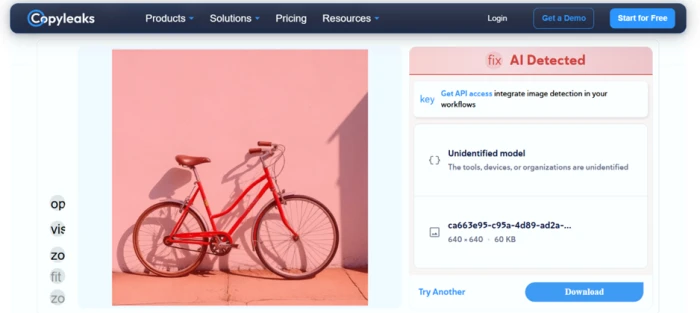
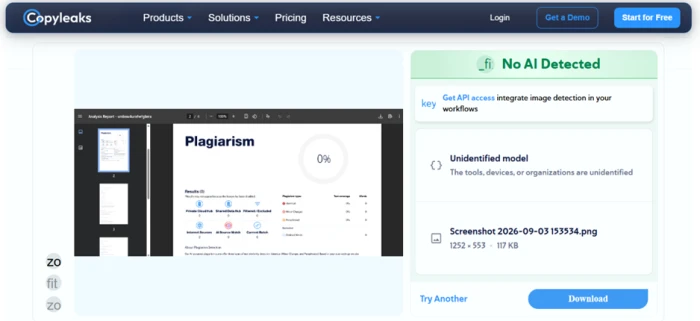
Copyleaks flagged it, though it could not identify which model had produced the picture. The second submission was a screenshot I had captured myself during this testing, 1252 by 553 pixels.
Copyleaks pricing
Figures taken from the official Copyleaks pricing page.
| Plan | Price | What's included |
|---|---|---|
| Free account | $0 | 25,000 characters per scan with no login · limited starter credits on signup · no permanent free allowance published |
| Personal Popular | $13.99 /mo | $167.88 billed annually, or $16.99 month to month · 1,200 credits on the annual plan (300,000 words or 1,200 images) against 100 on monthly · AI Logic · image detection · browser extension · Google Docs add-on |
| Pro | $74.99 /mo | $899.88 billed annually, or $99.99 month to month · 25 user seats · 12,000 credits annually (3,000,000 words) against 1,000 on monthly · full website scans · cross-language detection · analytics dashboard |
| Enterprise & Education | Contact sales | Priced on institution size and volume · LMS integration · API · role-based access · on-premises or private cloud hosting |
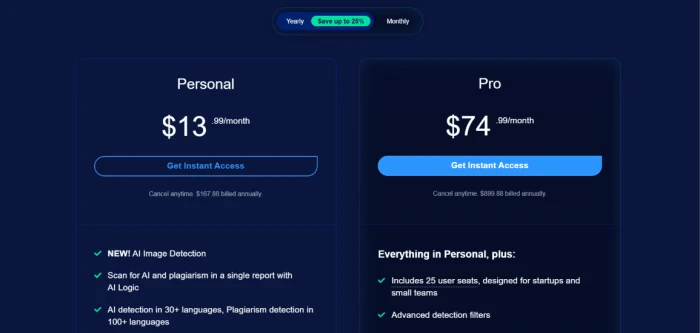
The yearly toggle is the default view and carries a stated saving of up to 25 percent.
Pros & cons
Specific conclusions from testing and real user reviews, not generic filler.
✅ Pros
- Similarity index spans 16,000+ open-access journals and 20+ code repositories
- Native support for Canvas, Moodle, Blackboard, D2L, Schoology, Sakai and Edsby
- AI and plagiarism results arrive in one report rather than two scans
- AI Source Match names where flagged phrasing already appears online
- Catches paraphrasing, character manipulation and translated reuse
- Cornell Tech researchers ranked its LLM detection top in a 2023 study
- SOC 2, SOC 3, GDPR and PCI DSS certified, with private cloud hosting available
⛔ Cons
- The advertised 0.03% false positive rate is not what reviewers describe
- Detection accuracy drops steeply on paraphrased or humanized AI text
- Users report identical text returning different scores between scans
- Image scans check AI only, with no plagiarism matching for pictures
- The web platform rejects any passage under 255 characters
- Grammarly's AI rewriting can trigger flags on otherwise human drafts
- Support rarely revisits a disputed result, per G2 and Trustpilot reports
Synthesized from real reviews on Trustpilot, G2, Capterra, TrustRadius & Reddit · paraphrased, not quoted
Copyleaks scorecard
Rated against what a combined AI and plagiarism platform is asked to do in practice.
| Dimension | Verdict | Score |
|---|---|---|
| Plagiarism matching Source accuracy, ranking, highlighting | Excellent |
9.0
|
| Integrations & API LMS, browser, Google Docs, developer API | Excellent |
9.0
|
| AI image detection Generated pictures versus genuine captures | Good |
8.0
|
| False positives on human text Whether original writing survives a scan | Average |
6.5
|
| Report exports & evidence quality How a PDF report reads to a third party | Average |
5.5
|
| Free access & credit value What you get before and after paying | Weak |
5.0
|
| Result clarity & labelling How verdicts and null results are worded | Weak |
4.5
|
| AI text detection consistency Same input type, same verdict | Weak |
4.0
|
| AI-generated code detection Catching machine-written source code | Weak |
3.5
|
| Billing transparency & support Refunds, renewals, disputed results | Weak |
3.5
|
| Scrutool Score Equal-weight average of all 10 dimensions |
5.9
|
What users say about Copyleaks
The themes reviewers raise most often, by share of analysed reviews.
% = share of analysed reviews mentioning each theme (Trustpilot, G2, Capterra, TrustRadius, Reddit)
Buy it for the plagiarism engine and treat the AI score as a rumour
The plagiarism side is the reason this platform sits in so many universities. A 1999 protocol specification was matched at 100 percent across 27 results with the right sources ranked first, the index reaches places lighter tools do not, and seven LMS integrations plus an API mean the checks run where the work already happens. Image detection called both of its tests correctly, including a screen capture that could easily have confused a classifier. The AI text detector is the problem. Two machine-written paragraphs on the same topic at the same length came back at 0 percent and 100 percent, unedited Python passed as clean, and the tool that markets a 0.03 percent false positive rate described 129 words of chatbot output as human text. Add a refund window that one test scan voids and the case gets narrower still. Institutions that want similarity checking inside their LMS will get their money's worth. Anyone buying this to settle the question of who wrote something should not.
Discussion
Join the discussion and share your perspective.