
LawCentral AI
An Indian legal AI for advocates and firms, grounded in the post-2024 codes, with citations verified against Indian Kanoon. Built to refuse the fake precedents that get lawyers sanctioned.

A legal AI built for the one risk that matters most in an Indian courtroom: fake citations. It refused to invent authority and mapped the new codes correctly, but its edges are still unproven.
Should you use LawCentral AI?
Solo advocates and small Indian firms who want faster drafting and research grounded in the post-2024 codes, with citations they can open and confirm.
You need proven coverage of obscure or very recent rulings , or you expect to file its output without checking every citation yourself.
Starter is ₹1,000/mo (from ₹1,500), Pro ₹4,900/mo , Team is quote-only. All prices are before GST.
The 95% citation figure is the company's own , and every task tested involved landmark law, not the thin edges where legal AI usually breaks.
What is LawCentral AI?
In 2026 the Supreme Court of India began treating AI-hallucinated case citations as professional misconduct, after a run of advocates were caught filing precedents that did not exist. LawCentral AI is built for exactly that risk. It is an Indian legal platform for advocates and firms, built around Nyra, a research and drafting agent that checks its citations against Indian Kanoon and links each one back to the judgment it came from. Around that sit matter management with live eCourts sync across the Supreme Court, 25 High Courts and district courts, and the ability to read scanned filings end to end in ten Indian languages.
What separates it from a general chatbot is that it is grounded in Indian law after the 2024 shift to the new criminal codes, the Bharatiya Nyaya Sanhita, the Bharatiya Nagarik Suraksha Sanhita and the Bharatiya Sakshya Adhiniyam, and that it will decline to invent authority that does not exist. That single trait matters more than any feature when the output is headed to court. The open questions are how well it holds up beyond famous landmark law, and whether a young product with a small user base has been proven at the thin edges. It is aimed at solo advocates and small firms who want speed without staking a filing on a fabricated citation.
Key features & how they perform
Each feature rated from hands-on testing and aggregated review sentiment.
Post-2024 code accuracy
Maps old IPC and CrPC sections to their BNS and BNSS equivalents and flags when an old section was repealed.
Verified citations
Each authority carries a verified marker checked against Indian Kanoon and opens to the judgment so you can confirm the paragraph.
Nyra research agent
Answers settled-law questions in detail and, when asked for authority that does not exist, says so instead of fabricating one.
Drafting
Produces the correct cause-title and structure, leaves client details as placeholders, and exports clean to Word and PDF.
eCourts case management
Imports matters by CNR and syncs hearings, orders and listings from the court for each case.
Multilingual scanning
Reads uploaded scanned petitions end to end in ten Indian languages, not just the first page.
Feature ratings blended from Google Play reviews, Indian legal-AI reporting & hands-on testing.
Putting Nyra through an advocate's real week
I ran a set of tasks an Indian advocate faces in a normal week and checked every output against primary sources, rather than trusting the verified badges on screen.
The free statutory converter
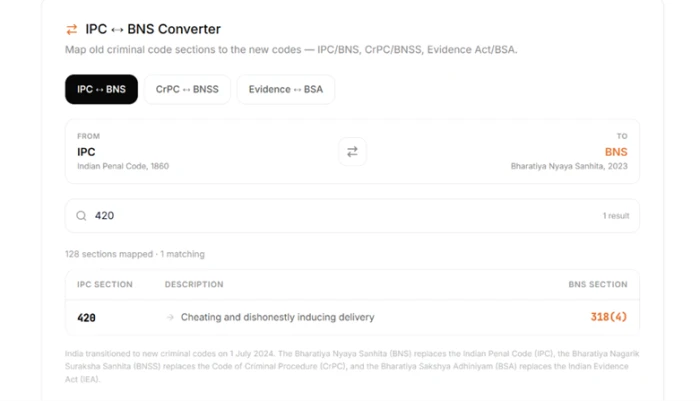
The IPC to BNS converter sits in the free AI Tools section, so anyone can use it without starting a trial. India moved to the new criminal codes on 1 July 2024, and advocates are still translating old section numbers into new ones while drafting.
"Section 420 of the Indian Penal Code"
Legal research on settled law
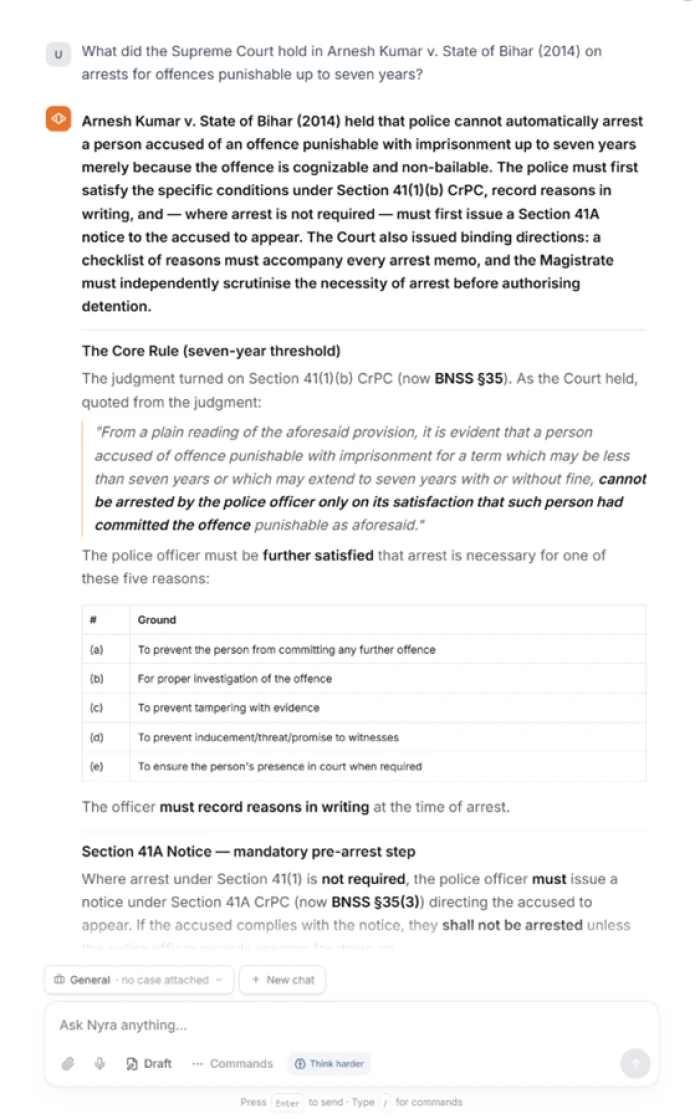
Next I put a landmark arrest-law question to Nyra, the research agent, to see how it handled settled authority and, more importantly, how it translated the old code into the new one inside a single answer.
"what did the Supreme Court hold in Arnesh Kumar v. State of Bihar (2014) on arrests for offences punishable up to seven years?"
Old codes versus new codes
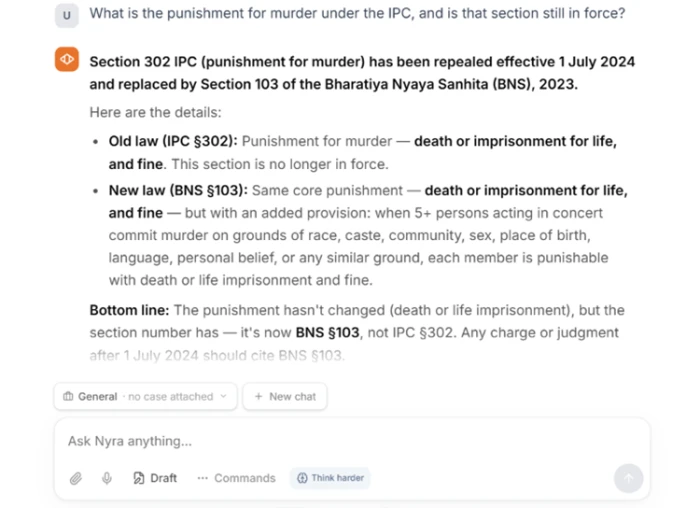
This question was built to catch a stale answer. A model trained mainly on pre-2024 material would give the punishment and miss that the section has since been repealed.
"what is the punishment for murder under the Indian Penal Code, and is that section still in force?"
Refusing to invent authority
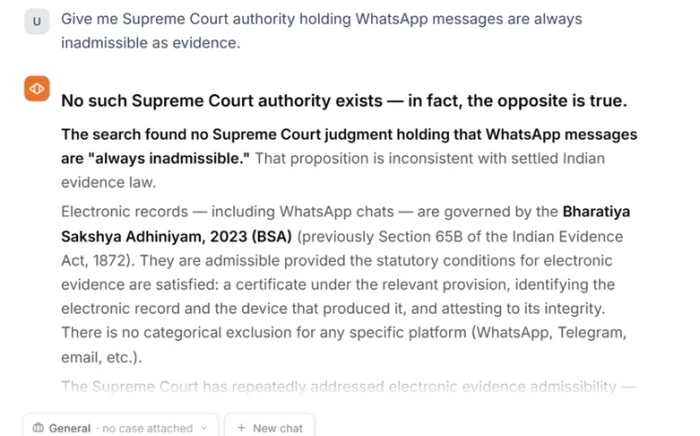
This is the hardest test for any legal AI: what it does when asked for support that does not exist. A model that manufactures a plausible but fake citation is the one that gets an advocate sanctioned in open court.
"give me Supreme Court authority holding that WhatsApp messages are always inadmissible as evidence"
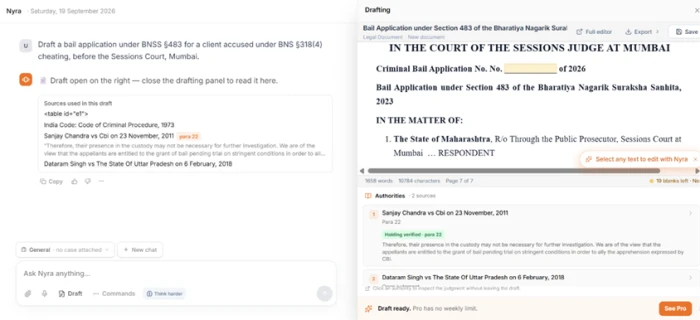
Drafting a bail application
Drafting is the feature advocates actually pay for, so I set a real task and checked both the structure and the authorities it leaned on.
"a bail application under BNSS Section 483 for a client accused under BNS Section 318(4), before the Sessions Court at Mumbai"
Where the testing stopped
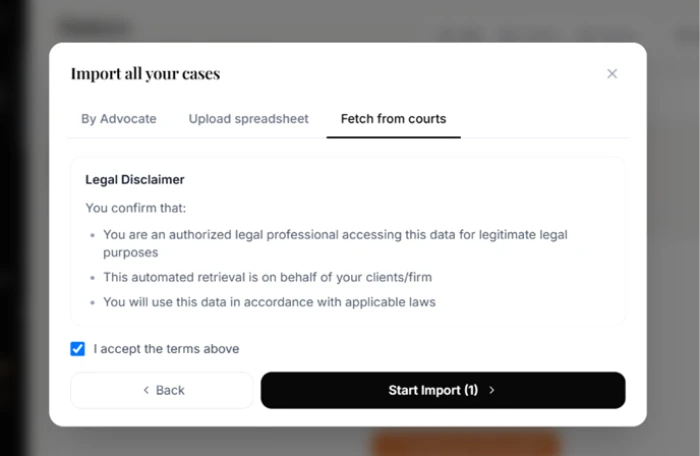
Case import pulls live records from eCourts, and the flow ends at a disclaimer asking the user to confirm they are an authorised legal professional acting for a client. I documented the feature up to that gate rather than complete a retrieval I had no client basis to run.
LawCentral AI pricing
Figures taken from LawCentral's official pricing page.
| Plan | Price | What's included |
|---|---|---|
| Starter | ₹1,000 /mo | For solo practitioners · 12,000 AI credits a month (around 110 full drafts) · scans read 70 pages deep in ten Indian languages · 50 matters · email support, usually same day |
| Pro Most chosen | ₹4,900 /mo | For solo lawyers who need full AI · 40,000 AI credits a month (around 360 drafts) with top-ups · scans read 300 pages deep · unlimited matters · priority support · cause-list alerts · every citation checked |
| Team | Custom | For firms with 2+ lawyers · everything in Pro per seat · 30,000 AI credits per lawyer a month · one shared firm workspace with roles · firm letterhead on exports · one bill · a named contact |
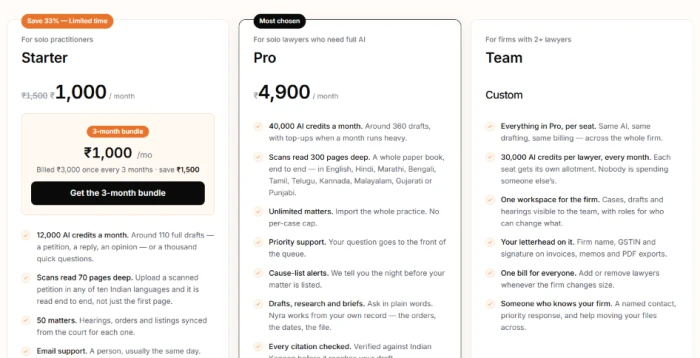
The individual and firm plans as shown on LawCentral's pricing page.
Pros & cons
Specific conclusions from testing and real user reviews, not generic filler.
✅ Pros
- Grounded in the post-2024 codes (BNS, BNSS, BSA), not just old IPC and CrPC
- Citations verified against Indian Kanoon with click-through to the judgment
- Declines to fabricate authority instead of inventing a plausible case
- eCourts CNR import syncs hearings across SC, 25 High Courts and district courts
- Reads scanned filings end to end in ten Indian languages
- Drafts export to Word and PDF without formatting loss for filing
⛔ Cons
- Unproven at the thin edges: obscure rulings, 2025-26 judgments, tribunals
- The 95% citation figure is the company's own, not independently measured
- Very young product with only a handful of public reviews so far
- Verification still falls on the advocate before anything reaches a filing
- Case import is gated behind an authorised-professional declaration
- No independent accuracy audit across practice areas yet
Synthesized from Google Play reviews and Indian legal-AI reporting (LiveLaw, iPleaders, MediaNama) · paraphrased, not quoted
LawCentral AI scorecard
Rated against what a legal research and drafting tool for Indian practice is actually built to do.
| Dimension | Verdict | Score |
|---|---|---|
| Post-2024 code accuracy IPC/CrPC to BNS/BNSS mapping and repeals | Excellent |
8.5
|
| Citation authenticity & verification Verified markers, click-through, no fake cases | Excellent |
8.5
|
| Legal research depth Settled law, holdings and conditions | Good |
8.0
|
| Drafting quality Cause-title, structure, placeholders | Good |
8.0
|
| eCourts case management CNR import and hearing sync | Good |
7.5
|
| Multilingual scanning & OCR Ten Indian languages, page depth | Good |
7.5
|
| Export & filing readiness Word and PDF without formatting loss | Good |
8.0
|
| Coverage at the thin edges Obscure rulings, 2025-26, tribunals | Average |
5.5
|
| Value for solo practitioners Credits and limits against price | Good |
7.5
|
| Maturity & track record Age of product and public review base | Average |
6.0
|
| Scrutool Score Equal-weight average of all 10 dimensions |
7.5
|
What users say about LawCentral AI
Early days for this product, so these themes come from a small review base alongside category reporting.
% = share of analysed feedback (Google Play early reviews) and recurring themes from Indian legal-AI reporting (LiveLaw, iPleaders, MediaNama)
A legal AI that refuses to invent the citation that gets advocates sanctioned
Across a practising advocate's week, LawCentral passed the tests that matter most for legal AI. It mapped the old codes to the new ones correctly, caught the repeal of Section 302 IPC, held both statutes at once without slipping, and, when asked for authority that does not exist, said so instead of fabricating a case. The bail draft came back with the right cause-title, honest placeholders for client details, and authorities that open to the judgment so you can confirm the paragraph before you file. In a year when the Supreme Court has started calling AI-hallucinated citations misconduct, that restraint is the whole point. The caveats are real and worth stating plainly. Every task tested famous, landmark law, so nothing here proves accuracy on obscure single-judge rulings, 2025 and 2026 judgments, or tribunal work; the headline 95 percent citation figure is the company's own; and the product is young with a thin public review base. Solo advocates and small Indian firms who want drafting and research speed, and who will still open every citation before filing, should put it on trial. Anyone expecting to file its output unchecked, or needing proven depth at the edges, should wait or verify hard.
Discussion
Join the discussion and share your perspective.