
LawLogic AI
An Indian legal AI assistant and drafting tool running on a Google AI Studio build. Cheap to try, but the headline assistant returned errors in testing.

A cheap, rough Indian legal drafting tool. The templates and ₹10/day price are the draw, but the AI assistant was unresponsive throughout our test and the drafts need real editing before they are usable.
Should you use LawLogic?
Litigants and small practices who want cheap, quick draft skeletons for common notices like tenancy agreements and cheque-bounce letters, and will finish the clauses themselves.
You need a dependable AI assistant , which was unresponsive throughout our test, or drafts you can file without heavy editing.
A 24-hour trial, then ₹10/day , billed daily (roughly ₹300 a month). A countdown timer shadows every screen.
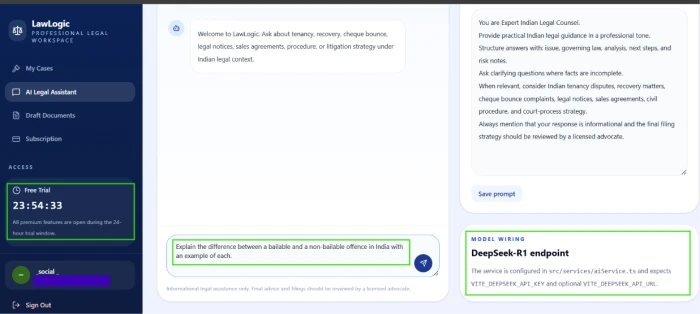
The app exposes its model wiring and API key variable in the interface, and the page is still named "My Google AI Studio App".
What is LawLogic?
Strip away the framing and LawLogic is a Google AI Studio build. The page still carries the default "My Google AI Studio App" title, and the AI Legal Assistant is a general DeepSeek-R1 model driven by an editable system prompt, with no Indian statute database or citation layer underneath it. It presents two things: an assistant that is meant to answer legal questions, and a set of drafting templates for documents like tenancy agreements and cheque-bounce notices.
It runs in the browser, opens on a 24-hour free trial, then charges ₹10 a day, and it pitches itself at advocates, firms and litigants. In our session the assistant was unresponsive, so the part that earned its keep was the drafting module: rough, but cheap and quick. Anyone who needs dependable legal research or a draft they can file without heavy editing should treat it as an early-stage tool rather than a finished product.
Key features & how they perform
Each feature rated from a hands-on testing session on the browser build.
AI legal assistant
Meant to answer Indian legal questions, but the endpoint returned a raw 404 on every prompt during our session, so we could not judge its answers.
Document drafting
Runs on a separate path, so it does produce output, but the drafts are short and skip clauses an enforceable Indian document needs.
Drafting templates
Tenancy agreement and cheque-bounce notice templates are relevant to Indian use, and the notice correctly cited Section 138.
Live draft preview
The on-screen preview ignored every value we entered and rendered empty brackets, even though the export path filled the fields in.
My Cases dashboard
A matter view with date-wise order timelines sits in the trial, aimed at litigants tracking court dates. Light on depth compared to dedicated case tools.
Access & trial model
No signup or email step, so the trial opens instantly, but it is a 24-hour countdown rather than a standing free tier.
Feature ratings are from a single hands-on testing session; no aggregated user reviews exist for this tool.
An hour inside LawLogic: what broke and what held up
The page source, the assistant, and two drafting templates, in the order we tested them.
What the tool turned out to be
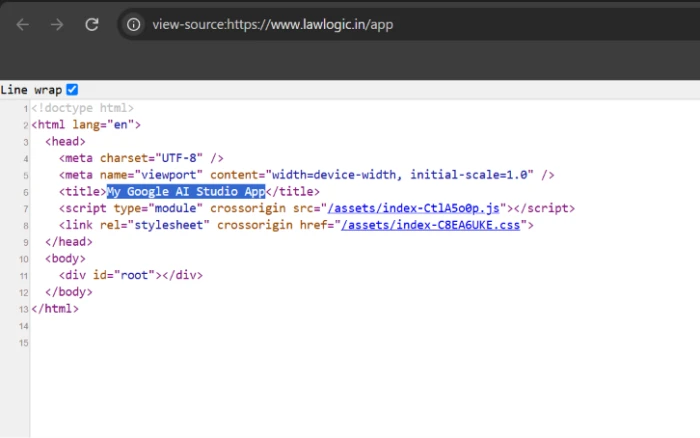
Before running a single legal query, we opened the page source. The title told us more than the homepage did: it still read "My Google AI Studio App," the label Google assigns by default to anything built in its AI Studio builder.
Nobody had renamed it, which places LawLogic closer to a weekend prototype than a built-for-purpose legal product.
The interface backed that up. Opening the AI Legal Assistant revealed a panel marked "Model Wiring" pointing at a DeepSeek-R1 endpoint, alongside the internal source file and the API key variable the app expected, details no finished product shows its users.
The assistant returned errors, not answers
Our first prompt was plain. We asked the assistant to explain a basic point of Indian criminal procedure, the kind of question the tool is built to field.
"Explain the difference between a bailable and a non-bailable offence in India"
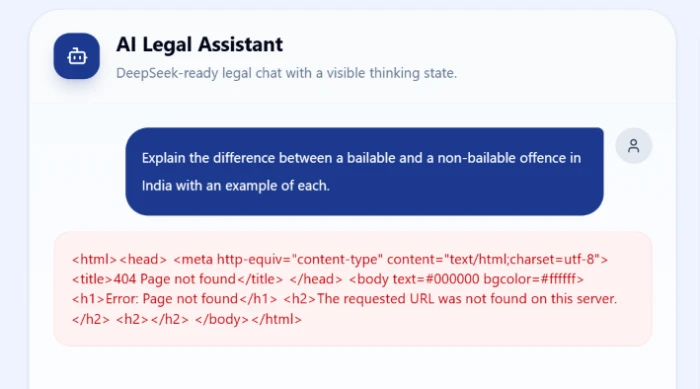
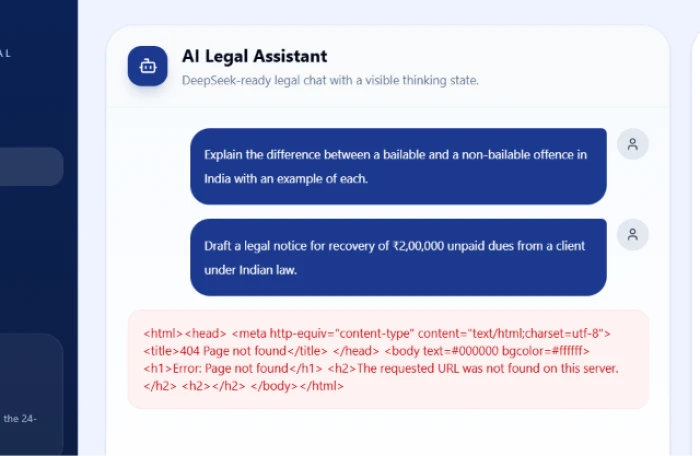
No legal answer came back. The chat bubble filled with raw HTML, a 404 "Page not found" response lifted straight from the server. We switched topic completely to rule out a subject-matter block.
"Draft a recovery notice for unpaid dues of two lakh rupees"
The tenancy draft: export fills in, preview stays blank
The drafting module runs on a different path and never touches the broken chat endpoint, so it did produce output. We opened the Tenant Agreement template and entered a landlord, a tenant, a Delhi address, and fifty thousand rupees of rent.
The live preview on the right ignored all of it, rendering empty brackets where the parties and the address belonged, showing "between ("Landlord") and ("Tenant")" above a blank property line.
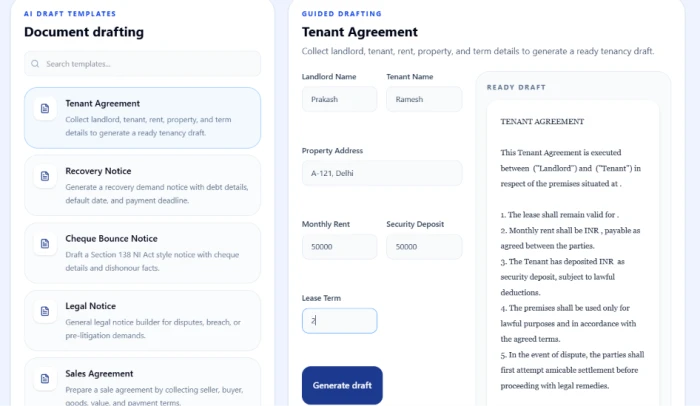
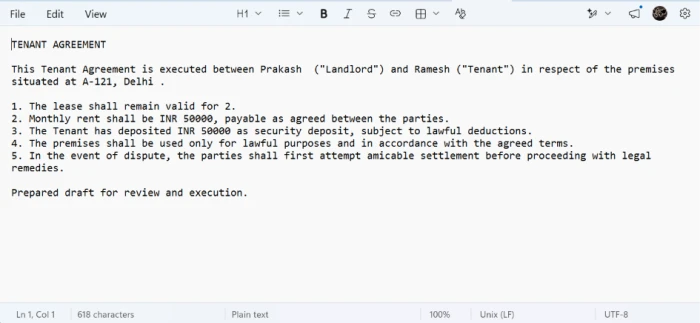
The download told a different story. The exported .txt file did fill in the names and the rent, so the export path works even while the preview stays empty.
The cheque-bounce notice repeats the same bug
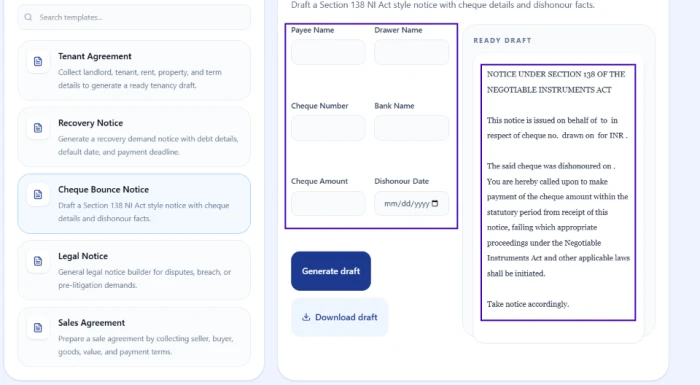
We tried the Cheque Bounce template next. The same preview bug reappeared, with the ready draft again showing unfilled fields.
The notice leaned on the phrase "the statutory period" without ever stating the timelines that Section 138 of the Negotiable Instruments Act actually sets.
LawLogic pricing
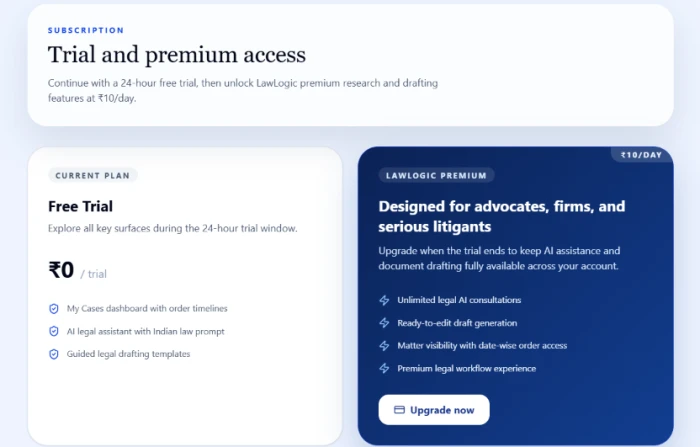
Figures taken from LawLogic's in-app subscription screen.
| Plan | Price | What's included |
|---|---|---|
| Free Trial | ₹0 | 24-hour access · My Cases dashboard with order timelines · AI legal assistant (Indian law prompt) · guided drafting templates |
| LawLogic Premium | ₹10 /day | Unlimited AI legal consultations · ready-to-edit draft generation · matter visibility with date-wise order access · premium workflow |
Pros & cons
Specific conclusions from the hands-on session, not generic filler.
✅ Pros
- Draft export fills in party names and rent even when the preview stays blank
- Cheque-bounce notice correctly cites Section 138 of the Negotiable Instruments Act
- Relevant Indian templates (tenancy, cheque bounce) available out of the box
- No signup or email step; the 24-hour trial opens immediately
- ₹10 a day is cheap in absolute terms
⛔ Cons
- AI legal assistant returned a 404 server error on every prompt tested
- Assistant produced no legal text, so accuracy could not be tested
- Runs a general DeepSeek-R1 model with no Indian statute database or citations
- Exposes internal "Model Wiring," source file name and API key variable in the UI
- Page is still named "My Google AI Studio App," the default builder label
- Live draft preview renders empty brackets while only the export fills fields
- Tenancy draft omits due date, notice period, stamp duty and signature blocks
- Drafts use vague phrasing like "valid for 2" and "the statutory period"
- Access is a 24-hour trial with a countdown, not a standing free tier
Synthesized from a hands-on testing session · no public third-party review corpus exists for lawlogic.in
LawLogic scorecard
Rated against what an Indian legal AI and drafting tool is actually built to do.
| Dimension | Verdict | Score |
|---|---|---|
| AI legal assistant reliability Does the assistant return answers | Weak |
4.0
|
| Document drafting quality Completeness of generated drafts | Average |
5.5
|
| Indian law grounding & citations Statute database and citation layer | Weak |
4.5
|
| Legal template coverage Range of usable draft templates | Average |
6.5
|
| Draft preview & editing Live preview and edit experience | Weak |
4.0
|
| Interface & ease of use Navigation, access, clarity | Average |
6.5
|
| Data privacy & security What the app exposes to users | Weak |
4.5
|
| Product maturity & polish Branding, error handling, finish | Weak |
4.5
|
| Value for money Trial length and daily pricing | Good |
7.5
|
| Transparency & legal safeguards Disclaimers, verification, trust | Average |
5.5
|
| Scrutool Score Equal-weight average of all 10 dimensions |
5.3
|
What held up and what failed
Drawn from the hands-on session, since lawlogic.in has no public review footprint.
No public user reviews exist for lawlogic.in. Percentages reflect how consistently each issue appeared across the hands-on session, not a share of aggregated reviews.
Cheap and quick for rough drafts, shaky wherever the stakes rise
LawLogic is a modest, inexpensive drafting utility with real rough edges. The AI legal assistant, the feature it leads with, returned a 404 on every prompt during our session, so the endpoint was down when we tested and we could not judge its answers. Underneath sits a general DeepSeek-R1 model with an editable system prompt and no Indian statute database, and the app still exposes its model wiring and carries the default "My Google AI Studio App" title. What works is the drafting: the export fills in your details even when the preview does not, the cheque-bounce notice correctly names Section 138, and at ₹10 a day with instant access the barrier to trying it is low. The catch is that the drafts skip the due dates, notice periods, stamp duty references and signature blocks an enforceable Indian document needs, so you finish the work yourself. Litigants and small practices who want a cheap starting skeleton for common notices will get some use out of it. Anyone who needs dependable legal research, or a draft ready to file, should reach for a purpose-built Indian legal tool.
Discussion
Join the discussion and share your perspective.