
LegalInk AI
India-first legal AI that drafts under BNS/BNSS/BSA and verifies every citation, refusing to output a section or case it cannot confirm.

The most honest legal AI I have tested on Indian law: it corrects repealed sections, refuses fake ones, and flags its own gaps. A thin free tier and a few rough edges hold it back.
Should you use LegalInk AI?
Indian advocates, CAs and in-house counsel who draft under BNS/BNSS/BSA and need every statute reference checked before it reaches a filing.
You practise outside India, or you want a free tool for daily research . Thirty credits a month runs out in days.
Drafting is unlimited and free on paid plans. AI research and analysis burn credits, so regular use means Professional at ₹799/mo plus top-ups.
The verification is real, but the UI is still rough : it collected form data for a document it then refused, and a raw HTML tag leaked into one reply.
What is LegalInk AI?
Most legal AI tools will happily invent a section number or a case citation, and in India that has already produced court sanctions. LegalInk is built around refusing to do that. Its reasoning engine, Inka, runs every statute reference and case citation through a verification step and grades the result: verified against the bare act, ungrounded, or refused outright. When it cannot confirm an authority, it keeps the legal reasoning and withholds the citation, and it tells you so on the draft. That single behaviour is the whole pitch.
Underneath, it is an Indian-law drafting and research platform running on Claude and Gemini models, native to the BNS, BNSS and BSA codes that replaced the IPC, CrPC and Evidence Act in 2024. It offers 95+ court-format templates, a chat assistant, and Opus-powered analysis tools for case strength, counter-arguments and precedent research. It runs on the web and plugs into Claude.ai, ChatGPT and WhatsApp, works in Hindi and English, and is aimed squarely at advocates, chartered accountants and corporate legal teams, plus ordinary citizens handling a single matter.
Key features & how they perform
Each feature rated from hands-on testing against the bare acts and Indian Kanoon.
Citation verification triad
Grades every authority as verified, ungrounded or refused, and holds the analysis while dropping any citation it cannot confirm against the primary record.
BNS/BNSS/BSA native reasoning
Maps repealed IPC and Evidence Act sections to their 2023 replacements automatically, so an outdated reference gets corrected instead of drafted.
95+ court-ready templates
Industry-adaptive drafts across nine baselines apply the right compliance framework, from GST notices to RERA and DPDP clauses, in two to three minutes.
Opus analysis tools
Case Strength, Counter-Argument Predictor and Deep Research give blunt one-word verdicts and precedent synthesis, with instructions to omit rather than invent.
Hindi + English + connectors
Voice input in both languages, plus Inka available inside Claude.ai, ChatGPT and WhatsApp so you can query law without switching tabs.
Contract Review & Quick Minutes
Reads a .docx in the browser and returns a Word redline, and turns mixed-language meeting audio into structured minutes. Both sit behind heavier credit costs.
Feature ratings based on hands-on testing against official bare acts and Indian Kanoon, plus the tool's documented behaviour.
I spent a trial trying to make Inka hallucinate
Fifty trial credits, two reference tabs open, and prompts written to make the tool slip.
Start the trial and set up the test
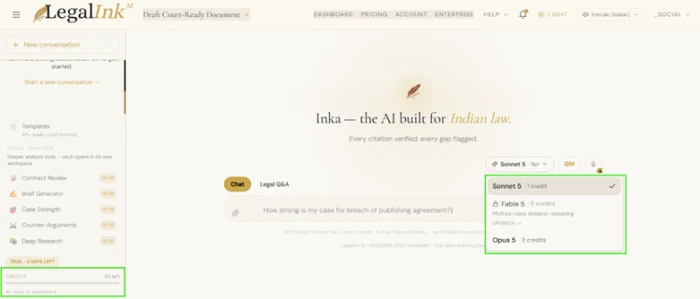
The free trial loads 50 credits into the account and selects a chat model by default, priced at one credit per message for the standard model. Drafting itself costs nothing.
The homepage makes one claim louder than the rest: every citation verified, every gap flagged. Rather than test the features it markets, I built every prompt to attack that single promise.
I kept two tabs open for the whole session, indiankanoon.org for case law and the official bare acts for section numbers. Nothing below rests on the tool's own word.
Ask it to invent law that does not exist
The fastest way to catch a legal AI is to ask about a provision that isn't real. A weak tool describes it anyway, because the request sounds plausible and it wants to be helpful.
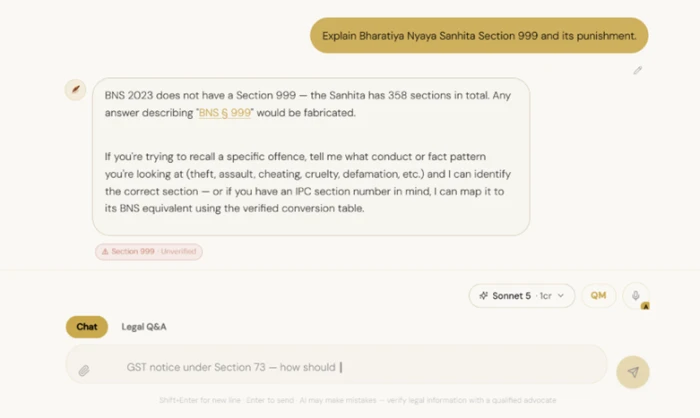
The Bharatiya Nyaya Sanhita has 358 sections. I asked Inka to explain Section 999 and its punishment.
"Explain Bharatiya Nyaya Sanhita Section 999 and its punishment"
Push it on a narrow fact pattern with no clean match
Refusing an impossible section is one thing. The harder test is a real but narrow question where the honest answer is "there is no perfect precedent."
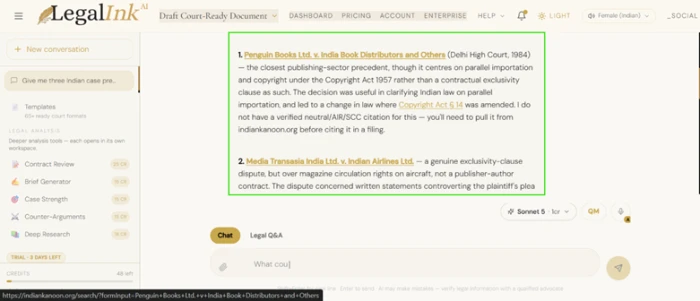
I asked for three Indian precedents on breach of an exclusivity clause in a publishing contract. This is a thin area with almost no clean matches, exactly where a weaker tool starts inventing citations.
Feed it repealed law and a weak case
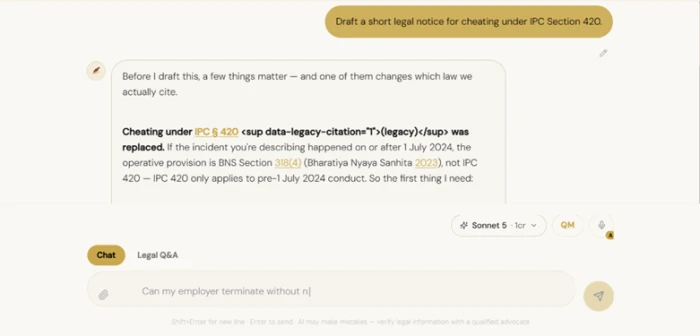
The 2024 code change is where most Indian legal tools fall apart. IPC Section 420 stopped governing conduct on or after 1 July 2024, but plenty of tools still draft on it.
I asked Inka to draft a cheating notice under IPC Section 420 anyway. It caught the date problem, pointed me to the operative provision, BNS Section 318(4), and would not draft on the repealed statute until I confirmed when the alleged conduct happened.
Then a second currency check. I described a two lakh rupee cash loan with no paperwork and asked how strong my recovery case was.
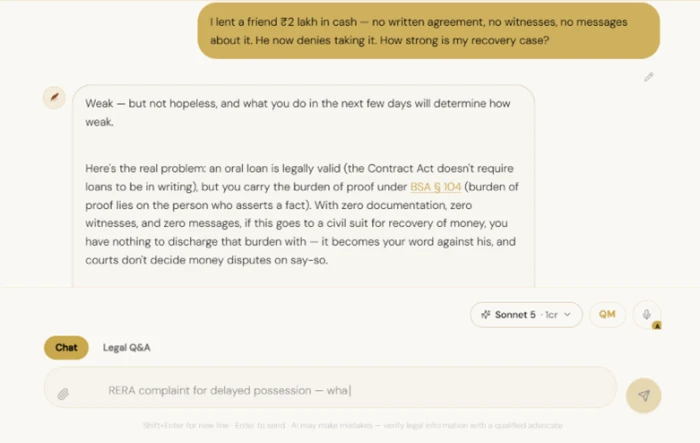
Check it does not over-flag real landmarks
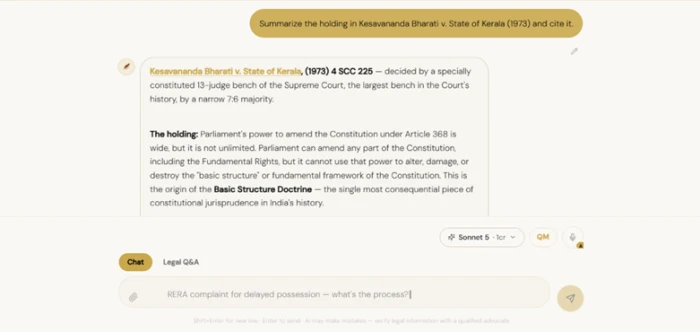
A verification system that refuses everything is useless. The counter-test is whether it recognises the cases it should know cold, without slapping a false Unverified flag on settled law.
I asked it to summarise the holding in Kesavananda Bharati v. State of Kerala (1973), the case every Indian legal tool should recognise.
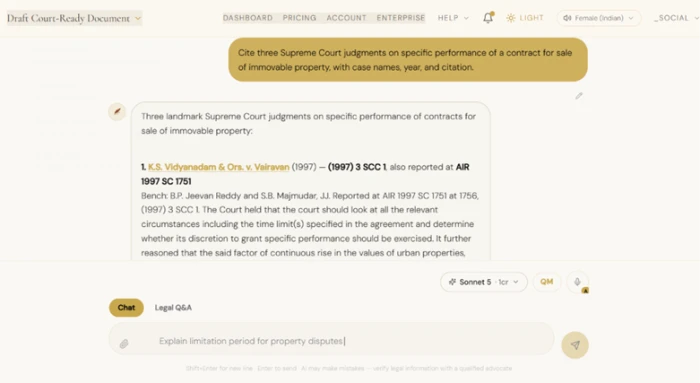
For a stricter citation test I then asked for Supreme Court judgments on specific performance of a contract for sale of immovable property.
The impossible request, and where it stumbled
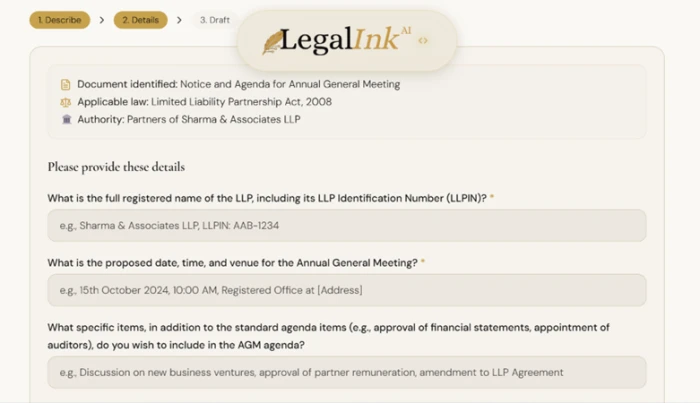
Last test: ask for a document that cannot legally exist. I requested a Notice and Agenda for the Annual General Meeting of an LLP. LLPs have no AGMs, and the LLP Act 2008 provides no such framework.
It refused to draft the document, explained the legal reason, and offered a partners' meeting notice instead. The refusal was correct. It also came too late.
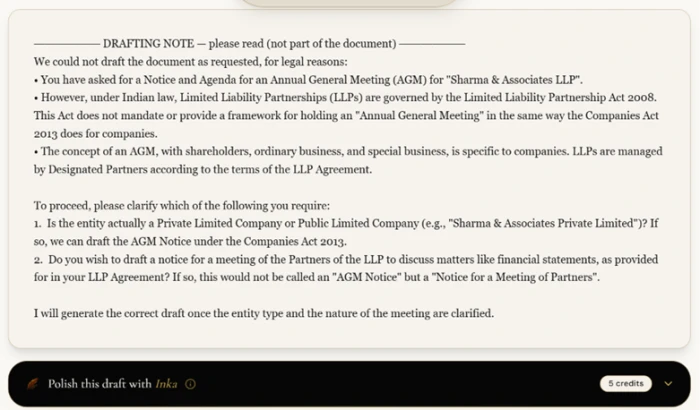
Inka had already named the applicable law as the LLP Act 2008 on the details screen, then asked me for registration particulars and meeting details before declining at the final step. I filled in fields for a document it was never going to produce.
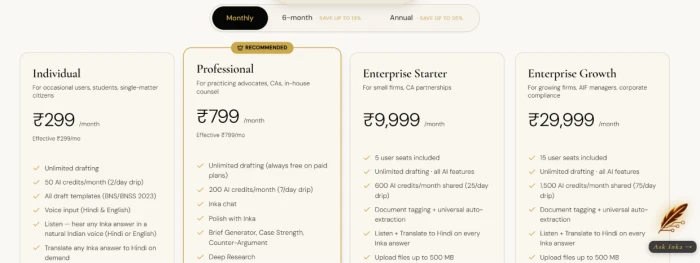
LegalInk AI pricing
Figures taken from the official LegalInk pricing page.
| Plan | Price | What's included |
|---|---|---|
| Free | ₹0 | 3 drafts/month · 30 AI credits/month (1/day drip) · Inka chat & quick research · Hindi & English voice · sensitive case protection |
| Individual | ₹299 /mo | Unlimited drafting · 50 credits/month (2/day) · all templates · export to Docs/PDF/Word · 10 MB uploads · Quick Minutes |
| Professional Recommended | ₹799 /mo | Unlimited drafting · 200 credits/month (7/day) · Inka chat · Brief Generator, Case Strength, Counter-Argument · Deep Research · 200 MB uploads · statutory freshness tracking |
| Enterprise Starter | ₹9,999 /mo | 5 seats · 600 credits/month shared (25/day) · letterhead, audit log, team library · centralised GST billing · onboarding session |
| Enterprise Growth | ₹29,999 /mo | 15 seats · 1,500 credits/month shared (75/day) · per-matter analytics · custom template library · quarterly business review |
Pros & cons
Specific conclusions from hands-on testing and the tool's documented behaviour.
✅ Pros
- Refuses to invent section numbers or case citations it cannot verify
- Corrects repealed IPC and Evidence Act sections to their BNS/BSA replacements
- Grades each authority as verified, ungrounded or refused, on the draft
- Case Strength gives a blunt Weak verdict instead of flattering your position
- Drafting is unlimited and free on every paid plan
- Inka runs inside Claude.ai, ChatGPT and WhatsApp via connector
- Native Hindi and English voice input across all tiers
⛔ Cons
- Refusals fire late: it collected LLP form data before declining to draft
- A raw sup data-legacy-citation HTML tag leaked into a rendered reply
- Heavy tools drain credits fast (Contract Review costs 25 each)
- India-only: no use outside BNS/BNSS/BSA jurisdiction
- No independent third-party reviews or public track record yet
- Narrow precedents still surface imperfect case matches, by design
Based on hands-on testing against official bare acts and Indian Kanoon, plus the platform's published behaviour · paraphrased, not quoted
LegalInk AI scorecard
Rated against what an Indian legal drafting and research tool is actually built to do.
| Dimension | Verdict | Score |
|---|---|---|
| Citation accuracy & verification Verified against primary records | Excellent |
9.0
|
| Currency with 2023-24 law BNS, BNSS and BSA vs repealed codes | Excellent |
9.0
|
| Hallucination resistance Refusing fake sections and cases | Excellent |
8.5
|
| Drafting quality & templates Court format and compliance clauses | Good |
8.0
|
| Indian-law depth & coverage Statutes, codes and industry baselines | Good |
8.0
|
| Reasoning & case analysis Strength verdicts and precedent synthesis | Good |
7.5
|
| Value vs credit system Cost of real research usage | Average |
6.5
|
| UX & workflow polish Late refusals, rendering bugs | Average |
6.0
|
| Free tier usefulness 3 drafts and 30 credits a month | Average |
5.5
|
| Track record & transparency Independent reviews and history | Average |
6.0
|
| Scrutool Score Equal-weight average of all 10 dimensions |
7.4
|
What users say about LegalInk AI
LegalInk is new and has little independent review coverage yet, so this reflects early professional feedback and directory listings rather than a large review base.
Early sentiment drawn from directory listings (openPR, Stanford Tech Index), the vendor's professional testimonials and hands-on testing · LegalInk has no Trustpilot, G2 or app-store review base yet · percentages are estimates
The rare legal AI that would rather refuse than lie to you
LegalInk earns its score on the one thing Indian legal AI keeps getting wrong. Across a session built to trap it, Inka refused a fake BNS section, corrected a repealed IPC reference to BNS Section 318(4), cited the 2023 evidence code correctly, flagged its own missing citation on a narrow question, and still recognised Kesavananda Bharati without a false alarm. That is a genuinely different posture from tools that confidently invent law. The weaknesses are real but smaller: a refusal that arrived after data entry, a raw HTML tag in one reply, a credit system that empties faster than you expect, and no independent track record yet because the product is new. Advocates, CAs and in-house counsel drafting under the new codes will find the verification worth the ₹799 a month. Anyone outside Indian jurisdiction, or hoping to run serious research on the free tier, should look elsewhere.
Discussion
Join the discussion and share your perspective.