
Manus AI
An autonomous agent from Butterfly Effect that plans, browses and executes whole tasks in a cloud VM. Strong output, unpredictable credit meter.

An agent that genuinely finishes multi-step work and shows you every command, wrapped in a credit meter that charges the same whether the answer was right or wrong.
Should you use Manus?
Researchers and operators who hand over whole tasks rather than asking questions, and who want to see the commands that produced the answer.
You need a predictable monthly bill . Credits are deducted whether the run succeeds or fails, and nothing estimates the cost first.
Free covers Manus 1.6 Lite properly. The full models start at $20 a month for 4,000 credits, with $40 and $200 tiers above it.
It blends retrieved text with background knowledge and presents both as sourced. Attributions need checking line by line.
What is Manus?
The difference between Manus and the chat window you already have is that Manus goes and does the thing. Hand it a research question and it writes a plan, opens a cloud virtual machine, browses pages, runs code and returns a finished artifact: a table, a deck, a website, a report. A side panel streams the commands while they execute, so the work is visible rather than hidden behind a spinner.
Butterfly Effect, the Singapore company behind it, sells access in credits rather than seats. A free account gets Chat Mode plus Manus 1.6 Lite in Agent Mode, 1,000 credits at signup and 300 more every 24 hours, one task at a time and two scheduled tasks. The stronger 1.6 and 1.6 Max models are paid only, so everything a free account produces comes from the smallest model in the range. It runs in a browser, on desktop, on mobile, and inside Slack and Telegram.
Key features & how they perform
Each feature rated from hands-on testing and aggregated review sentiment.
Conditional logic across long lists
Give it a branching rule over ten products and it applies the branch per item instead of flattening everything into one answer shape.
Agent Mode with live execution
A cloud VM browses, writes files and runs code while a side pane streams each command, so a wrong turn is visible while it happens.
Scheduled recurring tasks
Two slots on the free plan run workflows on a repeating timer, with approval gates that pause for confirmation rather than acting alone.
Sourced research output
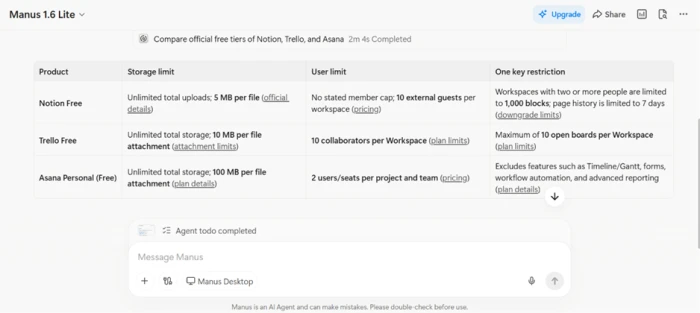
Tables arrive with links embedded per cell, pointing at vendor documentation. The links hold up better than the attributions around them.
Browser operator & connectors
Gmail, Calendar, Drive, Notion, GitHub and Slack connect natively. Everything else routes through a browser that breaks when sites change.
Credit metering
The post-run breakdown is detailed and honest. What is missing is any estimate before you commit, and any relief when a run fails.
Feature ratings blended from Trustpilot, G2, Reddit & Product Hunt review patterns + hands-on testing.
What 1,130 free credits actually bought in Manus
Two research tasks, a conditional-logic stress test, a scheduled run and a paywall check. Free plan, Manus 1.6 Lite, no card entered.
Start on the free plan and check what you actually have
The free plan is not a demo stub. It carries Chat Mode along with Manus 1.6 Lite in Agent Mode, one concurrent task and two scheduled tasks.
Credits are the unit that matters. Manus grants 1,000 at registration and refreshes 300 every 24 hours, and those daily credits work only with 1.6 Lite.
That constraint frames everything below. Manus 1.6 and 1.6 Max sit behind the paid tier, so none of this should be read as a verdict on them.
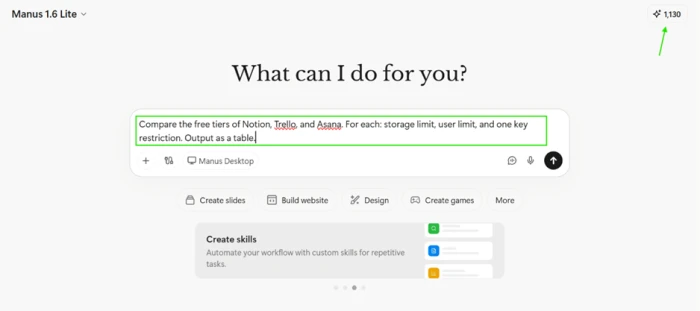
Give it a research task with a required output format
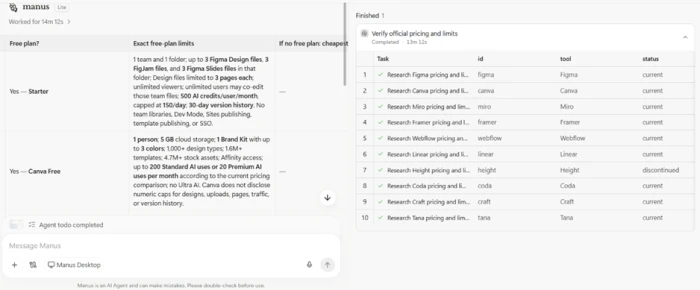
The opening task asked it to compare the free tiers of three project management tools and return the answer as a table.
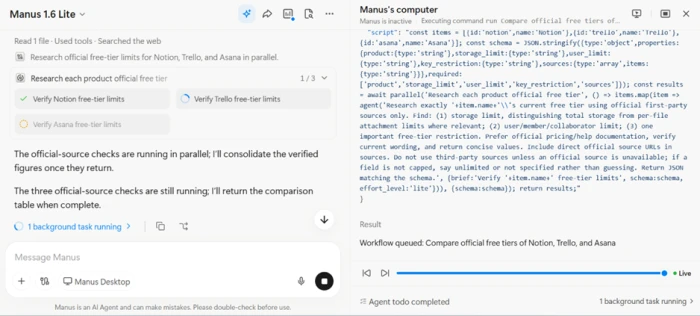
Manus broke the job into separate verification steps and ran them in parallel, showing progress in a side panel it calls Manus's computer.
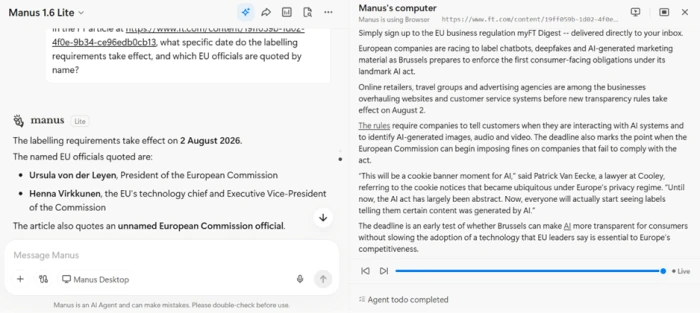
The right-hand pane streams the actual commands as they execute, so you can watch the reasoning rather than stare at a spinner.
The finished output is the part that counts, and this one arrived with its working attached.
Hand it a branching instruction across ten products
The second prompt was designed to break it. Ten products, and a conditional: list exact free-plan limits where a free plan exists, otherwise give the cheapest paid tier plus whether a trial is offered.
Conditional logic across a long list is where agents usually fail. They flatten the instruction and answer one branch for every item, then present the uniformity as thoroughness.
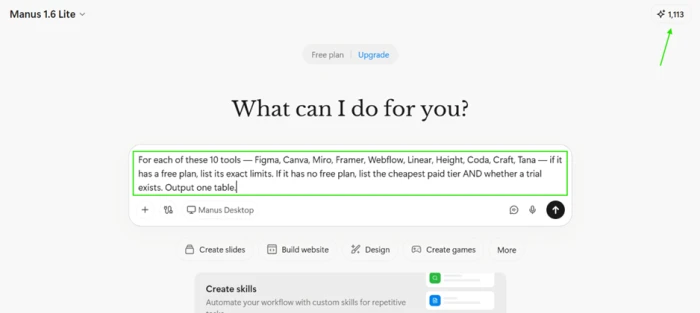
Verification status for all ten products stayed visible in the right-hand pane while the run continued.
Read the credit meter afterwards
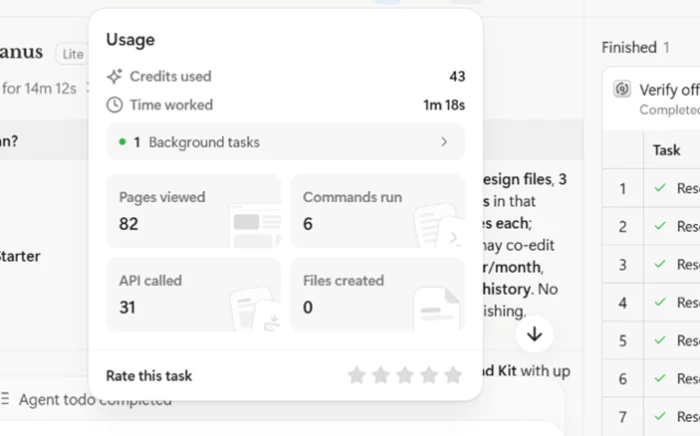
Manus says three things drive credit cost: LLM tokens for planning and output, virtual machine time for browsing and code execution, and third-party API calls.
Reviews circulating through 2026 put deep research at 500 to 900 credits per run. That is a figure worth measuring rather than repeating.
My balance moved from 1,130 to 1,113 after the first task, then to 1,070 after the second. That works out to 17 credits and 43 credits.
Leave a scheduled task running
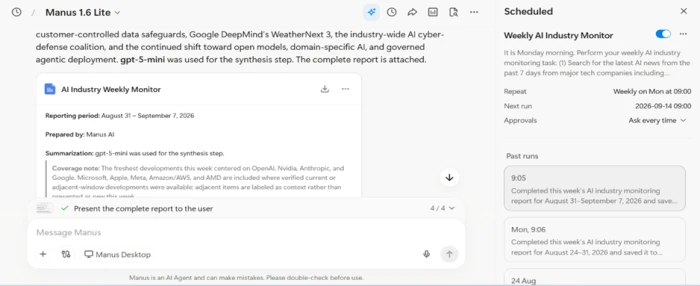
Multiple reviews state flatly that Manus cannot run recurring workflows. The help centre says otherwise, listing two scheduled tasks on the free plan.
Mine is a weekly AI industry monitor set to sweep the previous seven days.
The feature is gated rather than autonomous. Approvals are set to ask every time, so it pauses for confirmation instead of acting alone.
Point it at a paywalled article
The last test asked for a summary of the latest Financial Times article on EU AI regulation, with an instruction to cite the URL it used.
Paywalls are the honest limit of any browsing agent. What matters is whether the tool tells you it hit one.
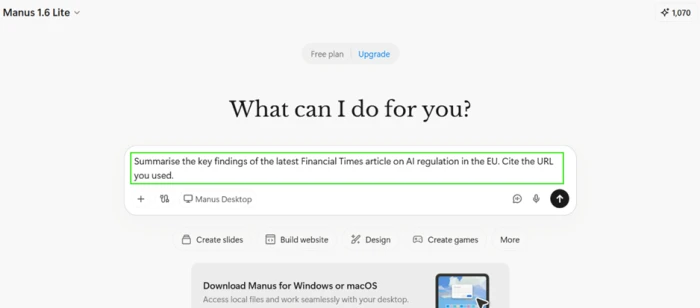
The link it returned was genuine. Opening that exact URL in an incognito window from my own browser gave me the subscribe wall and nothing else.

So I asked a follow-up question that only the article body could answer: the effective date for the labeling requirements, and the EU officials quoted by name.
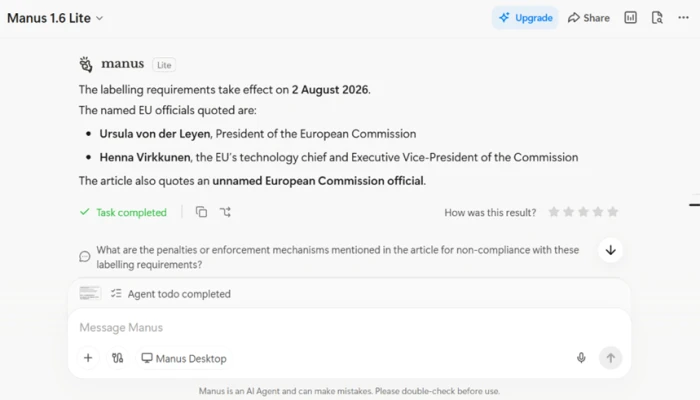
It answered with 2 August 2026 and named two officials, then added that the piece also quotes an unnamed European Commission official. That is a claim about the internal structure of the article, not something inferable from a headline. The browser pane settled the question: it shows the canonical ft.com URL loaded with the full article body rendering, including a quoted lawyer from Cooley that appears nowhere in the free preview.
Check the attributions before you use anything
The same answer carries an error that matters more than the retrieval question does.
Ursula von der Leyen is not quoted in that article. The piece describes her position on AI adoption, but it carries no quotation from her. Manus listed her under officials quoted by name, which is wrong.
It also attached job titles to both officials that the article never states.
Manus pricing
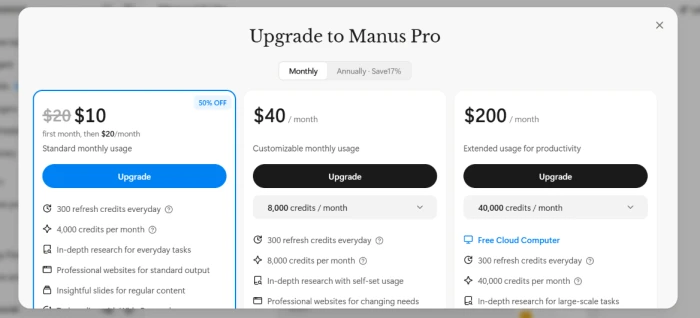
Figures taken from the in-app upgrade panel, checked on 7 September 2026 against the Manus help centre.
| Plan | Price | What's included |
|---|---|---|
| Free | $0 | Chat Mode + Manus 1.6 Lite · 1,000 signup credits · 300 daily refresh · 1 concurrent task · 2 scheduled tasks |
| Pro Standard 50% first month | $20 /mo | $10 first month, then $20 · 4,000 monthly credits · 300 daily refresh · Manus 1.6, 1.6 Max and Lite · in-depth research, websites and slides |
| Pro Customizable | $40 /mo | 8,000 monthly credits with a self-set usage dial · 300 daily refresh · research and websites for changing workloads |
| Pro Extended | $200 /mo | 40,000 monthly credits · free Cloud Computer · 300 daily refresh · large-scale research runs |
Pros & cons
Specific conclusions from testing and real user reviews, not generic filler.
✅ Pros
- Runs inside a cloud VM, so it executes code rather than describing it
- Wide Research fans one request across many parallel sub-agents
- Connectors cover Gmail, Calendar, Drive, Notion, GitHub and Slack
- Agents run inside Telegram on every tier since February 2026
- Desktop app adds local file access alongside the cloud sandbox
- Model-agnostic orchestration routes tasks to whichever frontier model fits
- Failed tasks caused by Manus infrastructure qualify for a credit refund
- Finished outputs stay stored and deployed without consuming further credits
⛔ Cons
- No cost estimate appears before a run, so budgeting stays guesswork
- Users report entire monthly allocations vanishing in minutes on Agent Mode
- Connector list omits Salesforce, HubSpot and spreadsheet workflows entirely
- Anything outside those connectors goes through a browser that breaks on UI changes
- No published SOC 2 or ISO 27001 for a tool handling live credentials
- Refund requests reportedly meet automated replies on Trustpilot and G2
- Data created after December 2025 was deleted during the Meta unwind
- Website builder provides no clean export, keeping output inside the platform
- Long runs hit high service load errors often enough to affect deadlines
Synthesized from real reviews on Trustpilot, G2, Reddit & Product Hunt, plus Manus help centre documentation · paraphrased, not quoted
Manus scorecard
Rated against what an autonomous task agent is actually built to do.
| Dimension | Verdict | Score |
|---|---|---|
| Instruction following & conditional logic Branching rules across many items | Excellent |
9.0
|
| Execution transparency Visible plan, live commands, usage breakdown | Good |
8.0
|
| Task speed Time from prompt to finished artifact | Good |
8.0
|
| Free tier usefulness What a no-card account can finish | Good |
7.5
|
| Automation & scheduling Recurring runs, connectors, approval gates | Good |
7.5
|
| Research accuracy & sourcing Whether claims match the cited source | Average |
6.5
|
| Credit efficiency & predictability Cost per run and ability to forecast it | Average |
5.5
|
| Model access on the free tier Which engines a free account can reach | Weak |
5.0
|
| Trust & data continuity Certifications, ownership, data retention | Weak |
4.0
|
| Billing, refunds & plan clarity Renewal terms, rollover, dispute record | Weak |
3.5
|
| Scrutool Score Equal-weight average of all 10 dimensions |
6.5
|
What users say about Manus
The themes reviewers raise most often, by share of analysed reviews.
% = share of analysed reviews mentioning each theme (Trustpilot, G2, Reddit, Product Hunt)
The work is real, the meter runs either way, and the attributions need checking
Manus does the thing most agents only claim to do. It took a branching instruction across ten products and applied the branch per item instead of flattening it, returned a comparison table in just over two minutes with vendor documentation linked inside the cells, and ran a scheduled weekly task on a free account that several published reviews insist is impossible. Watching the commands execute in the side pane is worth more than any confidence score. The problems sit on either side of that competence. It blends retrieved text with background knowledge and presents both as sourced, which produced a named official who is not quoted in the article at all, and job titles the piece never states. Around the product, credits are deducted whether a run works or not, nothing estimates the cost before you commit, monthly credits expire unused, and the Meta acquisition unwind in August 2026 forced deletion of data created after December 2025 before independent operation resumed on 1 September. Researchers and operators who verify output and can absorb a variable bill will get real work out of this. Anyone who needs a fixed monthly cost, or who intends to publish what it returns without checking every attribution, should stay away.
Discussion
Join the discussion and share your perspective.