
Replit AI
Replit turns a plain-English prompt into a running, deployable full-stack app with a database, auth and 100+ integrations built in. Fast, but effort-based billing is the catch.

A plain-English prompt becomes a working, deployable app in minutes, backed by a real database, auth and 100+ integrations. Effort-based billing and prototype-grade polish are the catch.
Should you use Replit?
Founders, PMs and non-coders who want a working prototype or internal tool fast, and who will set a hard spending cap.
You need a polished production UI out of the box, or a predictable monthly bill. Effort-based charges can spike without warning.
Free gives daily agent credits and 1 published app. Real use runs on Core at $20/mo , and credits drain even on failed or looping tasks.
Headline features (Plan Mode, high-power models) are paid , so free-tier output runs on weaker models than the demos show.
What is Replit?
Replit turns a sentence into a running app. You describe what you want in plain English, and the Replit Agent writes the code, spins up a database, wires in authentication, and deploys the result to a live replit.app address, all without you opening a file. It targets founders, product managers, designers and non-coders who want a working prototype or internal tool in minutes rather than a repo to maintain.
What defines Replit is the economics. It runs in the browser on a credit system, and AI work is billed by effort, so one prompt can cost anything from a few cents to several dollars depending on how hard the Agent works, including when it loops or fails. Free Mode covers brainstorming and light builds, but the models and features Replit demos sit on paid plans. The result is fast and capable, and genuinely hard to budget.
Key features & how they perform
Each feature rated from hands-on testing and aggregated review sentiment.
Replit Agent
Turns a plain-English prompt into a running full-stack app in minutes, with code, a database and hosting all handled for you.
Instant deployment
One click publishes to a live replit.app URL, with password or invite-only access available even on the free plan.
100+ integrations
One-click connectors for Stripe, OpenAI, Gmail and more, so payments or sign-in are an authorization step away rather than a setup project.
Built-in database & auth
Provisions a database, authentication and monitoring with no setup, and Pro keeps up to 28 days of database rollback.
Code diff & review
Every agent edit opens as a side-by-side diff you approve, though the flow keeps nudging you to prompt rather than type in the file yourself.
Plan Mode & parallel agents
Review-before-build planning and up to 10 parallel agents speed complex work, but both sit on paid plans only.
Feature ratings blended from G2, Trustpilot, Reddit & Product Hunt review patterns + hands-on testing.
Building a freelance invoice tracker on Replit's free plan
One real app, start to finish, on free credits: from the signup wall to a live dashboard and the paywall sitting behind the demos.
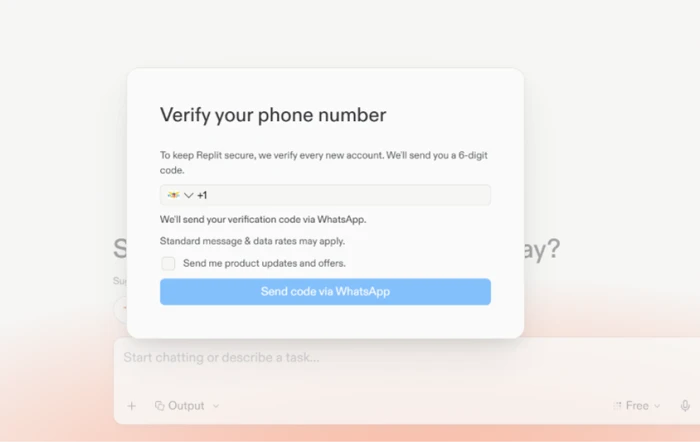
Signing up stops at phone verification
Before I could type a single prompt, Replit stopped me at a phone verification screen. There was no skip button, and the only delivery method on offer was WhatsApp.
This matters more for a US audience than it first looks. WhatsApp is not the default texting app for most people in the States, so a WhatsApp-only code becomes a wall you hit before you have seen the product at all.
The first prompt, and an upsell before the app
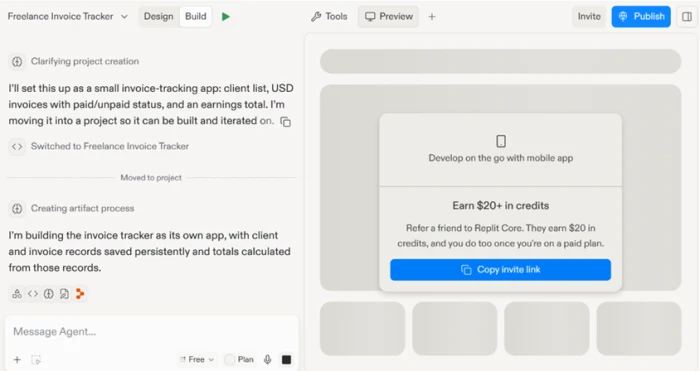
My prompt was plain English. Replit read it back to me, confirmed its plan, and moved the work into a project.
While it built, the preview pane did not show the app taking shape. It showed a card offering $20 in credits for referring a friend.
"a freelance invoice tracker where I could add clients, create invoices in USD, mark them paid or unpaid, and see total earnings"
What eight minutes produced
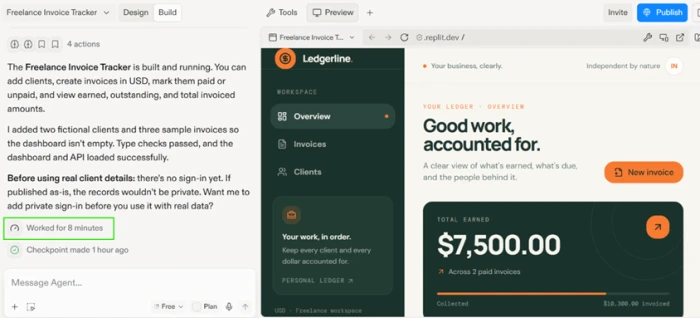
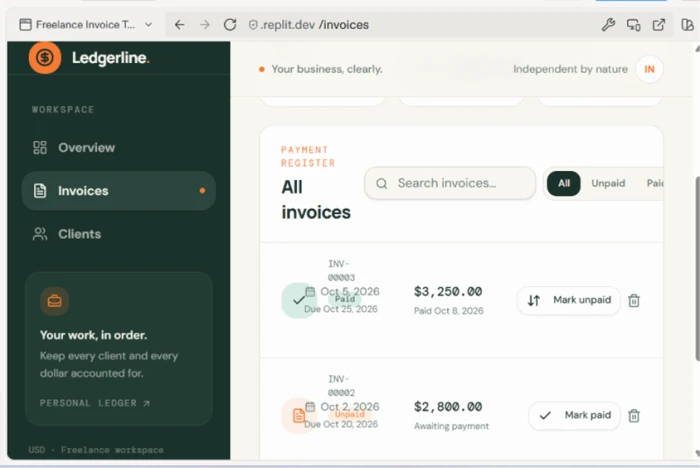
Eight minutes later I had a running app. Replit named it "Ledgerline" on its own, built a dark dashboard, and seeded it with two fictional clients plus a handful of sample invoices so the screen was not blank. The headline figure read $7,500 earned across two paid invoices.
Editing works, tidying up does not
I asked the agent to add a date filter to the invoice list. It added "Issued From" and "Issued To" date pickers, and they worked.
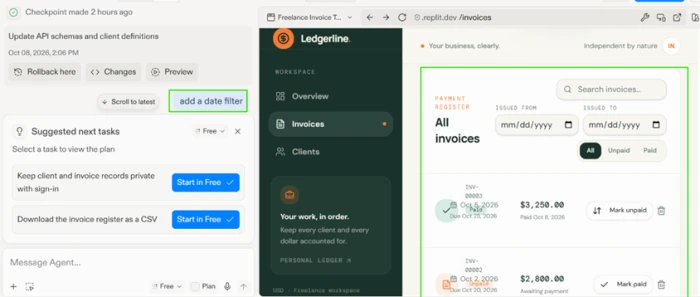
The feature landed, but the page got more crowded. The two date fields now sit beside the search box and the status tabs, all fighting over the same narrow strip, and the records themselves expose the limits of a one-shot build.
The code sits behind a review flow
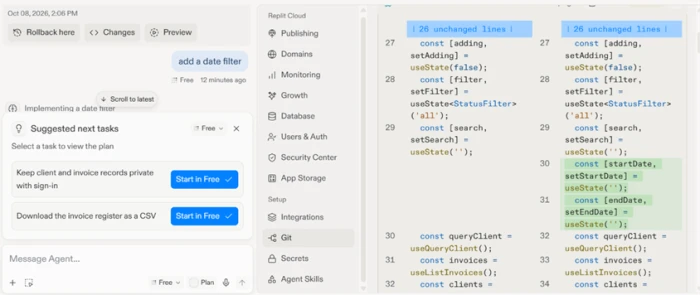
I expected the code to be hidden, given how hard the interface points you at the preview and the chat. It turned out to be reachable. Clicking "Changes" on a checkpoint opened a side-by-side diff of exactly what the agent had written, with the new date-range state highlighted in green.
The platform underneath
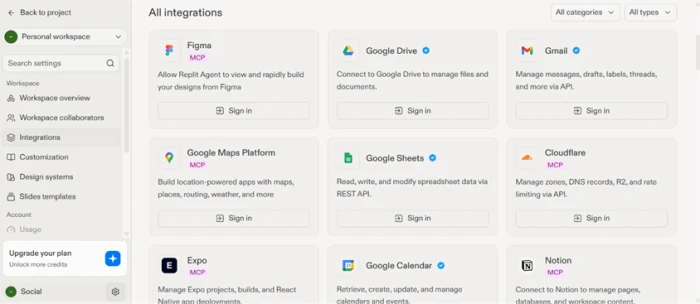
Replit is selling more than a code generator, and the integrations panel is where that shows. It lists over a hundred one-click connectors, with sign-ins for Stripe, Gmail, Notion and Cloudflare all a click away.
Publishing is free, with real privacy controls
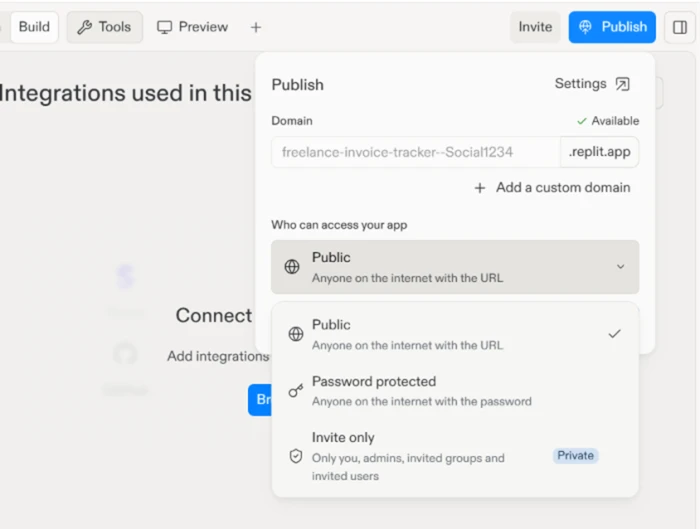
Going live did not cost me anything, and the publish dialog handed me more control than I expected on a free plan. The app gets its own replit.app address, and access is not forced wide open.
The paywall covers the headline features
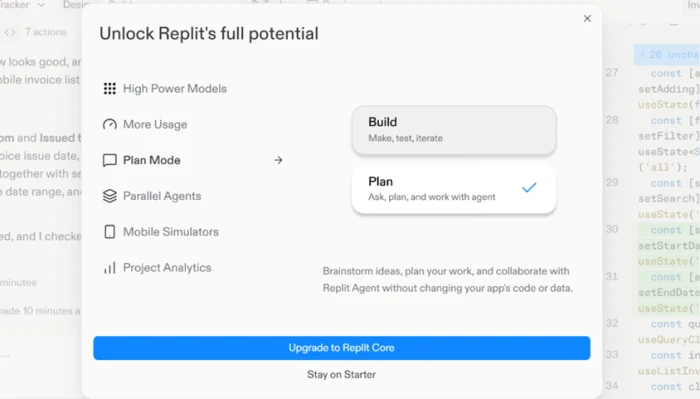
The part that reframed the whole test came when I hit the upgrade modal. Several of the features Replit leads with in its own marketing are locked on the free plan.
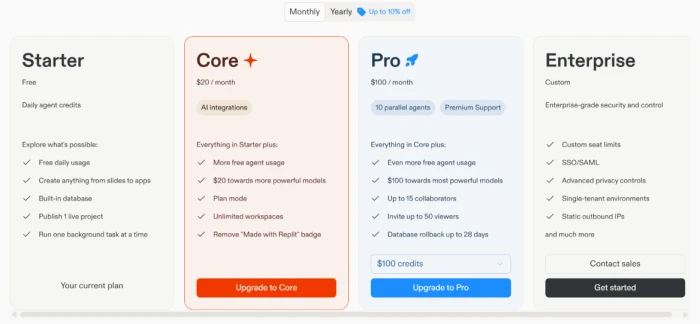
Replit pricing
Figures taken from the official Replit pricing page.
| Plan | Price | What's included |
|---|---|---|
| Starter | $0 | Daily agent credits · built-in database · publish 1 live project · 1 background task · "Made with Replit" badge |
| Core Popular | $20 /mo | Everything in Starter · more agent usage · $20 toward powerful models · Plan Mode · unlimited workspaces · badge removed |
| Pro | $100 /mo | Everything in Core · $100 toward top models · 10 parallel agents · up to 15 collaborators · 50 viewers · 28-day database rollback |
| Enterprise | Custom | SSO/SAML · custom seat limits · advanced privacy controls · single-tenant environments · static outbound IPs |
Pros & cons
Specific conclusions from testing and real user reviews, not generic filler.
✅ Pros
- Builds a running full-stack app from one plain-English prompt in minutes
- Provisions a database, authentication and hosting with no manual setup
- 100+ one-click integrations put Stripe, OpenAI and Gmail an authorization away
- Agent proactively flags gaps, like missing sign-in before you add real data
- Every agent edit opens as a reviewable side-by-side diff before you accept it
- Publishes to a live replit.app URL with password or invite-only access
⛔ Cons
- Output quality drops and new bugs appear as a project grows
- Agent claims tasks are complete when requirements remain unmet
- Generated UI ships with layout collisions and clipped elements
- Agent loops or stalls on tasks, producing nothing usable
- Support escalations reportedly take over a week to resolve
- Confusion across dev, preview and staging environments trips users up
Synthesized from real reviews on G2, Trustpilot, Reddit, Product Hunt & Capterra · paraphrased, not quoted
Replit scorecard
Rated against what an AI app-building platform is actually built to do.
| Dimension | Verdict | Score |
|---|---|---|
| Prompt-to-app speed Time from prompt to working app | Excellent |
8.5
|
| Built-in platform & integrations Database, auth, hosting, connectors | Excellent |
8.5
|
| App generation quality How solid the first build is | Good |
7.5
|
| Deployment & publishing Going live and access controls | Good |
7.5
|
| Code access & transparency Seeing and reviewing the code | Good |
7.0
|
| Editing & iteration Follow-up edits and cleanup | Average |
6.0
|
| Onboarding & access friction Signup and verification | Average |
5.5
|
| UI & layout polish Visual quality of generated screens | Average |
5.0
|
| Reliability & stability Loops, timeouts, environment issues | Average |
5.0
|
| Pricing transparency & value Predictability of effort-based billing | Average |
4.0
|
| Scrutool Score Equal-weight average of all 10 dimensions |
6.5
|
What users say about Replit
The themes reviewers raise most often, by share of analysed reviews.
% = share of analysed reviews mentioning each theme (G2, Trustpilot, Reddit, Product Hunt)
Fast and genuinely capable, as long as you watch the meter
Replit does the hard part convincingly. A sentence of plain English becomes a running, deployable app with a database, authentication and a hundred integrations behind it, and the Agent occasionally shows real judgment, like flagging a missing sign-in before you add real client data. The problems are just as consistent. The generated UI is prototype-grade, with collisions and clipped elements the moment you look closely, quality slides as projects grow, and the billing is the real hazard: effort-based charges that spike without warning and drain on tasks that fail. Founders, PMs and non-coders who want a fast prototype or internal tool, and who set a hard spending cap, will get real value here. Anyone who needs production polish or a predictable monthly bill should treat Replit as a prototyping tool, not a destination.
Discussion
Join the discussion and share your perspective.