
Scribbr AI
Scribbr is an academic writing suite offering plagiarism checking, AI detection, citation generation and human proofreading. Strong on the paid side, capped and inconsistent on the free tools.

A genuinely strong plagiarism check and human editing service, wrapped around free AI tools that are capped, ad-supported and shakier than the brand suggests.
Should you use Scribbr?
Thesis and dissertation writers who want one professional similarity report before submission, plus a citation generator that handles APA, MLA and Chicago without a login.
You need an AI detector you can act on . Independent benchmarks put its false positive rate near one in eleven human texts, and Scribbr's own disclaimer tells you not to rely on it.
Free covers detection and citations. A real plagiarism report starts at $19.95 per document , and human editing runs from $161 for 8,000 words plus a $25 setup fee.
Plagiarism checks are per document, not a subscription , and Scribbr states it will not refund people who assumed otherwise.
What is Scribbr?
Almost every Scribbr tool has a ceiling, and behind every ceiling sits a paid door. The AI detector takes 1,200 words per check but only claims average accuracy on older GPT models unless you buy a premium report. The paraphraser and the AI Humanizer stop at 125 words per input. The plagiarism checker runs free until it shows you a similarity indication, then charges per document to tell you what actually matched. Understanding that shape tells you more about the product than any feature list.
What sits on the paid side is legitimate. The plagiarism check compares your work against 99.3 billion webpages and 8 million publications, and submissions never enter a database another checker can search. Human editing comes from a pool of trained academic editors with turnarounds from 3 hours to 7 days. It is a browser-only service aimed at students writing theses, dissertations and papers, owned by Learneo, which also owns QuillBot and Turnitin. Several of the free tools are QuillBot running under Scribbr branding.
Key features & how they perform
Each feature rated from hands-on testing and aggregated review sentiment.
Plagiarism checker
Compares against 99.3 billion webpages and 8 million publications from 1,700 publishers, with a side-by-side view of every match and a self-plagiarism upload.
Human proofreading
Trained academic editors return tracked changes plus an improvement letter, with a 3 hour option for documents under 3,000 words.
Citation generator
Runs on the same open CSL engine as Zotero and Mendeley. Metadata pulls are usually clean, though source classification can send an entry to the wrong template.
Free AI detector
Unlimited checks with no account, split across AI-generated, AI-refined and human-written. Free coverage stops at GPT-3.5 and false positives are a documented problem.
Paraphraser & Humanizer
QuillBot's engine with Standard and Fluency modes and a click-to-swap thesaurus, hard capped at 125 words per input on both tools.
Knowledge Base
Over 300 free articles on citing, methodology and dissertation structure, plus editable Word and Google Docs templates and lecture slides.
Feature ratings blended from Trustpilot, Reddit, G2, Capterra & independent detector benchmarks + hands-on testing.
Putting five free Scribbr tools through deliberately awkward text
One logged-out browser session, no account, and inputs chosen to find the edges.
Running unedited machine text through the detector
The AI detector is the front door for most people who arrive at Scribbr. No signup, no card, unlimited checks, 1,200 words per submission.
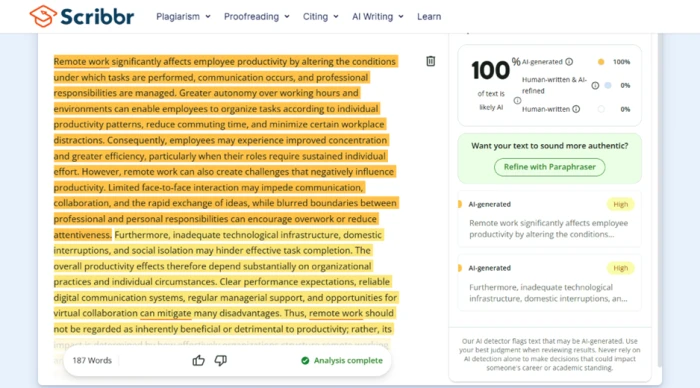
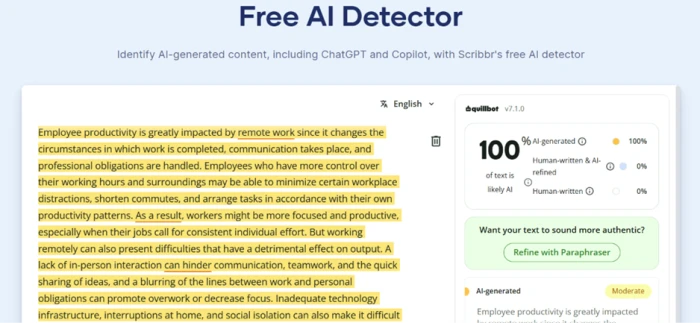
It splits its verdict three ways rather than giving a single number: AI-generated, human-written and AI-refined, with a confidence label on each flagged paragraph. The detector reported version 7.1.0 of QuillBot's engine during testing.
The first input was a 187-word paragraph on remote work and productivity, requested from a language model in a formal academic register and pasted in without a single edit.
The Humanizer round trip
The AI Humanizer advertises itself as stripping the telltale patterns out of machine writing. It sits two clicks from the detector, which makes the round trip an obvious thing to try.
The free version accepts 125 words. The same 187-word paragraph tripped the counter immediately and surfaced a prompt to buy premium alongside an Advanced Humanize button that hands you off to QuillBot.
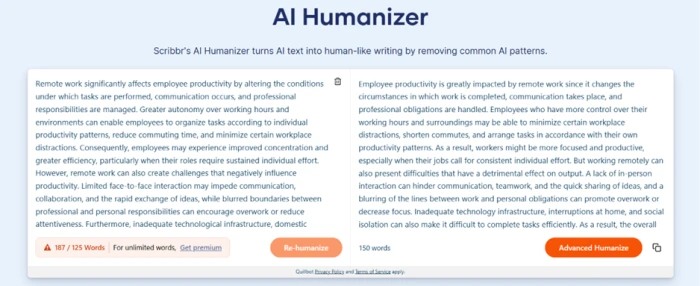
It humanized the paragraph anyway, returning 150 words against the 187 that went in. That output then went straight back into the detector.
Citing a deliberately awkward source in APA 7
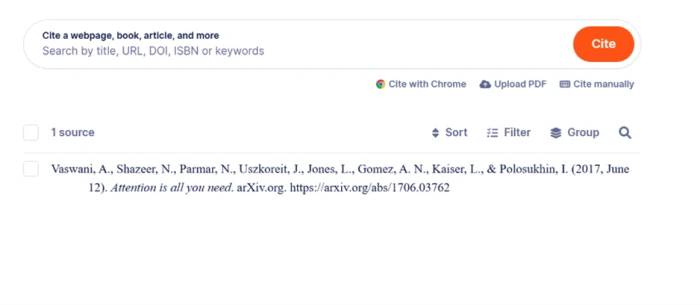
The citation generator takes a URL, DOI, ISBN or keyword and builds a reference list you can sort, group and export. It is built on the open Citation Style Language project, the same foundation Zotero and Mendeley use.
The test source was the 2017 arXiv preprint Attention Is All You Need. Eight authors, a title in title case, a seventh revision dated 2023, and a registered DOI separate from its public URL.
Every one of those is a place a generator can quietly go wrong.
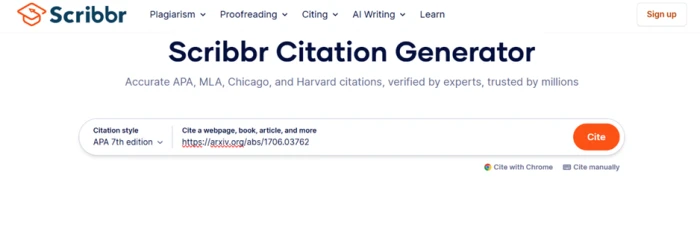
The reference came back in a couple of seconds and landed in a saved source list.
Paraphrasing clinical research language
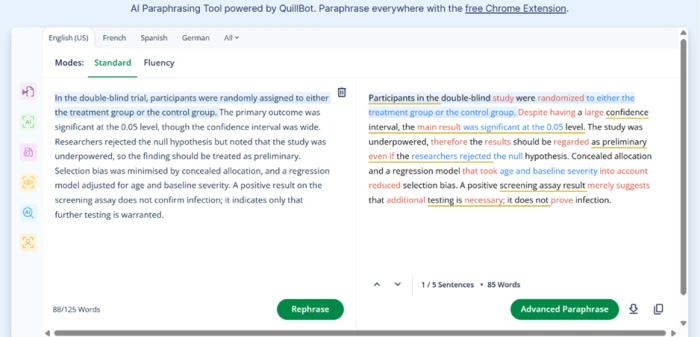
The paraphraser offers two free modes, Standard and Fluency, and highlights every segment it altered so you can see the diff without comparing by hand.
It shares the 125-word ceiling with the Humanizer, and the footer confirms QuillBot underneath.
The input was an 88-word passage written for this test in clinical research language, packed with terms that carry fixed technical meanings.
"In the double-blind trial, participants were randomly assigned to either the treatment group or the control group. The primary outcome was significant at the 0.05 level, though the confidence interval was wide. Researchers rejected the null hypothesis but noted that the study was underpowered, so the finding should be treated as preliminary. Selection bias was minimised by concealed allocation, and a regression model adjusted for age and baseline severity. A positive result on the screening assay does not confirm infection; it indicates only that further testing is warranted."
Two agreement errors in one sentence
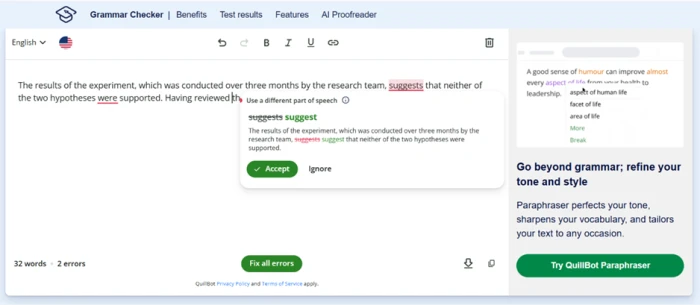
The grammar checker is the lightest tool in the set, built for fragments rather than whole documents. Anything longer is pushed toward the AI Proofreader, which takes .docx uploads only.
The test sentence carried two agreement errors at once: a subject-verb mismatch buried behind a long relative clause, and a neither-were construction.
"The results of the experiment, which was conducted over three months by the research team, suggests that neither of the two hypotheses were supported."
Scribbr pricing
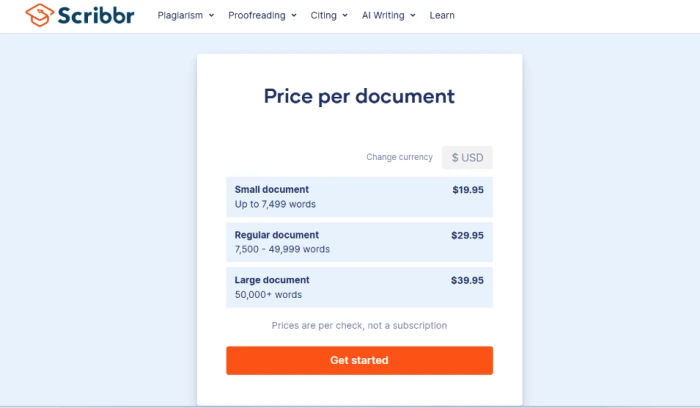
Figures taken from Scribbr's official plagiarism checker and proofreading rates pages.
| Service | Price | What's included |
|---|---|---|
| Free tools | $0 | AI detector (1,200 words per check, unlimited) · citation generator · grammar checker · paraphraser and Humanizer (125 words) · summarizer · ad supported |
| Plagiarism check, small Popular | $19.95 | Up to 7,499 words · full similarity percentage · complete source list · side-by-side comparison · AI Detector and AI Proofreader included |
| Plagiarism check, regular | $29.95 | 7,500 to 49,999 words · same report · private document upload for self-plagiarism · unlimited AI rechecks |
| Plagiarism check, large | $39.95 | 50,000+ words · same report · institutions buying more than 50 checks can request volume pricing by form |
| Human proofreading | from $161 /8k words | $161 at 7 days, $229 at 3 days, $297 at 24 hours, plus a $25 setup fee · tracked changes and improvement letter · Structure and Clarity Checks are add-ons |
| Editing add-ons | from $1.95 | Paper Formatting $1.95 per page per item · Citation Editing $2.75 per source · Citation Checker $9.95, waived with the AI Proofreader |
Pros & cons
Specific conclusions from testing and real user reviews, not generic filler.
✅ Pros
- Scans 99.3 billion webpages and 8 million publications from 1,700 publishers
- Your submissions never enter a database other checkers can search
- Citation generator runs on the same open CSL engine as Zotero and Mendeley
- Six citation styles built in, including AMA, IEEE and ACS
- Human editors return a marked-up document in as little as 3 hours
- Editors send an improvement letter naming your recurring mistakes
- Knowledge Base carries 300+ articles plus editable Word and Docs templates
- Private uploads let you catch self-plagiarism against your own earlier work
⛔ Cons
- Free AI detector claims only average accuracy on GPT-2, GPT-3 and GPT-3.5
- Independent benchmarks put false positives near one in eleven human texts
- Formal academic and ESL writing is the profile most often flagged wrongly
- Paraphraser and Humanizer stop dead at 125 words per input
- AI Proofreader accepts .docx only and corrects to US English conventions
- Detection engine belongs to QuillBot, so accuracy moves only when QuillBot ships
- Reviewers repeatedly report rushed edits that needed cleanup afterwards
- Citation generator users report failed source lookups and misfiled fields
Synthesized from real reviews on Trustpilot, Reddit, G2, Capterra & independent detector benchmarks · paraphrased, not quoted
Scribbr scorecard
Rated against what an academic writing and integrity suite is actually built to do.
| Dimension | Verdict | Score |
|---|---|---|
| Knowledge Base & resources Guides, templates, teaching material | Excellent |
9.0
|
| Human proofreading service Editor quality and turnaround | Excellent |
8.5
|
| Plagiarism detection depth Database reach and report usability | Good |
8.0
|
| Privacy & data handling Storage, deletion, third-party processing | Good |
8.0
|
| Grammar checker performance Error catching and explanation quality | Good |
7.5
|
| Citation generator accuracy Metadata capture and style compliance | Average |
6.5
|
| Free tier usefulness What you get without paying | Average |
6.5
|
| Value for money Per-document pricing against alternatives | Average |
6.0
|
| AI detection reliability False positives and model coverage | Weak |
5.0
|
| Paraphrasing accuracy Meaning preserved under rewriting | Weak |
5.0
|
| Scrutool Score Equal-weight average of all 10 dimensions |
7.0
|
What users say about Scribbr
The themes reviewers raise most often, by share of analysed reviews.
% = share of analysed reviews mentioning each theme (Trustpilot, Reddit, G2, Capterra, student forums)
A first-rate academic reference library bolted to AI tools you should not act on alone
Scribbr is two products sharing a logo. The paid half is good: a similarity report backed by 99.3 billion webpages and 8 million publications, private uploads for self-plagiarism, and human editors who send back an improvement letter rather than a marked-up file and nothing else. The 300 article Knowledge Base is better than most of what universities give students for free. The AI half is weaker than the brand implies. The detector called machine text correctly, then called the output of Scribbr's own Humanizer machine text too, and independent benchmarks put its false positive rate near one in eleven human passages. The paraphraser preserved every technical term in a clinical passage while quietly rewriting the relationships between them into a claim a reviewer would reject. Students writing a thesis who want one professional check before submission, and anyone who needs citations across six styles without a login, will get their money's worth. Anyone treating the AI score as evidence, or the paraphraser as a safe pass over technical writing, is using the wrong tool.
Discussion
Join the discussion and share your perspective.