
Shisho AI
Shisho AI is a web-based Indian law study platform with courses, a Legal Library, and a drafting bot. On the free tier the bot runs in demo mode with no model connected.

A well-built Indian law study platform wrapped around a drafting bot that, on the free tier we tested, runs in demo mode and writes nothing from your own facts.
Should you use Shisho AI?
Law students learning Indian procedure who want a structured course, a plain-language Legal Library, and a sense of how a senior marks up a draft.
You are a practising advocate needing real drafts from your facts. On the tier we tested, the bot writes from templates, not your matter.
Free and Basic (₹9) both cap the bot at 5 reviews and keep it on the trial. Unlimited drafting starts at Core, ₹499/mo .
On the free tier the bot runs in demo mode with no model connected , returning fixed template notes even when the input is gibberish.
What is Shisho AI?
The name is the pitch: a shisho is a master who marks up an apprentice's work and hands it back. Shisho AI applies that idea to Indian law, and it does three separate things. It runs two course tracks (Starter for foundations, Proficient for interim relief and commercial drafting), it hosts a Legal Library of Supreme Court and High Court judgments with bare acts cited in SCC form, and it offers a drafting assistant that is supposed to write pleadings from your facts and mark up drafts you paste in. It is web only, aimed at law students, aspiring lawyers and practising advocates, and it starts without a card.
The catch sits inside that third pillar. The homepage sells the bot as an AI legal mentor that drafts everything from a notice before suit to written arguments, but on the free tier we tested, the workspace openly states no model is connected and that it is running in demo mode. The courses and library are the parts that hold up. The bot, as it stands on the entry tiers, is a preview of a feature rather than the feature itself.
Key features & how they perform
Each feature rated from hands-on testing and what the official site documents.
Ask Shisho drafting
Meant to draft from your facts across ten document types. In demo mode it returned a generic civil plaint skeleton for a criminal bail request.
Draft review notes
Clause-level notes keyed to Indian authorities. The legal content is correct, but it fires on trigger words rather than reading the document.
Legal Library
Supreme Court and High Court judgments, bare acts and commentary, cited in SCC form and explained in plain language. Free tier gets a daily digest.
Starter & Proficient courses
Two tracks that end each module in a filing rather than a quiz, covering reading law, interim relief, commercial drafting and litigation strategy.
The Map
A stage-by-stage guide from advocate and forum through drafting, pleadings, trial and citations, linking each stage to the relevant tool.
Document coverage
On paper: plaints, written statements, bail applications under the BNSS, writ petitions under Articles 226 and 32, notices, and grounds of appeal.
Feature ratings from hands-on testing of the free tier plus the capabilities documented on the official Shisho AI site.
What happened when I put real drafts in front of Shisho
Three inputs through the free tier: a defective petition to review, a bail request to draft, and a block of gibberish to test the machinery.
The review returns pre-written notes
The review pane is meant to work like a senior marking up your draft: paste a document, set its type, and get notes in the margin tied to the clause and the Indian authority each one rests on.
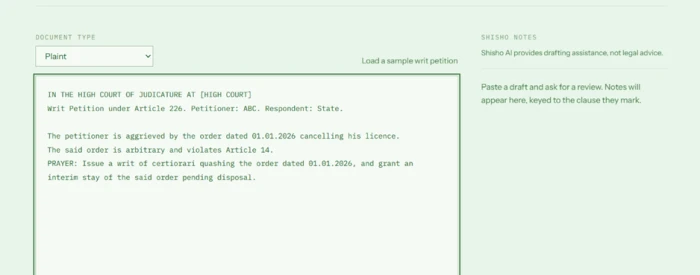
I fed it a deliberately broken writ petition skeleton set to "Plaint." The draft had no verification clause, never pleaded territorial jurisdiction, and asked for an interim stay without stating any grounds.
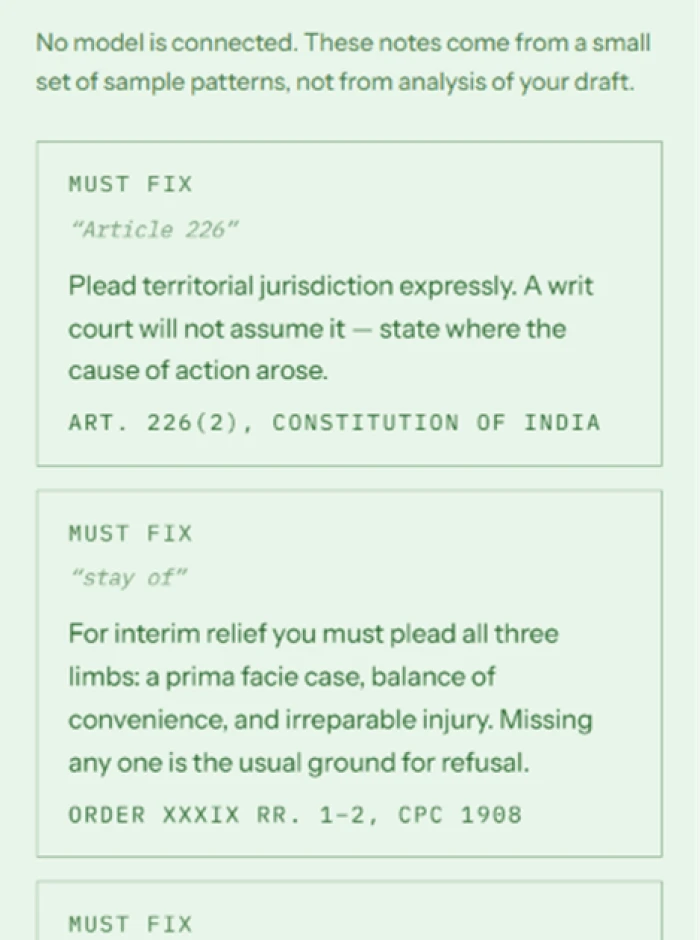
The notes that came back were legally sound. It flagged the absent territorial jurisdiction under Article 226(2), named the three limbs a court needs before granting interim relief, and caught the missing verification under Order VI Rule 15 CPC.
Then I read the line sitting above those notes, which admitted no model was connected and that the notes came from a small set of sample patterns rather than from analysis of my draft.
The drafting bot will not draft
Ask Shisho is the half of the product that is supposed to write a first draft from the facts you describe, with a picker covering legal notices, plaints, written statements, affidavits, bail applications and more.
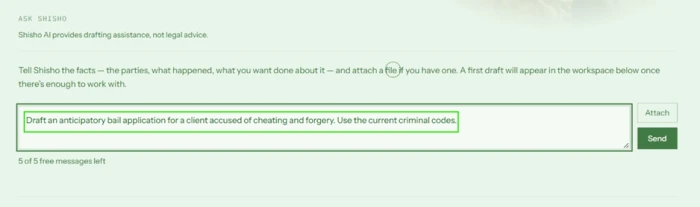
I gave it a precise instruction and watched the counter, which read five of five free messages.
"Draft an anticipatory bail application for a client accused of cheating and forgery. Use the current criminal codes."
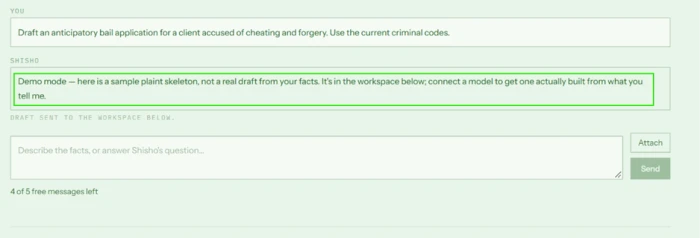
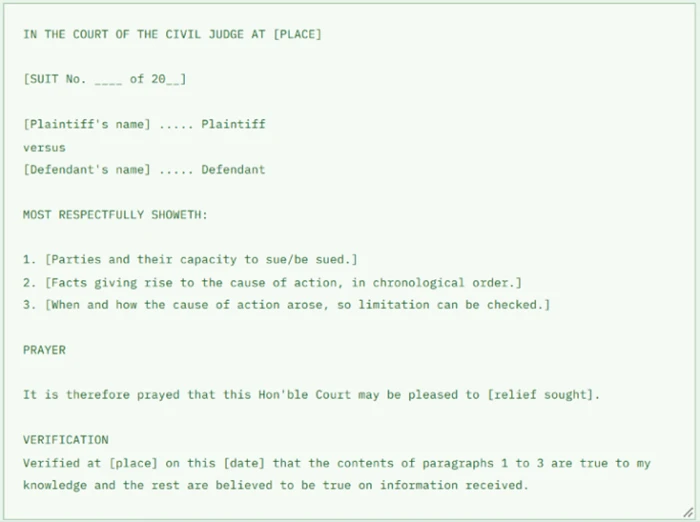
The reply told me exactly what I was working with. It called itself demo mode and offered a sample plaint skeleton in place of a draft from my facts, saying a model would have to be connected to build a real one.
The workspace then filled with a document, and it was not the one I asked for. It was a generic civil plaint skeleton with blank placeholders for the parties and facts, no bail application and nothing from the criminal codes.
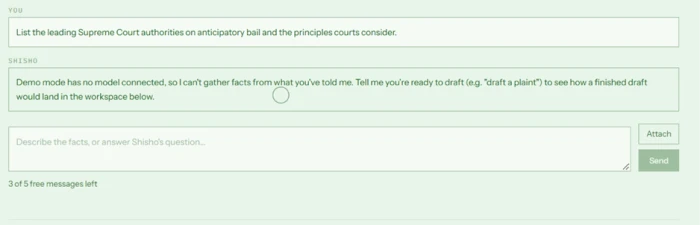
A second query tested legal research, asking for the leading Supreme Court authorities on anticipatory bail. It declined again, repeating that demo mode has no model connected and pointing me back to typing "draft a plaint."
Feeding it nonsense
One test settles how the review actually works. I pasted a block of pure gibberish, random letters with no legal content at all, and asked for notes.
If the review were reading the draft, gibberish should produce either nothing or an error. Instead it produced a formal note.
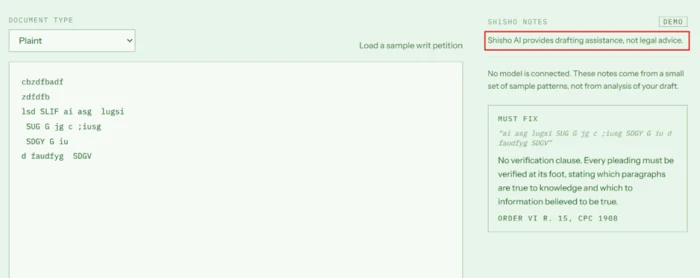
It returned a formal "MUST FIX" note about a missing verification clause under Order VI Rule 15 CPC. Nothing could be missing, because nothing had been pleaded, and the note even quoted my gibberish back as the clause it claimed to mark.
Shisho AI pricing
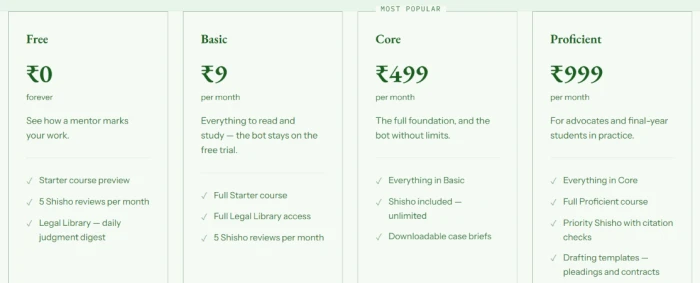
Figures taken from the official Shisho AI pricing page.
| Plan | Price | What's included |
|---|---|---|
| Free | ₹0 | Starter course preview · 5 Shisho reviews/month · Legal Library daily judgment digest |
| Basic | ₹9 /mo | Full Starter course · full Legal Library · still 5 reviews/month (bot stays on the free trial) |
| Core Popular | ₹499 /mo | Everything in Basic · unlimited Shisho reviews · downloadable case briefs |
| Proficient | ₹999 /mo | Everything in Core · full Proficient course · citation-checked review · drafting templates |
The four public plans on the Shisho pricing page. A standalone Shisho-only add-on runs ₹699/month.
Pros & cons
Drawn from the tool's documented scope and how it behaved under testing, not generic filler.
✅ Pros
- Judgments cited in SCC form and explained in plain language
- Courses end each module in a filing, not a multiple-choice quiz
- Openly labels demo mode instead of faking a live model
- Document scope covers BNSS bail, Article 226 and 32 writs, plaints
- The Map ties each litigation stage to the right tool and act
- Starts with no card and runs entirely in the browser
⛔ Cons
- Free-tier bot has no model connected, so it drafts nothing from your facts
- Review matches trigger phrases rather than reading the pasted draft
- Returned a civil plaint skeleton for a criminal bail request
- Flags a "MUST FIX" verification note even on pure gibberish input
- Legal research questions are declined outright in demo mode
- Citation checks, the guard against fake case law, sit only on the top plan
- No independent user reviews yet on any major platform
Based on hands-on testing of the free tier and the capabilities documented on the official Shisho AI site · no third-party review corpus exists yet
Shisho AI scorecard
Rated against what an Indian legal drafting and study tool is actually built to do.
| Dimension | Verdict | Score |
|---|---|---|
| Honesty & disclosure Being upfront about demo mode | Excellent |
8.5
|
| Legal content accuracy Correctness of the notes and references | Good |
8.0
|
| Course & Legal Library value Depth of study material | Good |
7.5
|
| Ease of use Signup, layout, workspace | Good |
7.5
|
| Document type coverage Breadth of pleadings supported | Good |
7.5
|
| Value vs paywall What each tier actually unlocks | Average |
6.0
|
| Trust for real filings Safe to rely on in court work | Weak |
4.5
|
| Document review depth Reading the draft vs matching keywords | Weak |
4.0
|
| Legal research Answering authority-based questions | Weak |
3.5
|
| Drafting from your facts Building a document from your matter | Weak |
3.0
|
| Scrutool Score Equal-weight average of all 10 dimensions |
6.0
|
What users say about Shisho AI
Shisho has no Trustpilot, G2 or app-store presence yet, so this reflects early testing signals and the wider trust concerns around Indian legal AI.
Signals estimated from hands-on testing and public reporting on Indian legal-AI reliability (including the Supreme Court's February 2026 warning on AI-drafted petitions citing fabricated cases) · no direct Shisho user reviews are published yet
A solid law-study platform shipping a drafting bot that is not switched on yet
Shisho AI gets the education right. The Legal Library, the two course tracks and the stage-by-stage Map form a genuinely useful way for an Indian law student to learn procedure, and the legal content the bot surfaces is accurate: correct sections, correct authorities, cited the way a court expects. The problem is the headline feature. On the free tier we tested, the drafting assistant runs in demo mode with no model connected, so it cannot write a document from your facts, it returned a civil plaint skeleton when asked for a criminal bail application, and its review fires the same template notes whether you paste a real petition or a block of gibberish. The tool is honest about this, and that honesty is worth crediting, but it also means the gap between the marketing and the product is wide. Students who mainly want the courses and the library will get real value, especially at ₹9 or ₹499. Practising advocates who need drafts they can file should wait until a live model is connected and, given the current climate around fabricated citations in Indian courts, verify every authority regardless.
Discussion
Join the discussion and share your perspective.