
Valant
Valant is a cloud EHR built only for behavioral health, with deep mental-health charting, rating scales and e-prescribing. Strong clinically, but let down by billing complaints, hidden pricing and hard-to-exit contracts.

A genuinely behavioral-health-first EHR with strong clinical templates and rating scales, dragged down by shaky billing, hidden pricing and contracts that are hard to leave.
Should you use Valant?
Psychiatry and group mental-health practices that live on rating scales, med management and standardized notes, and want an EHR built only for behavioral health.
You want published pricing and a free trial before you commit. Valant shows neither, and rivals like SimplePractice and TherapyNotes do both.
There is no price on the site. Third-party data puts it around $100 to $300 per provider a month , plus implementation fees, and only after a sales call.
Reviewers repeatedly flag billing glitches, slow support and contract lock-in , including an F rating and unaccredited status at the Better Business Bureau.
Key features & how they perform
Each feature rated from hands-on testing in the live demo and aggregated review sentiment.
Mental-health charts & measures
Charts open on F-code diagnoses with Measures and Screeners like PHQ-9 and GAD-7 built in. Most general EHRs make you assemble these yourself.
Documentation & ePrescribing
Narrative-generating notes, treatment plans and e-prescribing with PDMP lookups sit in one view. Reviewers rate it strongest for psychiatry and TMS.
Scheduling & multi-location
Color-coded calendar ran several providers across two offices cleanly. Solid, but a working calendar is table stakes for any EHR.
Outcome tracking & reporting
Scores from rating scales flow into per-patient trends and practice reports. Useful for groups that take measurement-based care seriously.
Integrated billing & claims
Billing lives inside the EHR, but it is the number-one complaint: glitches, claims hung up at insurers and codes that will not update without manual edits.
Records export & data exit
Printing a note to PDF is instant. Pulling your whole practice out at the end of a contract is a separate, much harder story in reviews.
Feature ratings blended from Capterra, G2, Software Advice, BBB & hands-on demo testing.
Judging Valant by its live demo, one screen at a time
I ran Valant inside its demo environment to see how the product behaves, not how the sales page describes it.
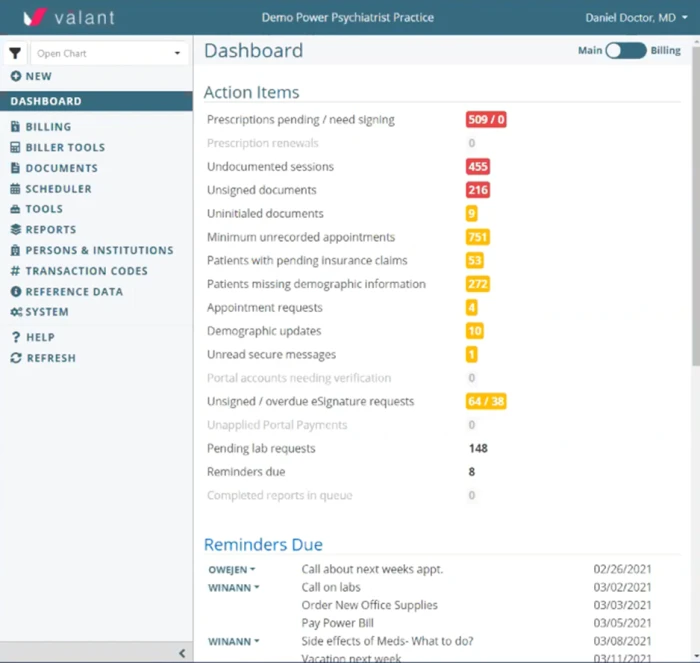
The dashboard: one queue for the whole practice
The first screen after login is a single action list that groups every piece of pending work by type. Prescriptions waiting for a signature sit at the top, then unsigned notes, then pending insurance claims.
A front-desk user can read the whole practice's open items off one screen without opening a separate module for each. The counts here belong to Valant's sample practice, so the red numbers are placeholders rather than a real backlog.
Opening a patient chart
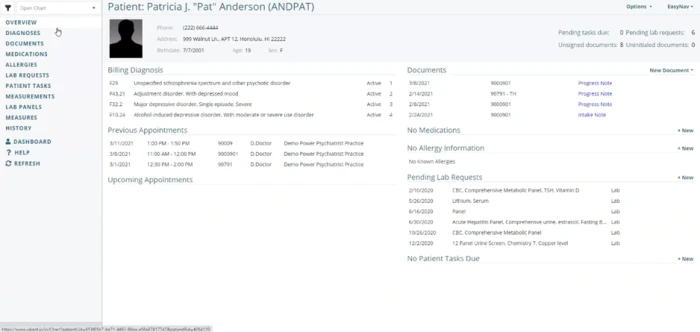
This is the screen that justifies the "built for behavioral health" label. The chart opens on billing diagnoses written in mental-health codes, with F29 for schizophrenia spectrum and F32.2 for severe depression sitting right at the top.
The left menu carries Measures and Screeners, the standardized rating scales mental-health clinicians use to track a patient over time. Most general-purpose EHRs make you build those yourself.
Scheduling across two locations
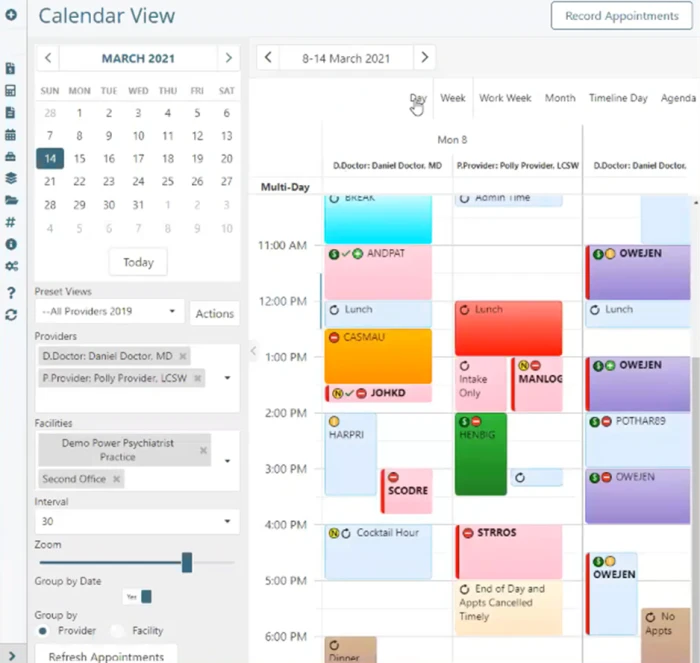
The calendar is color-coded by provider and ran several clinicians across two office locations without complaint. It is the kind of multi-provider view a growing group practice needs day one.
Getting records out as PDF
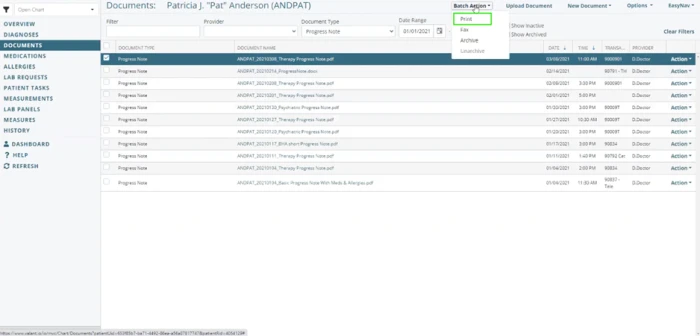
I picked a progress note, opened the Batch Action menu and chose Print. A PDF downloaded on the spot. The same menu will fax or archive the notes you select.
Pulling a patient's records out as PDF files is fast and does what you expect. Buyers should separate this from a full data migration, which is a different request worth putting to the sales team before you commit.
Checking the company record
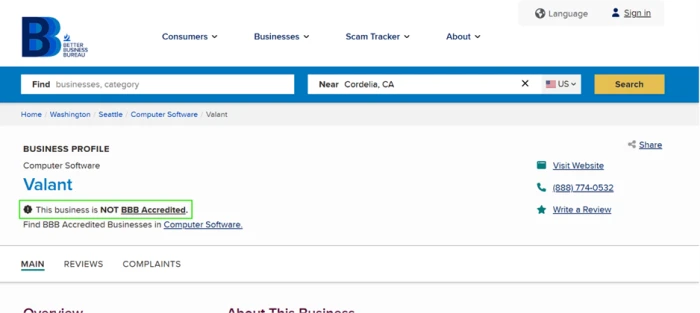
Before I recommend any health software, I look it up with the Better Business Bureau, a check US buyers tend to trust. Valant's BBB profile shows the company is not accredited.
On its own that means little, since BBB accreditation is optional and paid for. Read alongside the billing problems that surface again and again in verified user reviews, it is a detail worth weighing before you sign a contract.
Valant pricing
Valant publishes no prices. The structure below is taken from its official Plans & Pricing page; the dollar ranges are third-party estimates, not official figures.
| What drives the quote | Typical range | What it covers |
|---|---|---|
| Base license | Per provider /mo | Core EHR: scheduling, clinical documentation and billing, priced by the number and type of provider licenses |
| License type Varies | Role-based | Therapist, prescriber and supervisor seats are priced differently, so your mix of roles changes the quote |
| Add-ons | Extra | Patient engagement, intake automation, telehealth, advanced reporting and AI Notes Assist are optional paid modules |
| Implementation | One-time | Setup, data migration and training are quoted separately from the monthly license, by multiple third-party estimates |
| Est. street price | ~$100 to $300 /provider/mo | Range reported by independent EHR directories, not confirmed by Valant. No free trial and no free version |

Pricing structure is accurate as of 15 October 2026 and was captured from the official Valant website, which publishes no dollar figures. Plans and costs change often, so check the official Valant pricing page and request a quote for the current figures before you subscribe.
Pros & cons
Specific patterns from verified user reviews, not generic filler.
✅ Pros
- Built only for behavioral health, with every mental-health inventory imaginable
- PHQ-9, GAD-7 and other measures track each patient over time
- Reviewers rate it strongest for psychiatry, TMS and medication management
- Narrative note templates flow straight into signed progress notes
- E-prescribing with built-in PDMP controlled-substance lookups
- Group therapy tools: attendance, multi-participant telehealth, shared notes
- Long-tenured users report a decade-plus of stable daily use
⛔ Cons
- Billing is the top complaint: claims hung up at insurers, frequent glitches
- Billed codes will not update without manual edits on every change
- G2 ease-of-setup scores 5.2; onboarding called the worst part
- Support is inconsistent, with unanswered tickets and unreturned calls
- Patients report the portal redirecting them to the wrong practice
- Users say exiting the contract and moving data out is deliberately hard
Synthesized from verified reviews on Capterra, G2, Software Advice, Trustpilot & the BBB · paraphrased, not quoted
Valant alternatives
How Valant lines up against the behavioral-health EHRs buyers cross-shop it with. Figures are from each vendor's public information.
| ValantReviewed | SimplePractice | TherapyNotes | TheraNest | Tebra | |
|---|---|---|---|---|---|
| Public pricing | None, quote only | Published, from ~$29/mo | Published, from ~$49/mo | Published, by client count | Not public, quote based |
| Free trial | No, demo call only | Yes, 30 days | Yes, 30 days | Yes, 21 days | No, demo only |
| Best fit | Psychiatry & group behavioral health | Solo & small therapy practices | Therapy & psychiatry practices | Growing therapy groups | General medical + mental health |
| Standout strength | Deep measures, TMS & med management | Ease of use & client portal | Strong notes at a low price | Client-count pricing scales cheaply | Unified EHR plus billing platform |
| Known weak spot | Billing glitches & hidden cost | Pricey once add-ons stack up | Fewer engagement extras | Lighter psychiatry features | Higher cost, heavier setup |
| ePrescribing / PDMP | Built in | Add-on | Built in | Add-on | Built in |
Who Should Use Valant, and Who Should Avoid It?
Valant is a true specialty EHR for mental health, but its billing record, hidden pricing and contract terms make it a poor fit for some practices.
Who Should Use Valant?
Best suited for these practices
Psychiatry & Med-Management Practices
Charts open on mental-health codes, with e-prescribing and PDMP lookups in one view. Reviewers rate it strongest for psychiatry and TMS work.
Groups That Measure Outcomes
Built-in PHQ-9, GAD-7 and other scales track every patient over time and roll into reports, which matters for multi-provider behavioral health groups.
Multi-Provider, Multi-Location Clinics
Color-coded scheduling, role-based access and centralized billing are built for practices running several clinicians across more than one office.
Teams Wanting One Behavioral-Health System
Documentation, scheduling, billing, telehealth and a patient portal sit in a single platform designed only for mental health, not bolted onto a generic EHR.
Who Should Avoid Valant?
Consider an alternative if you need
Transparent Pricing Up Front
Valant lists no prices and offers no trial. If you want to compare costs yourself, SimplePractice and TherapyNotes publish theirs openly.
Rock-Solid Billing
Billing is the single most common complaint, with claims hung up at insurers and codes that will not update without manual edits.
A Light, Low-Commitment Start
Onboarding is called the worst part, G2 rates ease-of-setup 5.2, and users describe contracts that auto-renew and are hard to leave.
Fast, Reliable Support
Support is inconsistent, with unanswered tickets and unreturned calls, and the company carries an F rating and unaccredited status at the BBB.
Our Recommendation
Valant earns its place for psychiatry and group mental-health practices that need deep clinical tooling and will negotiate a contract with eyes open. If you are a solo therapist who wants published pricing, a free trial and clean billing, a lighter rival is the safer start. Before you sign, get the full quote with implementation fees in writing, test the billing workflow on a real claim, and read the renewal and data-export clauses closely.
Valant scorecard
Rated against what a specialty behavioral-health EHR is actually built to do.
| Dimension | Verdict | Score |
|---|---|---|
| Behavioral-health fit Specialty charts, codes, screeners | Excellent |
8.5
|
| Clinical documentation Narrative notes, treatment plans | Good |
8.0
|
| Measurement-based care Rating scales and outcome tracking | Good |
8.0
|
| Scheduling & multi-location Multi-provider, multi-office calendar | Good |
7.5
|
| Ease of use & navigation Day-to-day workflow friction | Average |
6.0
|
| Onboarding & setup Implementation and training | Average |
5.5
|
| Customer support Ticket and phone responsiveness | Average |
5.5
|
| Billing & claims reliability Clean claims and accurate coding | Weak |
5.0
|
| Data portability & contract Exit terms and record export | Weak |
5.0
|
| Pricing transparency & value Public pricing and trial access | Weak |
4.5
|
| Scrutool Score Equal-weight average of all 10 dimensions |
6.4
|
A real specialty EHR with real friction wrapped around it
Valant does the clinical side of behavioral health better than almost any generalist EHR. The charts speak in mental-health codes, the rating scales are built in, e-prescribing and PDMP sit in one view, and psychiatry and TMS practices consistently rate it their best option. The problems sit on the business side. Billing is the loudest complaint by a wide margin, with claims getting stuck at insurers and codes that will not update on their own. Onboarding is rough, support is inconsistent enough to draw an F at the BBB, and the whole thing hides behind a quote form with no public price and no free trial. A psychiatry or group practice that needs this depth and will negotiate the contract carefully can get real value. A solo therapist who wants transparent pricing, a trial and dependable billing should start with a lighter, more open rival instead.
Discussion
Join the discussion and share your perspective.