You heard a friend rave about “Poly AI.” You typed it into Google, clicked the top result, and landed on a sleek website talking about call-center automation, 99.994% uptime, and enterprise contracts. Nothing about anime characters or AI companions. Did your friend send you to the wrong place? Did the app you were looking for vanish overnight?
Neither.
You walked straight into one of the most confusing name clashes in consumer AI, and you are far from the only person it has caught.
The 10-second answer
There are two completely unrelated products that people call “Poly AI.” One is a character-chat and roleplay app that was renamed PolyBuzz. The other is PolyAI Ltd, a British company that builds voice assistants for large customer-service call centers. Same spoken name, zero connection between them.
The rest of this piece untangles which is which and how the mix-up started, so you end up on the right one. We will begin with the app most people are actually hunting for.
The app everyone remembers: what happened to Poly AI
Most people who search for “Poly AI” want the chat app. It arrived on the App Store in 2023 under the name “Poly.AI - Create AI Chat Bot,” built by a developer called Cloud Whale Interactive Technology LLC. The idea was easy to grasp. Open the app, pick from a big library of AI characters, and start talking, by text or by synthetic voice.
Then the name changed.
In January 2025, Cloud Whale announced that Poly.AI would now be called PolyBuzz. The company framed it as a personality upgrade rather than a change of ownership. Same developer, same app, same accounts, fresh label. Anyone who had characters and chat history under Poly.AI kept them under PolyBuzz. That reassurance matters to a lot of users, and we will return to the “did I lose my stuff” question in a dedicated section below.
The app kept growing after the switch. PolyBuzz now advertises more than 20 million user-made characters covering anime, fantasy, historical figures, and original personas. It runs on the web as well as on iOS and Android, with a free core experience and paid extras layered on top.
Why change a name that was working?
A rebrand is a gamble. Poly.AI had recognition and millions of downloads, so trading the name away looks risky on paper.
The honest answer sits at the center of this whole article: the name was crowded. Another company was already operating as PolyAI, and it held the cleaner web addresses. Before the switch, Cloud Whale’s app lived on the domain polyai.ai, while poly.ai and polyai.com belonged to that other business. Sharing a name with an unrelated firm breeds confusion for users and legal friction for both companies.
So Cloud Whale picked a name it could own outright. It secured polybuzz.com and polybuzz.ai, retired the old polyai.ai address, and moved everyone across. The company also stated plainly that its app has no affiliation with any other business using a similar name.
That “other business” is the second Poly AI, and it deserves a proper introduction.
Meet the other Poly AI: PolyAI Ltd
If PolyBuzz is the playful one, PolyAI Ltd is the one in a suit.
PolyAI is a London company founded in 2017 by a trio of researchers from the University of Cambridge’s dialogue-systems group. Nikola Mrkšić, the chief executive, started it with co-founders Tsung-Hsien Wen and Pei-Hao Su. The company spun out of academic research into one specific problem: the automated voice that greets you when you call a big company is usually so bad that customers mash “0” to reach a human.
Its product has nothing to do with roleplay. PolyAI builds voice assistants that answer the phone for large organizations, the kind of agent that picks up when you call a bank or a hotel and actually resolves your request instead of trapping you in a menu. The company calls this an agentic dialog platform.
The founders built the company around a staffing problem as much as a technology one. Call centers struggle to hire and keep people, and Mrkšić has pitched PolyAI as a way to cover that gap with voice agents that stay patient at 3 a.m. and never need a break. The target outcome is a caller who hangs up with the problem solved, rather than one who spent four minutes trying to reach a human.
The scale is enterprise-grade. PolyAI says its systems handle more than 100 million calls a year, with uptime of 99.994% on its largest deployments. It sells into sectors such as financial services, healthcare, retail, telecom, and utilities. Its toolkit pairs a voice model for live phone conversations with a separate text model for web chat and messaging, and it plugs into the customer-service platforms that companies already run.
Investors have taken it seriously. In May 2024, PolyAI raised $50 million at a valuation near $500 million, with Nvidia’s venture arm among the backers. In December 2025, it raised a further $86 million, lifting its valuation to roughly $750 million. Those figures belong to a business-to-business software company, not a consumer app funded by subscriptions and coin packs.
Here is the detail that matters for your search. This PolyAI sits at poly.ai, the exact address most people guess when they hear the chat app’s name. That single misfire is what sends roleplay fans into a call-center website, which is probably how you ended up reading the opening of this article.
PolyBuzz vs PolyAI Ltd, side by side
Lined up next to each other, the two could hardly be more different. One is built for entertainment and the other for enterprise operations.
What you're comparing
PolyBuzz (the app)
PolyAI Ltd (poly.ai)
Used to be called
Poly.AI chat bot app
PolyAI (name unchanged)
What it does
AI character chat and roleplay
Voice assistants for call centers
Who it's for
Everyday users and creators
Large enterprises and their customers
Maker
Cloud Whale Interactive Technology LLC
PolyAI Ltd
Headquarters
US-registered in Delaware, Singapore subsidiary
London, United Kingdom
Where to find it
polybuzz.ai
poly.ai
How you pay
Free, with subscriptions and coins
Enterprise contracts (contact sales)
Founded or launched
App launched in 2023
Company founded in 2017
Read the bottom row again. The chat app launched in 2023, while the enterprise company has existed since 2017. The older company held the name first, which is a large part of why the newer app eventually stepped aside.
The confusion is measurable, not imaginary
If this name tangle felt like a personal failing, relax. The search data shows a flood of people fumbling it the same way you did.
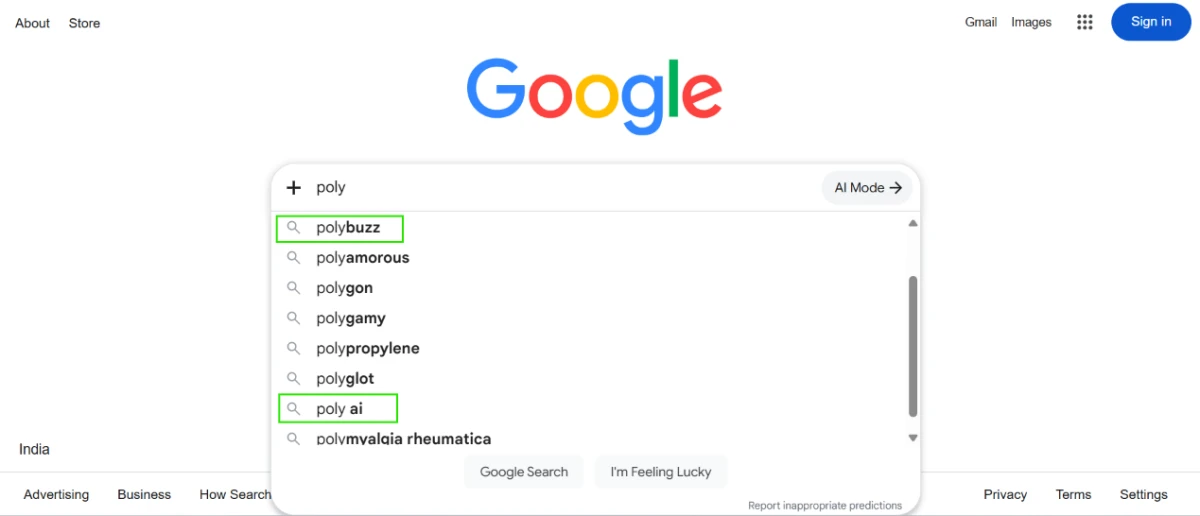
Look at how people actually type the name when they reach for the chat app. Beyond “polybuzz” itself, common searches include “poly buzz ai” as two words and “poly ai buzz” with the words flipped, plus a long tail of misfires like “poly buss ai” and “poly uzz ai.” Tens of thousands of searches a month land on these scrambled spellings. People remember that the name has “poly” and “buzz” in it somewhere, yet not the order or the spacing.
Meanwhile, a steady stream of searches for plain “poly ai” carries split intent. Some of those searchers want the app. Others want the call-center company. The search engine has to guess, and so does every person clicking through the results.
This is why the mix-up persists. Most people do not know there are two separate things, so it never occurs to them to ask whether the names differ. They type what they half-remember and hope the first result is the right one.
Why a name clash like this even happens
Step back, and the double Poly AI starts to make sense. Companion and roleplay apps have exploded into a crowded field. By one industry count, the category now spans more than 300 active, paying platforms, with over a hundred launching in 2026 alone, a jump of around 60% from two years earlier.
When that many products chase short, catchy, AI-flavored names, collisions get close to inevitable. “Poly” is a tempting root. It hints at many, as in many characters or many conversations, and it sits neatly next to “AI.” Two unrelated teams reached for the same instinct years apart, one building call-center software in London and one building a roleplay app, and the word ended up stamped on both.
Seen that way, the rebrand to PolyBuzz is a story about a younger company outgrowing a name it could never fully own, in a space that keeps getting louder.
"Did I lose my characters?" What the rebrand changed for users
For everyday users, the rebrand was mostly cosmetic. The icon and name changed, the interface got a refresh, and the character catalog kept expanding. Accounts, saved characters, and past conversations survived the transition.
Search behavior captures how people reacted. After the switch, users each month started typing worried questions like “what happened to polybuzz” and “where did my poly ai chatbots go.”
Most of that worry was misplaced. The app did not shut down and was not banned. It simply answered to a new name. A smaller set of searches points to genuine friction, such as short outages or the app behaving differently after an update, which is ordinary for a platform adding users at this pace.
If you used Poly.AI and cannot find it, you are not chasing a deleted app. You are looking for PolyBuzz under its new name, sitting on the same app stores where Poly.AI used to be.
What PolyBuzz offers today
With the name settled, here is what you actually get when you open PolyBuzz.
The core loop is character chat. You browse or search a library of more than 20 million characters, choose one, and talk. If none of them fit, you build your own by writing a name, a personality, a backstory, and an opening line. Characters can carry a voice alongside text, so a conversation can sound spoken rather than typed.
A handful of features shape the day-to-day experience:
• Voice chat, so characters speak their replies instead of only texting them.
• Live Photos, images generated to match a moment in the conversation.
• Memory that carries context between sessions, with stronger memory reserved for paid tiers.
• Multi-character chats, where a single card can hold several personalities at once.
The pull for many users is the creation side. Writers and roleplayers build original characters with set personalities and speaking styles, then either publish them or keep them private. Plenty of others never make a thing and simply dip into the existing catalog to talk with a favorite anime lead or a historical figure. Both habits feed the same library, which is why it keeps swelling.
PolyBuzz is free to start, and the free plan covers the main business of chatting and creating. Revenue arrives through two doors. The first is subscriptions, reported in app-store listings at roughly $9.90 a month for the entry tier and climbing to about $29.90 a month for the top tier. The second is coins, small in-app purchases that unlock extras such as response regenerations and Live Photos.
One honest caveat belongs here. PolyBuzz does not publish a single, clear pricing table on its website. Figures shift by region and by platform, so check the live price inside the app or the store listing before you subscribe. Scattered pricing is the complaint reviewers raise most often.
Is PolyBuzz safe, and who is it for?
This is where PolyBuzz needs a clear-eyed look, because the app is built for adults.
PolyBuzz carries a mature age rating on the app stores and markets itself to users over 18. Child-safety reviewers have flagged companion apps of this type as unsuitable for minors, on the grounds that they are designed to build emotional attachment. The web version has drawn extra criticism for a weaker age check than the mobile apps enforce.
On content, the company’s official position is that explicit material is prohibited, and that filtering tightens further in a stricter setting the app calls Pure Mode. At the same time, a large share of PolyBuzz-related searches come from users trying to get around those filters. That gap between the stated policy and what some users clearly want is worth understanding before you consider the app for a household that includes minors.
On privacy, PolyBuzz states that private conversations between you and your characters stay private and that other users cannot read them, though the company may review content for moderation. Private characters you create remain visible only to you, while public characters are open to the wider community.
Put plainly: PolyBuzz suits adult users who want open-ended roleplay and a deep character library. It is a poor fit for children, and it is not a productivity or work tool.
So which "Poly AI" do you actually want?
Back to the question that opened this article. The answer depends entirely on why you searched in the first place.
• You want to chat or roleplay with AI characters: head to PolyBuzz, at polybuzz.ai or your app store. The old Poly.AI app is the same product under its former name.
• You run a business and want to automate phone support, or you read about a funding round and a $750 million valuation: head to PolyAI Ltd, at poly.ai.
One spoken name, two destinations. Save the right address and the confusion stops following you around.
A 10-second check before you click
Here is the habit that saves you every time: read the web address, not the headline. The character-chat app lives at polybuzz.ai. The enterprise company lives at poly.ai. If a page is talking about uptime percentages and enterprise demos, you are on the enterprise site and can close the tab. If it is showing character cards and chat bubbles, you have found the app.
Search results add one more trap. A plain search for “poly ai” can surface either business near the top, so skim the description under each link before you click. A mention of “call center” or “enterprise” points to PolyAI Ltd, while “roleplay” or “characters” points to PolyBuzz. Thirty seconds of reading the snippet beats clicking into the wrong world and starting over.
The Conclusion
The Poly AI story is small on its own, yet it previews a problem that will keep repeating. As companies race to plant flags with short, AI-flavored names, two unrelated products landing on the same one will stop being a curiosity and start being routine. The teams that win are the ones that spot the clash early and move, the way Cloud Whale did when it became PolyBuzz, rather than the ones that cling to a name they quietly share with a stranger.
For you, the takeaway is simpler. If you came here chasing an AI companion and feared your app had disappeared, it has not. It is waiting at polybuzz.ai under a new name, holding the same characters you left behind. If instead you came looking for the voice technology that answers enterprise phone lines, you now know it was never the same product, just an unlucky neighbor that happened to share a name.











Discussion
Join the discussion and share your perspective.