
Consensus AI
Consensus is an AI academic search engine that answers research questions from 250M+ peer-reviewed papers, with a citation on every claim. Its Consensus Meter shows at a glance where the studies agree.

A rigorous, cited answer engine for peer-reviewed science, let down by a shaky in-app PDF reader and a Deep Search that retrieves far more than it reads.
Should you use Consensus?
Researchers, grad students and clinicians who need cited, peer-reviewed answers to a specific empirical question, not a web summary.
You need the open web, news, preprints or your own PDFs . Consensus searches only published papers and cannot read documents you upload.
Unlimited basic search is free, but Pro analyses and Deep reviews are capped. Unlimited analysis starts at Pro, $12/mo billed yearly ($144/yr).
Coverage leans heavily toward English-language journals , and results thin out fast on brand-new or quickly moving topics.
Key features & how they perform
Each feature rated from hands-on testing and aggregated review sentiment.
Search across 250M+ papers
Ask a plain-language question and it runs hybrid keyword and vector search over a corpus drawn from Semantic Scholar and OpenAlex, updated weekly. It stays inside peer-reviewed literature, so there is no web noise.
The Consensus Meter
For a yes or no question with enough papers behind it, the meter tallies the top results into a Yes, No, Possibly and Mixed split. It is a fast read on where studies land, though it does not weigh study quality.
Deep Search
Switch it on and Consensus builds a search strategy and returns a structured, cited literature review. On settled topics it is genuinely useful. It casts a very wide net but reads only a small slice at the end.
Filters & quality signals
Narrow results by publish year, journal quartile (Q1 to Q4), minimum citation count, and toggles that hide preprints or closed-access work. Every reference carries its SJR quartile and citation count up front.
Study Snapshots & Ask Paper
Each result gets a summary card with its key finding, and the Evidence tab lets you pull the exact cited sentence or put questions to a paper's full text. The in-app PDF reader is the part that lets it down.
Export, extension & MCP
Export any answer with its citations or as a PDF, overlay Consensus on a normal Google search through the Chrome extension, and wire it into Claude or ChatGPT through the MCP server.
Feature ratings blended from hands-on testing plus user sentiment on Product Hunt, the App Store, Google Play & Trustpilot.
Two questions with Consensus: one it nailed, one it fumbled
I ran a settled medical question, then deliberately pushed it onto ground it was never built for.
Setting up the test on a free account
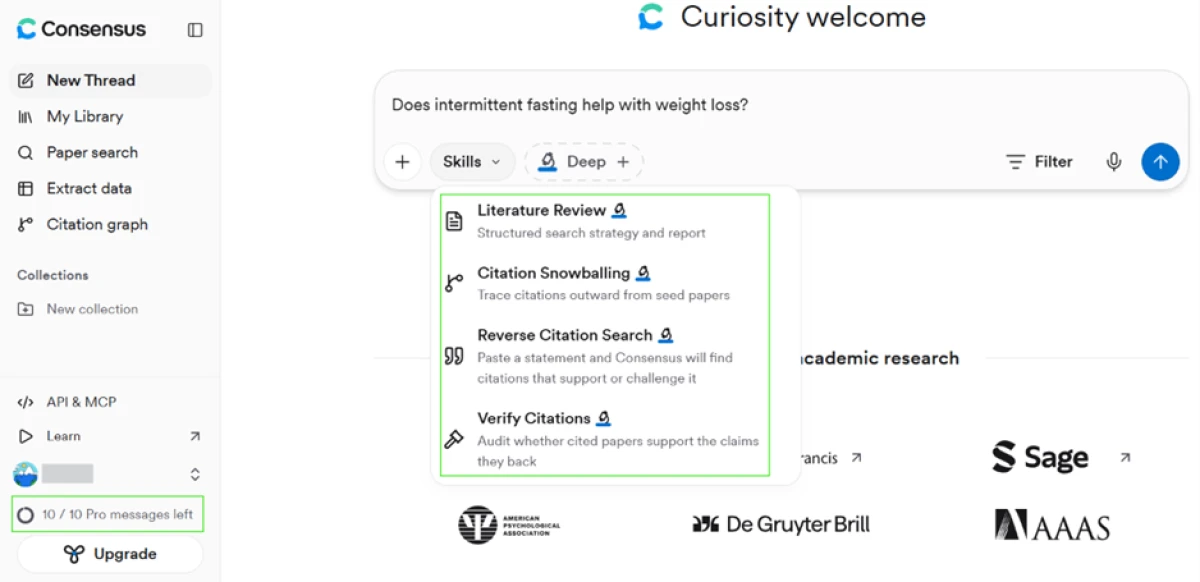
I started on a clean free account so nothing here touched a paid feature. The header showed 10 of 10 Pro messages still available, which is the monthly pool of AI analyses a free user gets.
Consensus can route a query through its Skills, so I switched that menu off and typed a plain question straight into the search box. I wanted to see the core engine, not an add-on.
"Does intermittent fasting help with weight loss?"
Filtering before reading a single result
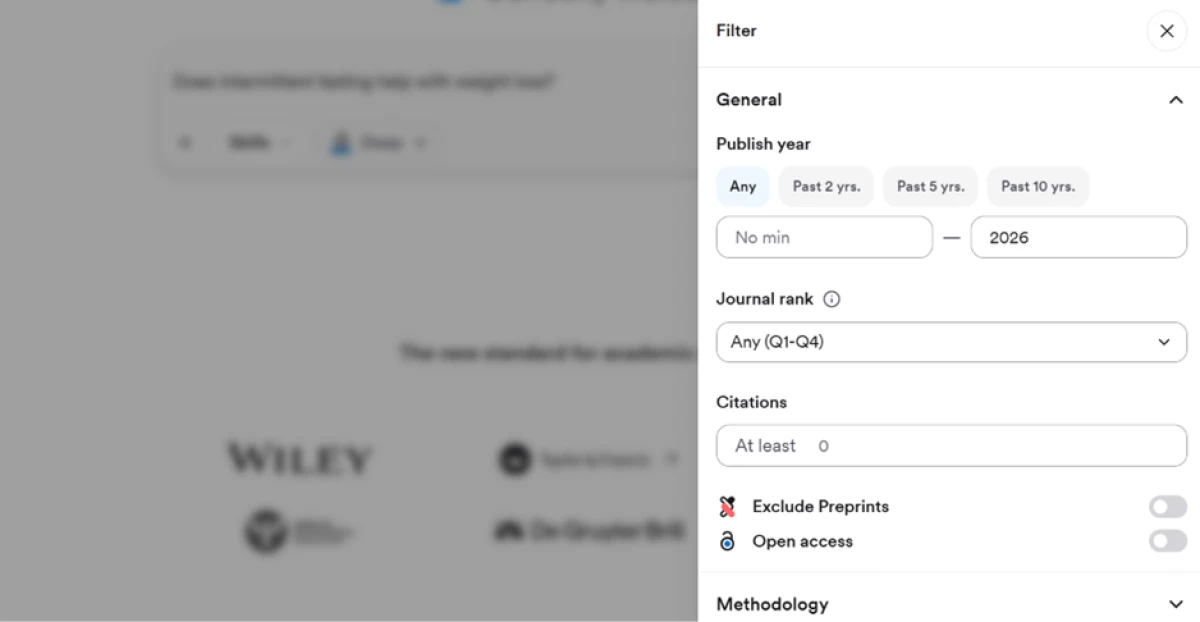
Before I read anything, I opened the filter panel. This is where Consensus pulls ahead of a general chatbot, which gives you none of these controls.
I could set the publish year, choose a journal rank from Q1 to Q4, demand a minimum citation count, and hide preprints or closed-access papers. On a research question, deciding what counts before you read is half the work.
The verdict and the Consensus Meter
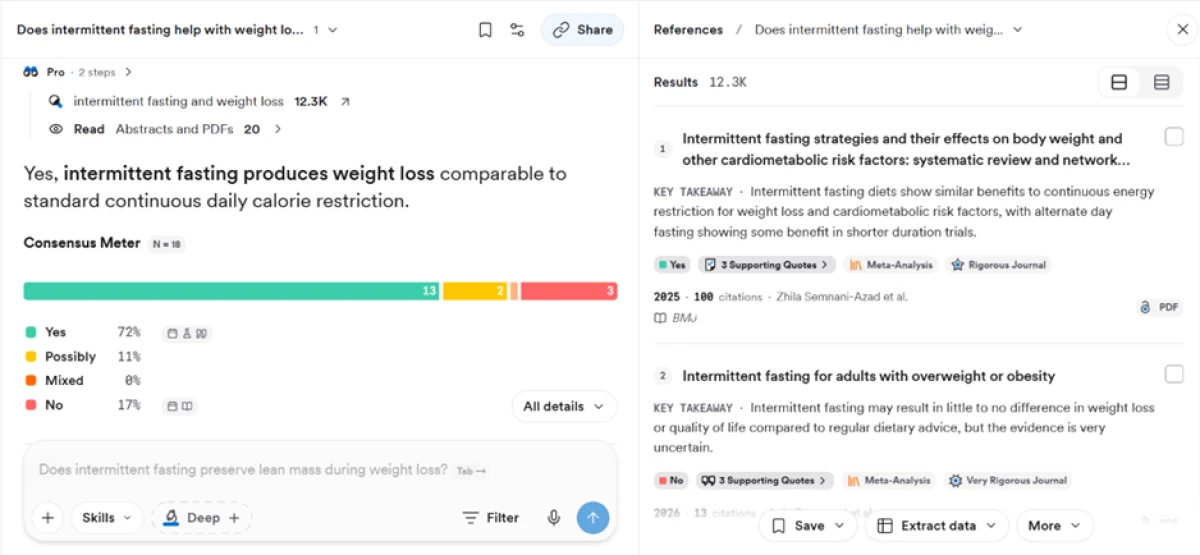
Consensus read 18 papers and returned one line: yes, intermittent fasting produces weight loss comparable to standard daily calorie restriction.
The Consensus Meter split those 18 papers four ways: 72% Yes, 11% Possibly, 0% Mixed, and 17% No. Each reference carried its own tags for study type and journal rigour, and a separate count showed how many quotes backed the verdict.
Checking the evidence, and where it broke
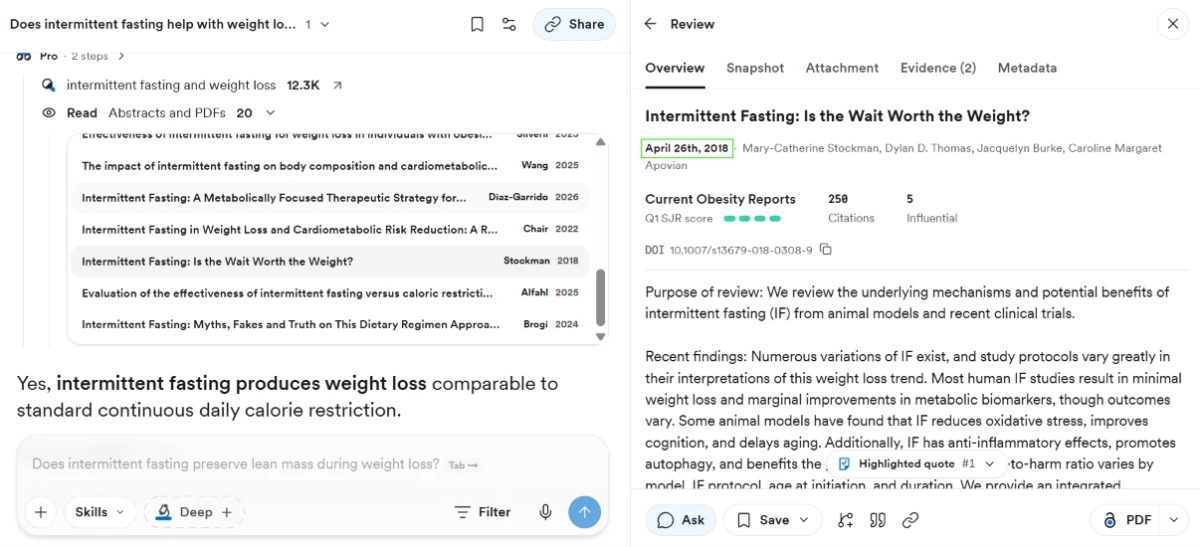
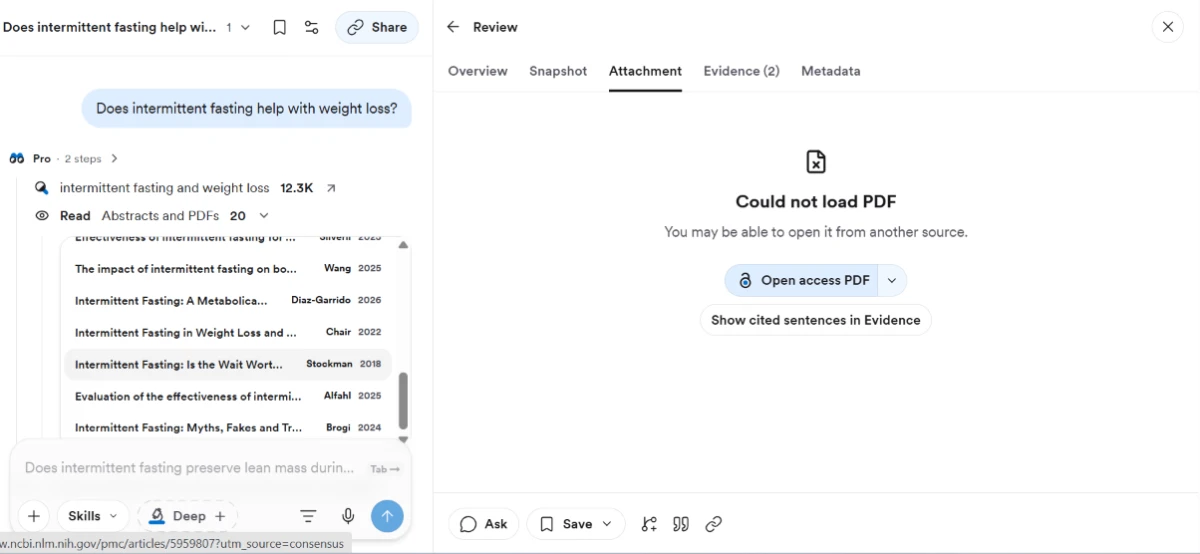
I clicked into one paper to check a claim. The Overview gave me the publication date, the journal and its SJR quartile, the citation count, and a highlighted quote matched to the claim.
One source was from 2018, which did not worry me: a well-cited review in a Q1 journal holds up, and my top results were from 2025 and 2026 anyway.
The friction showed up on the next tab. I opened the Attachment view to read the full PDF inside Consensus, and it failed with "Could not load PDF." The tool offered an external open-access link and a "Show cited sentences in Evidence" option instead.
The citation graph, marked Beta
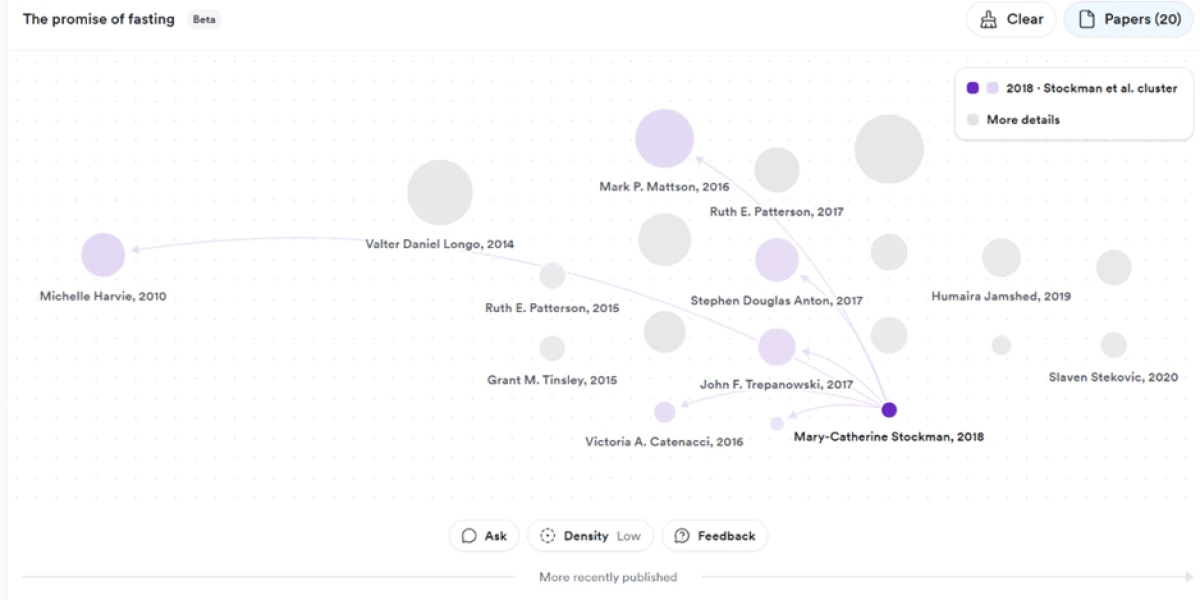
Consensus also drew a citation graph, labelled Beta. It places the seed paper among earlier and related work, so the authors clustering around a topic become visible at a glance.
For mapping who cites whom in a field, this is a useful orientation tool. The Beta label is honest about how rough it can still get.
Snapshots, export, and the free ceiling
The free plan caps Study Snapshots. Mine read 10 left, with a reset date and an Upgrade button for unlimited use.
Export, though, stayed open on the free plan. I could copy the answer with its citations or save the whole thing as a PDF. The exported file kept the meter and the inline citations, and it carried the Consensus brand mark across the top.


A privacy setting to change first
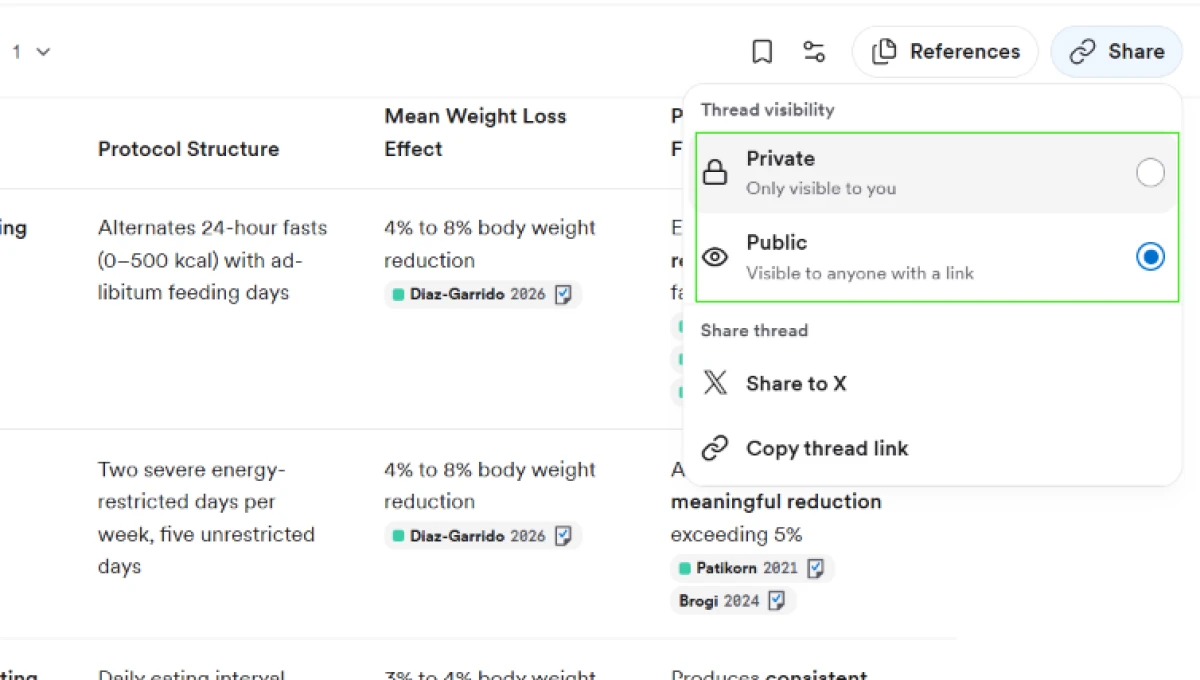
One setting needs a look before you share anything. The thread visibility toggle sat on Public, which lets anyone with the link read the entire thread.
For a private literature search tied to unpublished work, that default is worth knowing about. I switched mine to Private.
Where it struggled: a question off its home ground
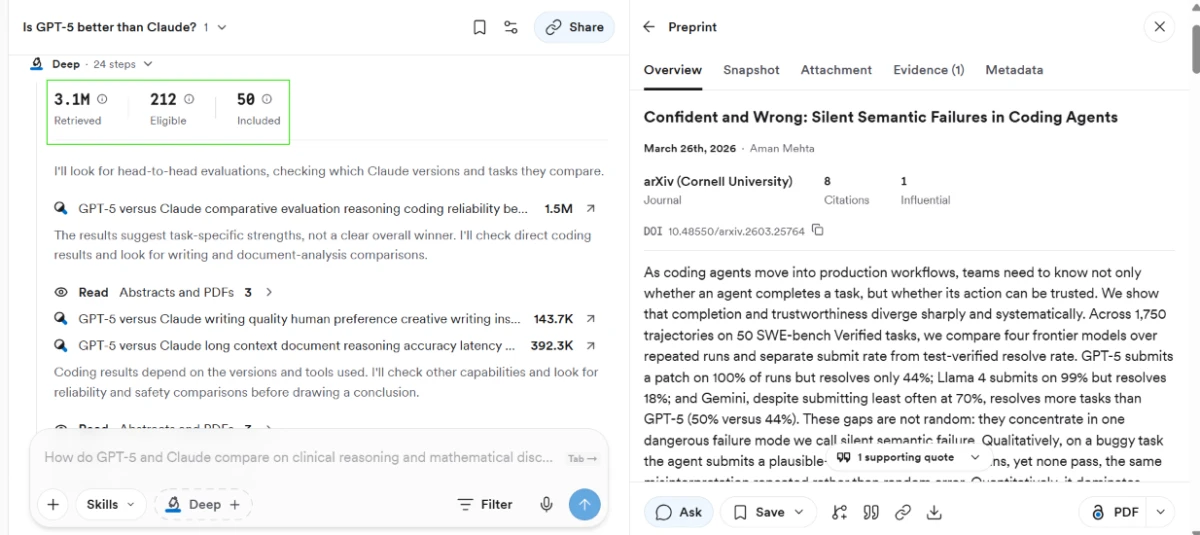
Then I pushed it off its home ground on purpose. I turned Deep search on and asked a question with almost no peer-reviewed literature behind it.
"Is GPT-5 better than Claude?"
The run took 24 steps. It reported 3.1 million papers retrieved and 212 eligible, of which it kept 50. At the deep-reading step it opened 3 abstracts and PDFs. The large retrieval figure looks impressive until you notice how little it reads at the end.

What the Consensus Meter does not measure
The feature that gives the tool its name has one blind spot worth understanding before you cite it.
The meter works by reading the conclusions of the papers at the top of your results and sorting them into agreement buckets. What it does not do is judge how good those papers are. There is no risk-of-bias step and no weighting by study design.
In practice that means a small observational study can count the same as a large randomized trial in the final split. A field where the strong evidence disagrees with a pile of weak evidence can still show a confident percentage. The number tells you where the retrieved papers land, not which papers deserve the most weight.
The fix is already in the product. Use the meter to gather the relevant papers fast, then judge them yourself using the journal quartile and citation count Consensus shows on every reference. Treat the percentage as a map of the literature, not a finished conclusion you can drop into a manuscript.
Consensus pricing
Figures taken from the official Consensus pricing page, Individual plans shown with annual billing.
| Plan | Price | What's included |
|---|---|---|
| Free | $0 | Unlimited basic search across 250M+ papers · 10 Pro messages/mo · 3 Deep reviews/mo · 10 Study Snapshots/mo · Consensus Meter · 10 bookmarks, 1 list |
| Pro Popular | $12 /mo | Billed yearly ($144/yr), or $20/mo monthly · unlimited Pro messages · 15 Deep reviews/mo · 500 API & MCP uses/mo · citation graph · every research tool |
| Deep | $45 /mo | Billed yearly ($540/yr), or $65/mo monthly · everything in Pro · 200 Deep reviews/mo · 2,000 API & MCP uses/mo · priority support |
| Team & Enterprise | Custom | Seat-based plans with organization account management, centralized billing and the Consensus Search API · sits under a separate tab, contact sales |
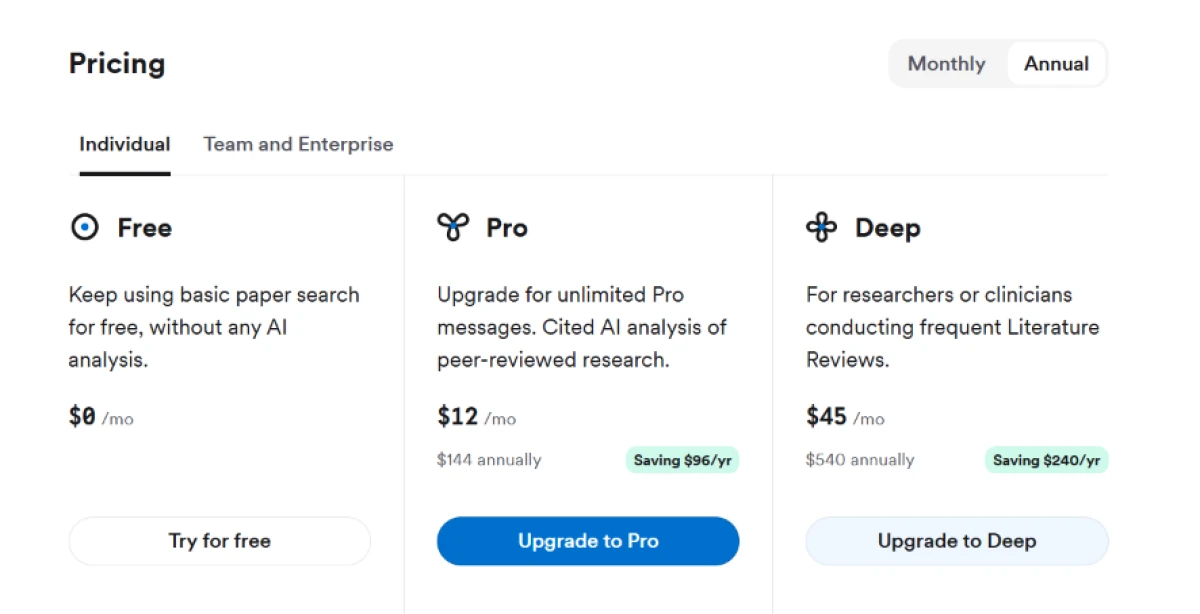
Pricing is accurate as of 14 November 2026 and was captured from the official Consensus website. Plans, prices and credit limits change often, so check the official Consensus pricing page for the current figures before you subscribe.
Pros & cons
What real users of the research tool praise and complain about, kept separate from my own testing.
✅ Pros
- Every claim links to the source paper, so reviewers report no hallucinated citations
- The Consensus Meter shows the Yes, No, Possibly and Mixed split at a glance
- Natural-language search feels cleaner than PubMed or Google Scholar, users say
- Reviewers trust it because it draws only from peer-reviewed papers, not the open web
⛔ Cons
- Reading a paper's full PDF inside the tool is heavy and can slow the browser
- The mobile app's export options are thinner than the web version
- Users report it occasionally missing papers they know are published
Synthesized from real user reviews on Product Hunt, the Apple App Store, Google Play & Trustpilot · paraphrased, not quoted
Consensus alternatives
| ConsensusReviewed | Liner AI | Genspark AI | |
|---|---|---|---|
| Our Score | 7.5/10 | 6.7/10 | 6.4/10 |
| Entry paid plan | $12 / mo, billed yearly | $10.99 / mo, billed yearly | $19.99 / mo, billed yearly |
| Free tier | 10 Pro messages, 3 Deep reviews/mo | 30 credits/mo, ads on answers | Full use, but no exports |
| What it searches | 250M+ peer-reviewed papers only | Web plus academic sources | Live web research |
| Citations | Every claim linked to its source paper | Line-by-line cited answers | Sourced reports with working links |
| Best for | Cited answers to peer-reviewed questions | Quick sourced answers for students | Slides, research and sheets in one tool |
Who Should Use Consensus, and Who Should Avoid It?
Consensus is excellent at finding cited, peer-reviewed answers, but its academic-only scope makes it the wrong tool for several common jobs.
Who Should Use Consensus?
Best suited for these workflows
Researchers Running Literature Reviews
Deep Search synthesises a cited review and the filters let you scope by journal rank and citation count before you read a word.
Clinicians Checking the Evidence
Every source shows its journal quartile, citation count and a matched quote, so you can weigh the strength of a finding fast.
Anyone Sanity-Checking a Claim
The Consensus Meter gives a quick read on whether a statement in a draft or an argument has peer-reviewed backing.
Students Who Want Sources, Not Guesses
Each sentence links to the paper behind it, which makes it easy to cite the original rather than an AI summary.
Who Should Avoid Consensus?
Consider an alternative if you need
Open-Web or News Research
Consensus stays inside published papers, so for current events, company reports or industry analysis a general search tool fits better.
To Query Your Own Documents
It cannot ingest an uploaded PDF or a private library, so document-grounded workflows belong in a tool built for that.
The Newest, Fastest Fields
Peer-reviewed coverage lags preprints, so in quickly moving areas the tool runs thin and leans on tangential work.
Non-English Literature
The corpus skews heavily toward English-language journals, so coverage drops off for research published in other languages.
Our Recommendation
Consensus is the strongest pick for cited, peer-reviewed answers to a specific empirical question, and the free tier is enough to judge whether it fits your field. If your work needs the open web, your own documents, or the newest preprints, pair it with another tool or look elsewhere. Before you pay, run a few real questions, confirm Deep Search covers your area, and check the current Deep review quotas.
Consensus scorecard
Rated against what an AI academic search engine is actually built to do.
| Dimension | Verdict | Score |
|---|---|---|
| Search relevance & result quality Finding the right papers for a question | Excellent |
8.5
|
| Evidence transparency Every claim traceable to a source | Excellent |
9.0
|
| Consensus Meter Yes, No, Possibly, Mixed split | Good |
7.5
|
| Filters & search controls Year, journal rank, citations, preprints | Excellent |
8.5
|
| Source quality signals Journal quartile and citation counts | Excellent |
8.5
|
| Coverage & database breadth 250M+ papers, English-skewed | Good |
8.0
|
| Export & sharing Free export, carries a brand mark | Good |
7.5
|
| Value & free tier Free search, metered AI features | Good |
7.0
|
| Deep Search depth Retrieves broadly, reads a small slice | Average |
5.5
|
| Full-text verification In-app PDF reader reliability | Weak |
5.0
|
| Scrutool Score Equal-weight average of all 10 dimensions |
7.5
|
A rigorous evidence engine for settled questions, out of its depth on the frontier
Consensus does the thing it was built for better than almost anything else. Ask a specific, well-studied question and you get a cited one-line verdict, a Consensus Meter that shows where the papers land, and quality signals on every source that let you decide what to trust. The free tier is generous enough to judge all of this, and the filters put real editorial control in your hands before you read a word. The weak spots are specific, not fatal. The in-app PDF reader failed on me and pushed verification to external links, Deep Search retrieves millions of papers only to read a handful, and on a brand-new question it reaches for tangential preprints that were never peer reviewed. Researchers, clinicians and students who work inside published literature will get genuine value here, especially for sanity-checking claims and scoping reviews. Anyone who needs the open web, their own documents, or the newest preprints should treat it as one tool in a stack, not the whole stack.
Discussion
Join the discussion and share your perspective.