
FreeTextDetector
FreeTextDetector is a free, no-login AI text checker and rule-based humanizer that names the style habits behind its score. It reads how writing sounds, not who wrote it, so treat the result as a style coach, not proof.

A transparent, free writing-style analyzer and readability cleaner that shows which habits read as machine-made, but not a reliable test of whether text is human or AI.
Should you use FreeTextDetector?
Writers and students who want to see which AI-sounding habits to fix and clean the stiffness out of a draft.
You need to prove whether text is human or AI . It reads writing style, not origin, and casual AI slips straight through.
Nothing. It is free with no account or paid tier ; the only ceiling is 5,000 characters per check.
Its verdict disagrees with model-based detectors , and formal writing without contractions gets marked down as AI.
Key features & how they perform
Each feature rated from hands-on testing and the tool's documented behaviour.
Writing-pattern detector
Scores the habits common in AI drafts, but it judges how the text reads, not who wrote it, so the number is a style signal rather than a verdict.
Transparent breakdown
Instead of a lonely percentage, it lists each signal with its own score, sentence variety, word variety and cliché level, and names the stock phrases it caught.
Rule-based humanizer
Rewrites with fixed linguistic rules and no generative model, so it trims filler and splits long sentences while keeping your meaning and your data private.
Readability scoring
Grades each rewrite before and after across eight formulas, including Flesch Reading Ease and Flesch-Kincaid grade level, so you can see if a change actually helped.
Rewrite modes
Seven modes, from Natural and Casual to Academic, Formal and Concise, aim the rewrite at a specific tone rather than one generic pass.
No-friction access
The page opens straight to an input box with no login, no account and no card prompt, and the check runs in the browser.
Feature ratings from hands-on testing and the tool's documented behaviour.
Three texts and a second opinion: stress-testing FreeTextDetector
A plain AI paragraph, a chatty AI passage checked twice, a real 2018 research paper, and a humanizer pass, all on the free tool with no sign-up.
Getting in: no account, a 5,000 character ceiling
Getting started took no effort. There was no login, no sign-up and no card prompt. The page just opens to an input box.
That box caps each check at 5,000 characters, tracked by a live counter. For a single paragraph that is room to spare. A full article has to go in piece by piece.

Test 1: a plain AI paragraph
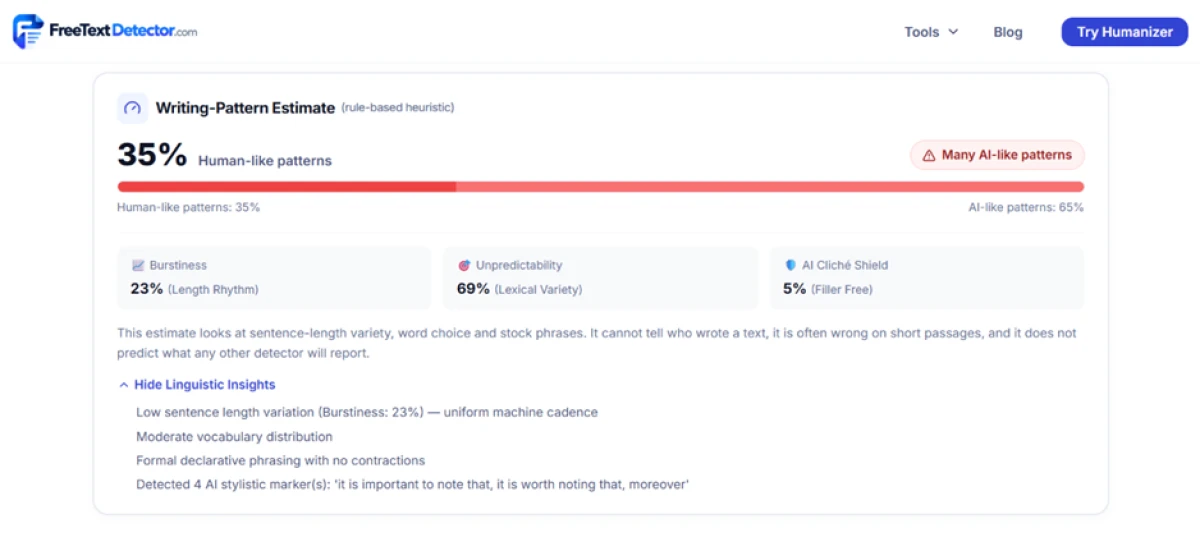
First I pasted a stiff, AI-style paragraph about business and artificial intelligence to see how the detector handled an obvious case. Here is the exact text I entered.
"Artificial intelligence has become an essential part of modern business operations. Moreover, it is important to note that companies are increasingly adopting these technologies. Furthermore, the implementation of AI solutions requires careful planning and consideration. In addition, organizations must evaluate the potential risks and benefits. It is worth noting that successful adoption depends on proper training and resources. Consequently, businesses that invest in AI are likely to gain a competitive advantage."
Test 2: a natural-sounding passage, and a second opinion
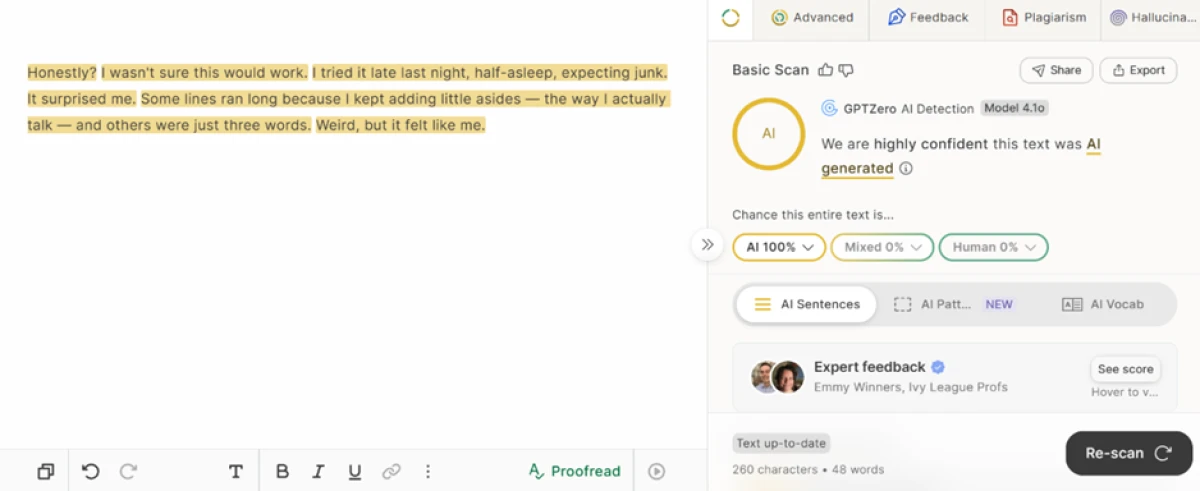
Next I flipped it around. I took an AI-generated passage written in a loose, chatty voice, kept the short fragments and left in a contraction. This was the input.
"Honestly? I wasn't sure this would work. I tried it late last night, half-asleep, expecting junk. It surprised me. Some lines ran long because I kept adding little asides (the way I actually talk), and others were just three words. Weird, but it felt like me."

FreeTextDetector rated it 89%, Strongly human-like. Sentence variety jumped to 98% and the cliché shield read 100%.

Then I pasted the identical text into GPTZero. It returned the opposite call: 100% AI, highly confident the text was machine-generated.
Test 3: a real 2018 research paper
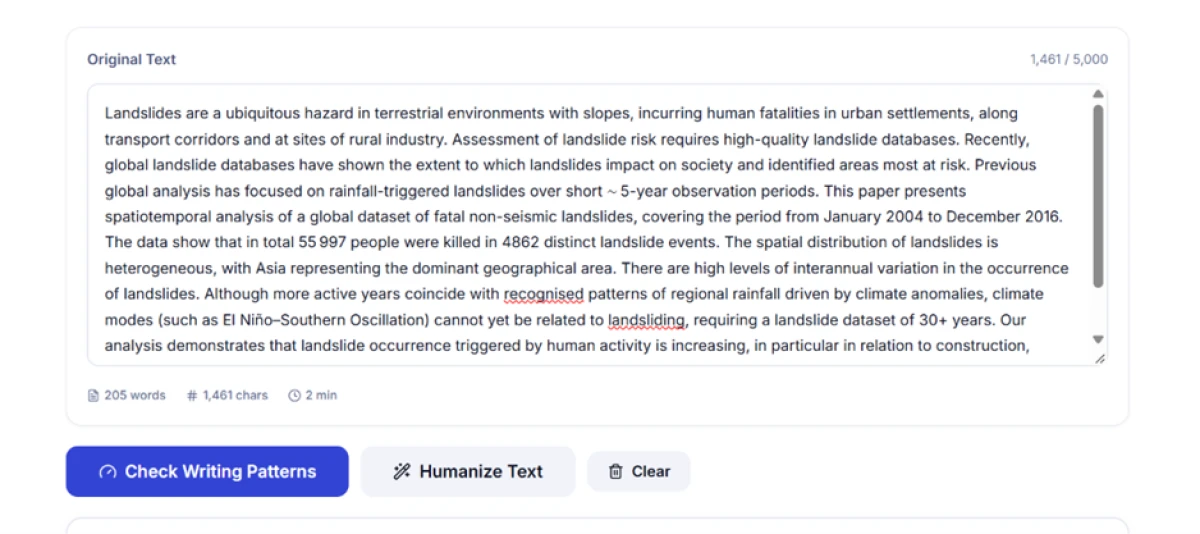
To check for false alarms, I pasted the opening 200 words of a research paper published in 2018, well before ChatGPT existed. The excerpt is below.
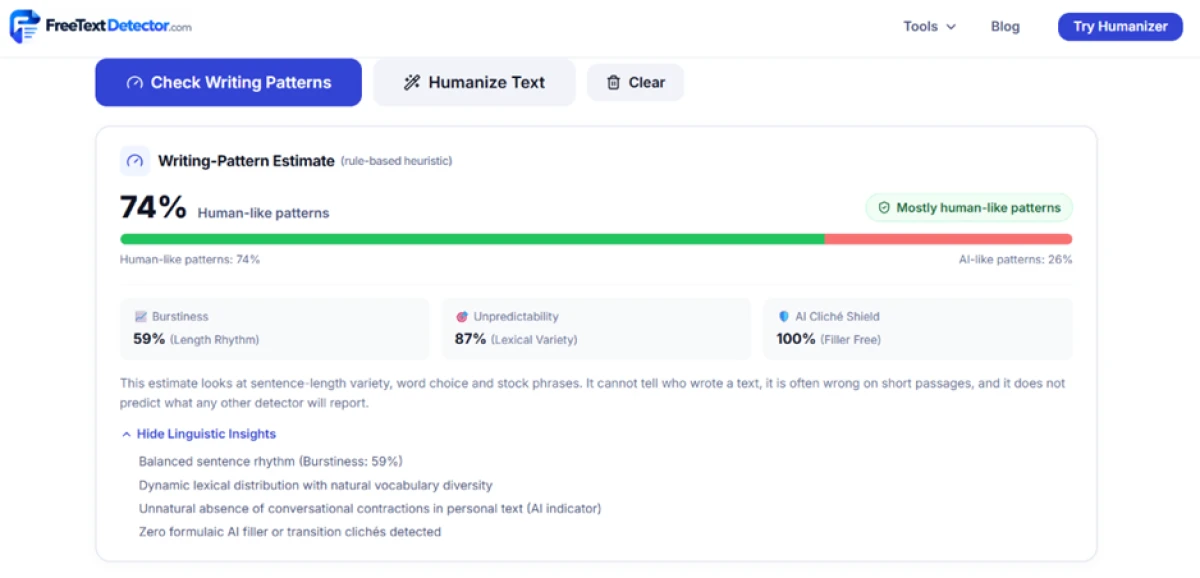
It scored 74%, Mostly human-like, so the tool did not panic and brand formal academic writing as AI, which counts in its favour.
The humanizer on text that was already clean
The same page also rewrites text. I reused the chatty passage and ran it through the Natural mode to see what it would change.
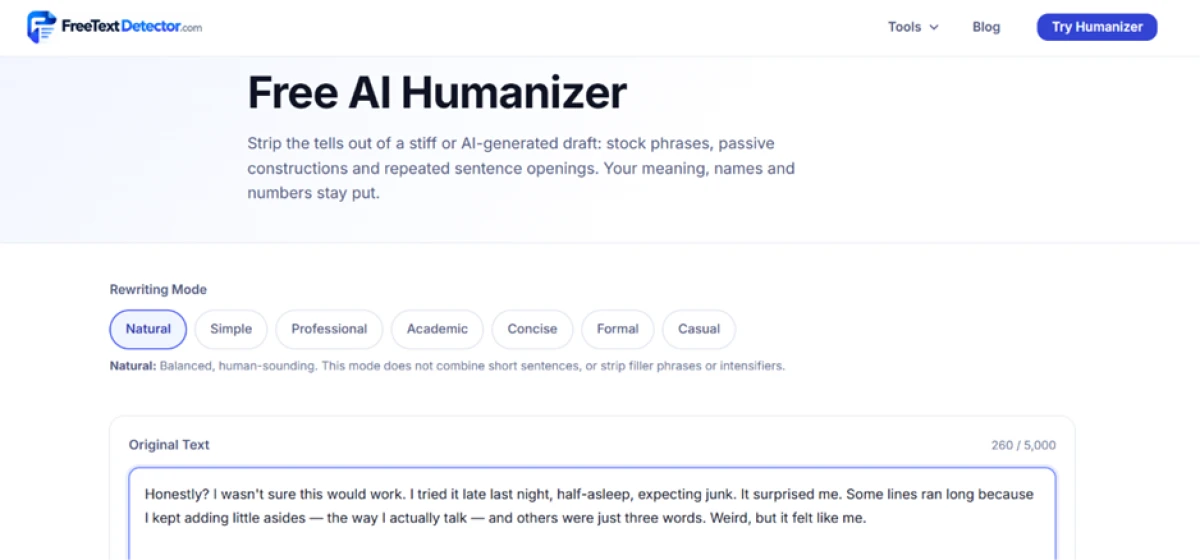
The rewrite came back 100% similar, graded Easy at a 3.6 reading level, with readability scored before and after.

What FreeTextDetector costs
There is no pricing page, because there is nothing to pay for.
Both tools, the detector and the humanizer, are free. There is no account to create, no login, no card prompt and no paid tier waiting behind a feature. The only limit anywhere is the 5,000 character ceiling on each check, so the real question is not what it costs but how far the free scope stretches.
Pros & cons
What the tool does well and where it falls short, drawn from its design and independent analysis.
✅ Pros
- Names each style signal behind the score, not a lone percentage
- Lists the exact stock phrases it caught, so you can fix them
- Humanizer uses fixed rules, no generative model, so text stays private
- Scores readability before and after across eight formulas
- Seven rewrite modes target Natural, Academic, Formal and other tones
- Opens in the browser with no account, login or sign-up
⛔ Cons
- Reads writing style, not origin, so it cannot confirm who wrote a text
- Casual AI with short sentences and a contraction slips through as human
- Treats the absence of contractions as AI, penalizing formal writing
- Its verdict disagrees with model-based detectors, so a human score misleads
- Pastes text only, with no file, PDF or bulk upload that rivals offer
Based on the tool's documented method and independent research on pattern-based detectors · paraphrased, not quoted
FreeTextDetector alternatives
| FreeTextDetectorReviewed | Pangram AI | Sapling | Detect AI | |
|---|---|---|---|---|
| Our Score | 6.3/10 | 7.2/10 | 6.4/10 | 4.2/10 |
| How it decides | Writing-style patterns, no ML model | Trained ML model, sentence-level | Trained ML model | Trained ML model |
| Shows why | Names each style signal and phrase | Sentence-level prediction map | Per-sentence AI scores | Sentence-by-sentence shading |
| Built-in humanizer | Yes, rule-based | No | No, rephrase only | Yes, AI humanizer |
| False-positive record | Penalizes formal, no-contraction writing | Lowest verified rate, about 1 in 10,000 | High, widely reported | Rated weak overall |
| Best for | Style and readability cleanup | Accuracy-critical AI checks | Writing help with detection on the side | Cheap detect-and-rewrite |
Who Should Use FreeTextDetector, and Who Should Avoid It?
The tool is a genuinely useful writing-style coach, as long as you never ask it to settle whether a piece was written by a person or a machine.
Who Should Use FreeTextDetector?
Best suited for these workflows
Writers Polishing AI Drafts
See exactly which habits read as machine-made, fix the flagged phrases and uniform sentences, then rerun until the draft loosens up.
Students Checking Their Own Voice
Spot stock transitions and flat sentence rhythm before submitting, and use the breakdown as a self-edit checklist rather than a verdict.
Anyone Who Wants a Private Rewrite
The rule-based humanizer never sends text to a generative model, so it suits sensitive drafts that should not touch a third-party AI.
Readability-Focused Editors
Before-and-after scores across eight formulas show whether a rewrite genuinely simplified the text or just moved words around.
Who Should Avoid FreeTextDetector?
Consider an alternative if you need
Proof of Who Wrote Something
Teachers and editors judging authorship get a style reading, not evidence, and acting on it risks a wrong call either way.
One Trustworthy Verdict
Casual AI passes as human and a clean score is not proof, so a single result cannot carry a high-stakes decision.
Fairness on Formal Writing
Correct academic style that drops contractions gets marked down, so dense formal work can be pushed toward the AI side.
File or Bulk Checking
It accepts pasted text only, with no PDF, document or batch upload, so large or multi-file jobs do not fit.
Our Recommendation
FreeTextDetector is a transparent writing-style coach, not an origin detector, and it is honest about that itself. Use it to understand and fix the habits that make writing sound robotic, and to tidy a stiff draft without handing your text to an AI. Never let its percentage decide whether something was written by a person, and cross-check any decision that matters with a model-based detector.
FreeTextDetector scorecard
Rated against what a free, style-based AI checker and humanizer is actually built to do.
| Dimension | Verdict | Score |
|---|---|---|
| Ease of access No login, instant, in-browser | Excellent |
9.0
|
| Breakdown transparency Names each signal and phrase | Excellent |
8.5
|
| Honesty about limits States it reads style, not origin | Excellent |
8.5
|
| Style & readability insight Signals, cliché list, reading level | Good |
8.0
|
| False-positive safety Leaving human writing alone | Average |
6.5
|
| Humanizer quality Rule-based rewrite, stays on meaning | Average |
6.5
|
| Input capacity Characters per check, file support | Weak |
5.0
|
| Score reliability Headline figure vs real origin | Weak |
4.5
|
| AI detection accuracy Telling human from machine | Weak |
3.5
|
| Resistance to disguised AI Catching casual or edited AI | Weak |
3.0
|
| Scrutool Score Equal-weight average of all 10 dimensions |
6.3
|
Honest about what it is: a style coach, not an AI detector
FreeTextDetector is better than its category suggests, as long as you read the label. The breakdown is the best part: it names the habits behind the score, lists the exact filler phrases, and grades readability before and after a rewrite, all free and with no account. The rule-based humanizer keeps your text off a generative model and leaves clean writing alone. The catch is the one it owns up to in grey text. It measures how writing reads, not where it came from, so a chatty AI passage scored 89% human here while GPTZero called the same text 100% AI, and a formal 2018 paper lost 26 points purely for dropping contractions. As an AI-origin detector it is weak, and no student or teacher should lean on its verdict. As a transparent coach for spotting robotic habits and tightening a draft, it earns its place. Use it to improve writing, not to judge it, and send anything that actually matters to a model-based detector as well.
Discussion
Join the discussion and share your perspective.