How to Get Your Brand Cited by ChatGPT and Perplexity in 2026 (They Don't Cite the Same Things)
Learn how to get your brand cited by ChatGPT and Perplexity in 2026 with proven tactics for content, third-party mentions, AI crawlers, citations, and AI search visibility.
A client called last winter, pleased and baffled at the same time. Their site had finally cracked the top three on Google for a phrase they had chased for two years. The team had already picked a restaurant.
Then their head of sales typed the obvious buyer question into ChatGPT. The answer named four companies. None of them was the client.
That gap is the subject of this article. Two search systems now run side by side. One pays out for position. The other pays out for being quotable. You can win the first and lose the second without ever noticing, because no rank tracker on earth will flag it.
Most guides on this topic treat ChatGPT and Perplexity as one target. The citation data says that assumption is expensive. The two engines pull from almost entirely separate slices of the web, so one flat strategy will quietly fail one of them. This piece separates the two, and every claim below traces back to a named study.
The short version, if you only read one box
• Allow the retrieval crawlers. Blocking OAI-SearchBot or PerplexityBot removes you from those answers outright.
• Write in self-contained chunks, with the answer inside the first two sentences of every section.
• Earn third-party mentions. Roughly 4.5% of branded AI citations point at a brand's own pages.
• Split effort by engine. Perplexity rewards community posts and video. ChatGPT rewards vendor pages and technology media.
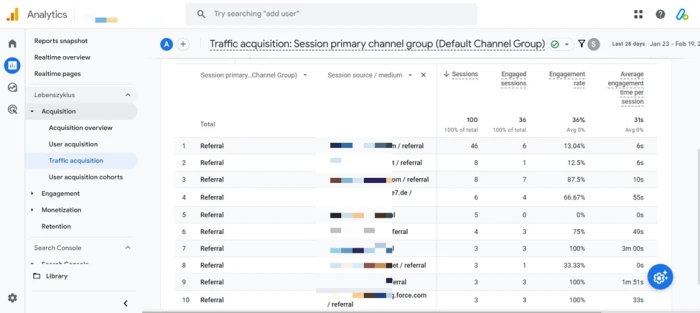
• Start measuring in GA4 today. Both engines already appear there as referral sources.
The click that stopped arriving
Search demand did not fall. The click did.
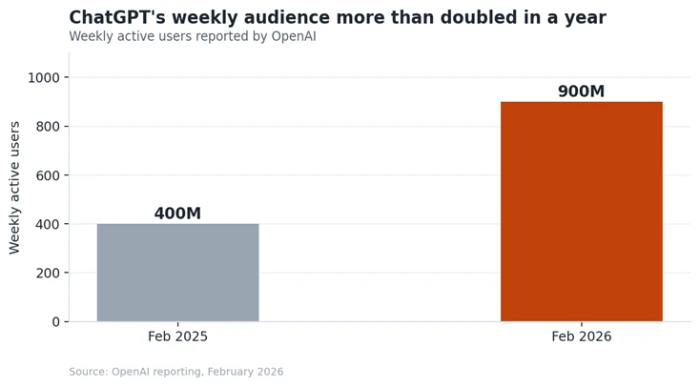
SparkToro's analysis of Similarweb clickstream data found that around 68% of Google searches ended without a click in early 2026, a sharp jump year over year. The question is answered on the results page, and the visit never happens. Meanwhile the audience for the answer engines themselves has grown at a pace that makes the shift hard to write off as a phase.
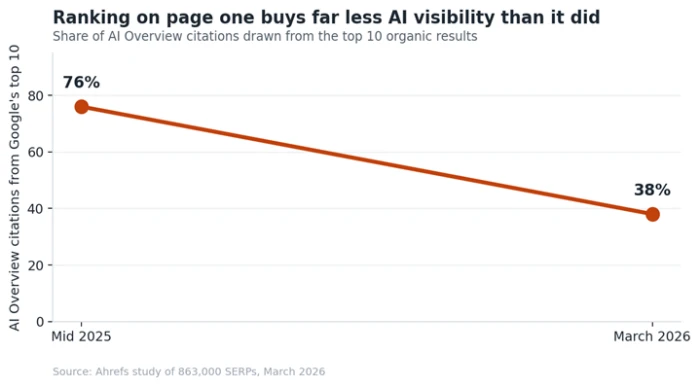
The instinct at this point is reassuring and wrong: rank well on Google and the AI answers will follow. They used to. Ahrefs studied 863,000 SERPs in March 2026 and found that 38% of AI Overview citations came from the top 10 organic results, down from 76% less than a year earlier.
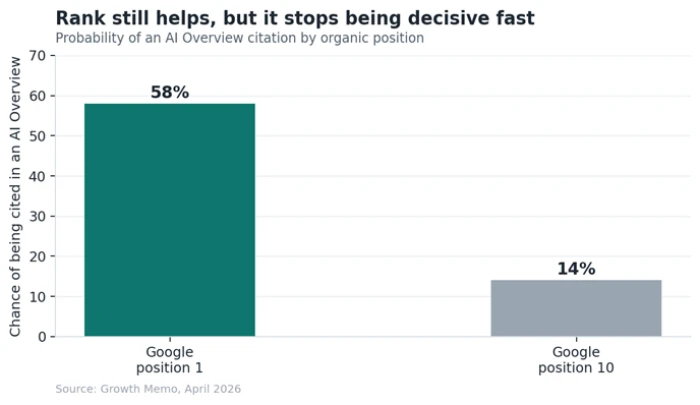
Growth Memo's April 2026 analysis put the odds of a position-one page being cited in an AI Overview at 58%, falling to 14% by position ten. Page one still helps. It has simply stopped being sufficient, which is why the next section looks at what these engines are actually doing when they choose a source.
What happens inside an answer engine before it names a source
An LLM does not read your page the way a person does. It breaks content into short token segments, converts each one into an embedding, and retrieves the individual segment that best matches the query. Your page is never the unit of competition. A paragraph is.
Two things follow from that, and both are counterintuitive.
• A brilliant 3,000-word guide with one weak paragraph on the topic in question will lose to a mediocre page with one excellent paragraph on it.
• A paragraph that leans on the sentence before it ("as we saw above") retrieves badly, because it stops making sense once it is lifted out.
The second mechanism is query fan-out. The engine does not paste your question into a search box. It rewrites the question into several narrower sub-queries, runs each one separately, then assembles citations from across all of those results. Ask about the best project management tool for agencies and the system may run three or four different searches you never see.
That single design choice explains the Ahrefs number in the previous section. Cited URLs increasingly do not match the top ten for the original query, because the original query was never the query that ran.
The 89% problem
Here is where the single-strategy approach falls apart.
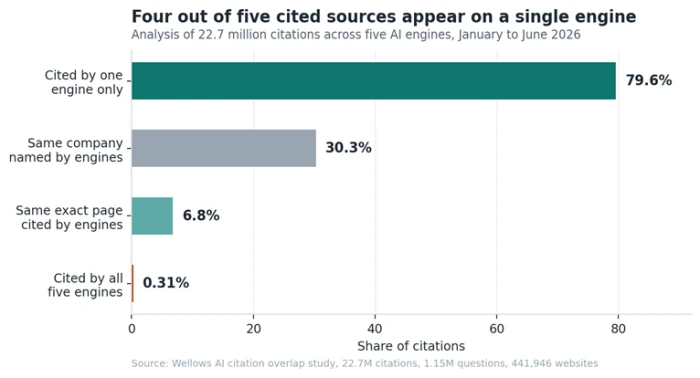
Wellows analysed 22.7 million citations spanning 1.15 million questions and 441,946 websites between January and June 2026. On the same question, Perplexity never touches 89.1% of the websites ChatGPT cites. Run the comparison the other way and the figure is 90.1%.
Read the bottom bar again. Of every source cited across those five engines, 0.31% appeared on all five.
The third bar is the one that changes your plan. Engines land on the same exact page 6.8% of the time, yet they name the same company 30.3% of the time. Pages travel badly between engines. Brands travel four times better. Section 5 turns that finding into a tactic.
Where each engine goes shopping
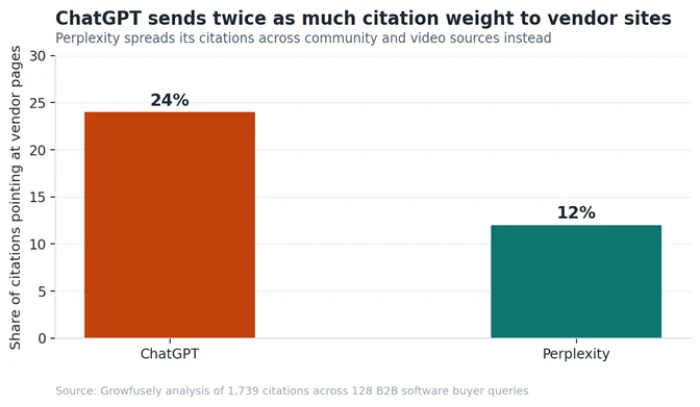
Growfusely ran 128 realistic B2B software buyer queries through both engines and logged all 1,739 resulting citations. The split was consistent.
ChatGPT sent twice as much citation weight to vendor pages, and roughly three times as much to technology media. Perplexity spent its citations elsewhere: 47 references to YouTube and 11 to Reddit in that sample, against almost none from ChatGPT.
A video that earns you Perplexity citations will do close to nothing for ChatGPT. A well-built comparison page that ChatGPT loves may never surface in Perplexity.
ChatGPT
Perplexity
How it retrieves
Blends model knowledge with an indexed search layer
Runs a live web search on every single query
Citation habit
Cites selectively, sometimes answers without sources
Roughly four to eight weeks for new pages to surface
Days to weeks
Your lever
Digital PR plus authoritative owned pages
Genuine community presence plus video
You are usually not the source. You are the name inside it
Most brands read everything above and conclude that they need better pages. That instinct misreads who the engines actually quote.
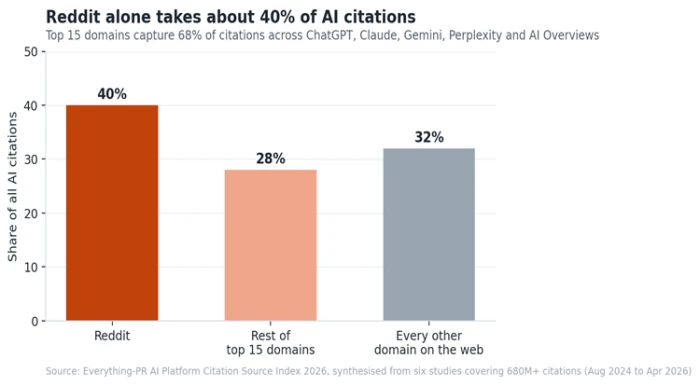
Everything-PR synthesised six citation studies covering more than 680 million citations between August 2024 and April 2026. The top fifteen domains captured 68% of all citation share across ChatGPT, Claude, Gemini, Perplexity and Google AI Overviews. Reddit alone took roughly 40%.
Wikipedia sits at 7.8% of ChatGPT's total citations, its single most-cited source.
You are not going to outrank Reddit. You are going to get mentioned inside it.
Omniscient Digital tested this directly on branded queries, examining 23,387 citations across the five major engines. The breakdown deserves to be printed and pinned to a wall.
Source of a branded citation
Share
Reviews and social proof (review sites, listicles, press)
57%
Directories
17%
The brand's own About, FAQ or Home pages
About 4.5%
Your homepage is not where you win a branded query inside an LLM. Third-party validation is. That reframe drives the whole action plan that starts now.
Step one: stop blocking the crawlers that would cite you
This is the fastest fix on the list and the most common own goal.
AI companies now run separate crawlers for separate jobs. Training crawlers such as GPTBot and ClaudeBot feed future models. Retrieval bots such as OAI-SearchBot, Claude-SearchBot, PerplexityBot and Perplexity-User fetch pages in real time to build cited answers. Block a retrieval bot and you are removed from that engine's answers immediately. There is no domain authority that compensates for it.
A Q1 2026 cohort audit by CapstonAI found that 41% of B2B sites still block at least one major AI bot, usually a leftover from the block-everything mood of 2023 and 2024.
The configuration to paste
# Retrieval bots: allow these or you cannot be cited
User-agent: OAI-SearchBot
Allow: /
User-agent: ChatGPT-User
Allow: /
User-agent: PerplexityBot
Allow: /
User-agent: Perplexity-User
Allow: /
User-agent: Claude-SearchBot
Allow: /
User-agent: Claude-User
Allow: /
# Training bots: a separate decision, allow or block on purpose
User-agent: GPTBot
Allow: /
User-agent: Google-Extended
Allow: /
Sitemap: https://yoursite.com/sitemap.xml
Blocking GPTBot while allowing OAI-SearchBot keeps you out of training data and still eligible for citation, which is a legitimate position to take. Confusing the two categories is what makes brands invisible by accident.
The part robots.txt will not tell you
Your file can be perfect while your CDN quietly overrules it. Aggressive Cloudflare or Sucuri configurations frequently treat OAI-SearchBot and PerplexityBot as scrapers and block them at the edge, where robots.txt has no say. Check your firewall rules and bot-fight settings, then confirm with server logs that these user agents are getting 200 responses.
Add an llms.txt file once access is clean. Robots.txt is the access layer. Llms.txt is the context layer, a plain-text map pointing agents at your best pages, your pricing, your author credentials. One controls whether you are reachable. The other controls whether you are understood.
Step two: write pages a machine can lift a paragraph out of
Section 2 established that retrieval happens at paragraph level. Here is what that means for a writer.
Answer inside the first 40 words
Put a question-shaped heading up top, then answer it in the opening two sentences of the section. Evidence and examples come after. Content that buries the answer under three paragraphs of context loses to content that states it immediately.
Make every section survive being cut out
Read each section on its own. If it depends on something said earlier to make sense, restate the missing piece in six words. This is the one place where mild repetition is a feature.
Trade adjectives for numbers
"Significantly faster" is unquotable. "Cuts onboarding from 14 days to 3" is a sentence an engine can extract and attribute. Original figures, dated studies and named sources are what get pulled into answers.
Add the schema that earns its keep
Organization with a clear entity name, Article with a real author, plus Product and Review markup where they apply. Skip the schema-spam advice. Marking up thin content does not make it citable, it just makes it valid.
Step three: show up where each engine already looks
Section 4 proved that third-party mentions carry branded citations. Section 3 proved the two engines shop in different places. Put those together and the work splits cleanly in two.
For Perplexity: communities and video
• Answer questions in the subreddits your buyers already use. Real participation over months, under a real account, with the brand mentioned only where it genuinely fits.
• Publish video on the questions people actually ask. Perplexity gave 47 YouTube references in the Growfusely sample where ChatGPT gave close to zero.
• Get into recent coverage. Perplexity runs a live index, so a mention published this month outweighs one from last year.
One warning before you brief anyone. Coordinated posting gets detected, gets the account banned, and gets the brand a reputation that outlives the campaign. Communities cite brands they like.
For ChatGPT: vendor pages and earned media
• Build the comparison and alternatives pages properly, since ChatGPT weights vendor pages at twice Perplexity's rate.
• Pitch technology media and industry publications. Data-led pitches land where opinion pitches do not.
• Claim and complete your G2 or Capterra profiles, which feed the directory bucket worth 17% of branded citations.
• Keep your entity data identical everywhere. Same company name, same founding year, same description across your site, your profiles and your press.
The overlap play
Both lists feed the same underlying asset: how often your brand name appears next to your category across the open web. That is the mechanism behind the 30.3% company-level agreement in Chart 4, and it is the only lever that pays out on both engines at once.
Step four: publish on each engine's clock
Freshness windows differ by engine, and almost nobody plans around them.
Engine
How fast new content surfaces
What to do about it
Perplexity
Days to weeks
Ship time-sensitive pieces here first. Refresh quarterly.
ChatGPT
Roughly four to eight weeks
Publish well ahead of launches and seasonal peaks.
Gemini
Four to eight weeks, plus Knowledge Graph dependency
Prioritise entity consistency over publishing speed.
Claude
Longest window of the four
Depth outlives news here. Claude is around three times more likely than ChatGPT to cite content that is two to four weeks old.
Practical read: a launch announcement should go live at least six weeks before you need ChatGPT to know about it, and it will be working in Perplexity within days.
Step five: measure it, or you are decorating
Everything above is testable, and the cheapest test costs nothing.
Start free, today
Open GA4 and go to your referral report. Both chatgpt.com and perplexity.ai appear there as source entries. A lift after a fix is your first real signal that the work landed.
Alongside that, run a fixed prompt panel. Write down 20 questions your buyers actually ask, run them through both engines on the first Monday of every month, and log whether you appear, where in the answer you land, who is named beside you, and which sources the engine linked. Twenty prompts takes 40 minutes and produces a trend line inside three cycles.
When to pay for a tool
Buy tooling once manual testing shows movement worth defending. Pricing has settled into recognisable bands.
Band
Roughly
Examples
Best for
Entry
$20 to $29 per month
Otterly.AI, Rankscale
Monitoring a handful of prompts
Mid-market
$85 to $300 per month
Peec AI, Scrunch AI, SE Ranking
Source-level gap analysis
Bolt-on
Included in your existing plan
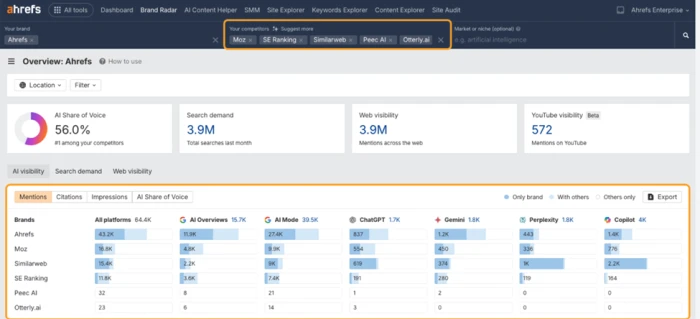
Ahrefs Brand Radar, Semrush AI Toolkit
Teams already paying for those suites
Enterprise
Custom
Profound, Conductor
Board-level reporting and compliance
If you already pay for Ahrefs or Semrush, switch on the built-in module before adding a subscription. The data sits next to metrics you already read, which is usually worth more than marginal accuracy.
Track four numbers and ignore the rest: citation frequency, share of voice against named competitors, sentiment in the answers you appear in, and AI referral traffic in GA4.
10. Five things that backfire
• Coordinated Reddit posting. Detected quickly, punished permanently, and the removed threads take your citations with them.
• Mass-produced pages built to be "AI-optimised". Volume does not create the third-party validation that Table 2 shows carries branded citations.
• Schema on thin content. Valid markup on a page with nothing to extract produces no citations.
• Blocking training bots and assuming search bots still work. They are separate user agents and need separate rules, as Section 5 covered.
• Rewriting the homepage as a citation strategy. Owned pages account for around 4.5% of branded citations.
Your first 30 days
The order matters. Fixing content before fixing access means shipping work no crawler can reach.
Week
Do this
You will know it worked when
Week 1
Audit robots.txt and CDN rules. Run your 20-prompt baseline in both engines and log every result.
Retrieval bots return 200s in your server logs and you have a written baseline.
Week 2
Restructure your five highest-intent pages. Answer first, self-contained sections, real numbers, correct schema.
Rich Results Test passes and each section reads correctly in isolation.
Week 3
Claim review profiles, fix entity inconsistencies, pitch two data-led stories, start participating in two communities.
Two new third-party mentions exist that did not exist before.
Week 4
Re-run the 20 prompts. Compare against Week 1. Check GA4 referrals from both engines.
Perplexity shows movement. ChatGPT probably will not yet, which is expected from Table 3.
Expect the Week 4 result to be lopsided. Perplexity re-indexes in days, so that is where early wins appear. ChatGPT lags by four to eight weeks, which means the honest evaluation point for the full programme is day 60, not day 30. Book that review now, because the brands that abandon this at day 30 do so exactly one cycle before the second engine catches up.


Discussion
Join the discussion and share your perspective.