On an AI pricing page, "unlimited" almost never means uncapped. It usually means unlimited access to one element of the service, subject to a fair-use policy, rate limits, a slower queue, or abuse of guardrails, while the expensive parts stay metered by credits, requests, or time windows.
That distinction now carries real money. Individual plans run from $10 to $200 a month, teams sign annual contracts against them, and Anthropic is currently defending a proposed class action over what its plan labels promised. The word is doing heavy lifting on nearly every pricing page in the category, and most buyers have no reliable way to check it before their card is charged. What follows is a way to read the claim: the six things it can mean, the mechanisms sitting behind it, the legal test that already exists, and a five-minute audit you can run on any plan.
The short answer: "unlimited" is a policy, not a promise
Two distinctions make almost every AI pricing page readable.
The first is access versus consumption. UK advertising regulators settled this for telecoms more than a decade ago. An "unlimited" claim is understood to describe access to a service rather than its performance, which is why a provider can slow you down without lying, but cannot quietly cut you off. Read AI pricing through that lens and the slow queues, peak-hour throttling, and silent fallback to a weaker model stop looking like bugs. They are the mechanism.
The second is scope. "Unlimited chat" is not the same claim as "unlimited plan," and vendors rarely make the difference obvious. Windsurf offers genuinely uncapped tab completions while agent work draws on a quota. GitHub Copilot pairs unlimited inline suggestions with a monthly premium-request allowance where top-tier models consume several units per call. In both cases the word is accurate and the plan is capped.
The one-line test
Ask which element the word is attached to, then ask what happens to that element when you use a lot of it. If the answer to either question is missing from the page, you are buying undefined fair use.
The Unlimited Spectrum: six meanings behind one word
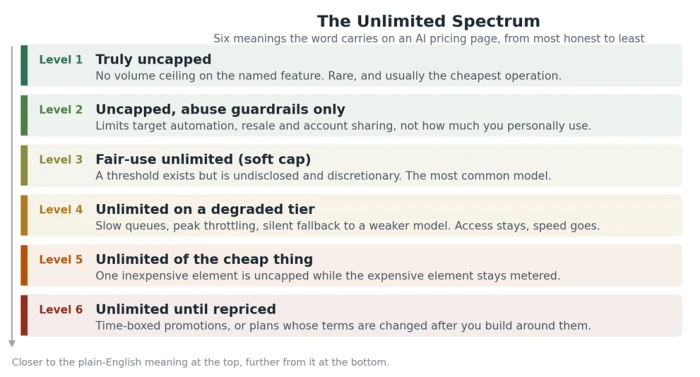
Sorting claims by honesty rather than by vendor makes the pattern visible. The six levels below run from the plain-English meaning down to the version that keeps generating headlines.
The Unlimited Spectrum: a classification of unlimited claims used on AI pricing pages.
Level 1 is rarer than the marketing suggests, and when it appears it is usually attached to the cheapest operation a vendor runs. OpenAI removed the message cap on text chat across ChatGPT plans in August 2026, a genuine example of the top of the spectrum.
Level 3 is where most of the category sits. A threshold exists, it is enforced, and it is never published. Buyers in adjacent markets have already learned to treat this as a contract question rather than a marketing one: if the boundary is not defined in writing, the service is not unlimited, it is discretionary.
Level 5 catches more people than any other. One inexpensive element is uncapped while the thing you actually came for stays metered. AI answering services advertise no per-minute or per-call charges while capping the number of unique callers per month. Video platforms advertise unlimited generation that turns out to apply to the image models, or to a slower queue.
Level 6 covers two patterns that feel identical to the customer. The first is the time-boxed promotion, such as Adobe running unlimited Firefly image generations for eligible plans between late January and mid-March 2026. The second is the plan that changes after you have built a workflow around it. Cursor removed the 500 fast-request cap from its Pro plan in June 2025 and described the result as unlimited, then rewrote the plan description to "extended limits on agent" weeks later. The company later published a pricing clarification acknowledging it had not been clear that the unlimited claim applied only to Auto mode.
The mechanisms that actually stop you
The spectrum tells you what kind of claim you are reading. The next step is knowing which machinery enforces it, because the enforcement method determines what a limit feels like in practice.
Mechanism
How it reads on the page
What it feels like
Rolling session window
Limits reset every few hours
Bursts are fine, long sessions end abruptly
Fixed weekly cap
Weekly usage limit across all models
A heavy Monday costs you Thursday
Credit or dollar pool
Includes $20 of model usage
Spend is visible but hard to forecast
Premium request quota
300 premium requests per month
Better models drain the budget several times faster
Effort-based billing
You pay for what the agent does
Debugging loops cost more than building
Model gating
Access to advanced models
The plan works until you need the good model
Queue priority
Faster generations, priority access
Unlimited, at a speed you would not choose
Context ceiling
Larger context window
Long files silently degrade before any cap appears
Acceptable use policy
Subject to abuse guardrails
Rarely bites individuals, always bites automation
Change-of-terms clause
Buried in the terms of service
The limit you bought is not the limit you keep
Two clocks, not one
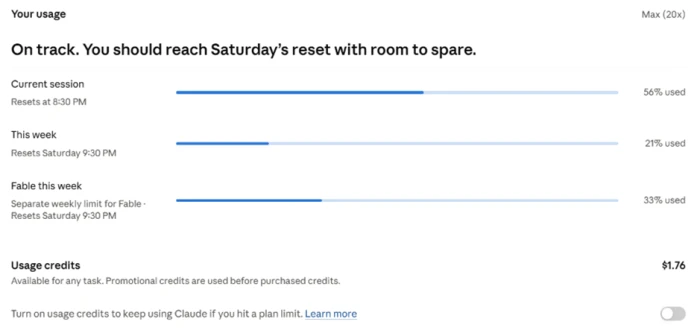
Anthropic meters paid Claude plans on a rolling five-hour session window and a separate weekly cap that resets at a fixed time tied to your account. Most confusion about Claude limits comes from people assuming there is one clock. There are two, and they fail differently. You can be locked out by the weekly cap while your session still has headroom, which is why bursts feel generous and sustained work does not.
Units you cannot count
Credits, premium requests, flow actions, and effort units share one property: the buyer cannot convert them into work before purchase. GitHub Copilot publishes a premium-request allowance, but advanced models draw three requests per call, and overage runs at four cents each. The published number is real. It is also not the number you get.
The clause that overrides everything else
Almost every consumer AI subscription reserves the right to change usage limits. That clause is what turns a Level 1 claim into a Level 6 claim without a single word on the pricing page changing. Anyone signing an annual plan should read it before the feature list.
Why "unlimited" keeps breaking
It is worth being fair to the vendors here, because the economics are not a pretext. Every request is a compute event, and the reasoning-heavy models that buyers now prefer cost meaningfully more per call than the ones they replaced. Flat pricing survived that. What it did not survive was agents.
A chat user sends a few dozen messages a day. A single paying account running an autonomous coding agent can issue thousands of calls while its owner is at lunch. That is the structural break, and it explains why the pricing controversies cluster around coding tools rather than marketing or support products. Coding is flow work with an unknowable scope. A quota wall arriving mid-task is the exact opposite of what the product promises.
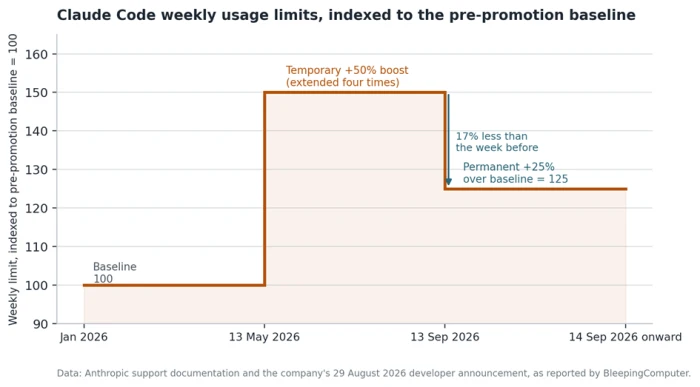
Capacity moves the other way too, and most coverage ignores it. Anthropic permanently doubled five-hour limits for paid Claude plans in May 2026 and removed peak-hour reductions at the same time. The chart below shows what happened next to the weekly limits, and why the same announcement can be accurate and infuriating at once.
Anthropic ran a temporary 50% weekly boost from May 2026, extended it four times, then replaced it on 14 September 2026 with a permanent 25% rise over the original baseline.
Anthropic described the September change as a permanent increase, which is true against the pre-promotion baseline. Measured against the boosted level users had been working with all summer, it is roughly 17% less capacity. Both figures are correct. They use different reference points, and the omission of the comparison date is what turned a capacity decision into a trust story.
The lesson for buyers
When a vendor announces a limit change, find the reference point before you react. When a vendor announces a multiplier, find out which window it applies to. A 20x label on a session window tells you almost nothing about a weekly cap.
Where the legal line sits
This is the part of the topic almost nobody covers, and it matters because the standard already exists. AI pricing pages are being written as if telecoms never had this argument.
The four-part test AI never adopted
UK advertising guidance sets out when an unlimited claim is acceptable despite a fair-use policy. A legitimate user must incur no additional charge and no suspension of service for exceeding a usage threshold. Any provider-imposed limitation affecting speed or usage must be moderate only. That limitation has to be explained clearly in the marketing communication itself, not somewhere the customer has to go looking. And the claim is judged against the specific element of the service it is attached to.
Run current AI pricing pages against those four criteria and the third one is where most of them fail. The limits exist, they are often documented, and they are almost never explained where the claim appears.
The US standard is net impression, not footnotes
The Federal Trade Commission judges the overall impression an advertisement creates. Its guidance is blunt about the fix most companies reach for: disclosures that flatly contradict a deceptive claim are generally ineffective, and the better course is to narrow the claim to something you can substantiate rather than adding a qualifier. The agency's prominence test is equally direct. If a disclosure is genuinely clear and conspicuous, consumers do not have to hunt for it. The FTC's own deception policy statement is the primary source worth reading if you write pricing copy for a living.
What the Anthropic case is actually about
In June 2026, a Claude subscriber named Karl Kahn filed a proposed class action in the Northern District of California over the Max 5x and Max 20x plans. The complaint argues that once weekly limits are counted, the delivered capacity falls well below the multipliers in the plan names, and it puts the real figures closer to 3.5x and 6x to 8x. Claims include false advertising, violations of California's Consumers Legal Remedies Act, negligent misrepresentation, and breach of contract. The suit was expanded into a consolidated class action in September 2026. These are allegations. Anthropic has not been found liable, and filing a complaint is not a finding of wrongdoing.
The most instructive part is the defence. Anthropic has argued the relevant usage details were reachable through links shown during checkout. Plaintiff's counsel countered that a customer should not have to click through several pages to learn what they are buying. However that argument resolves, it tells every buyer exactly what to measure: how far the truth sits from the claim.
If you have already been throttled
• Check whether the plan changed after you subscribed, using archived versions of the pricing page as evidence.
• Use the vendor's own refund window first. Most consumer AI subscriptions have one, and it is faster than any other route.
• UK and EU buyers have consumer-authority routes under unfair commercial practices rules that run independently of any US class action.
• Card chargebacks usually end your account, so treat them as a last option. None of this is legal advice.
The Asterisk Audit: reading a claim in five minutes
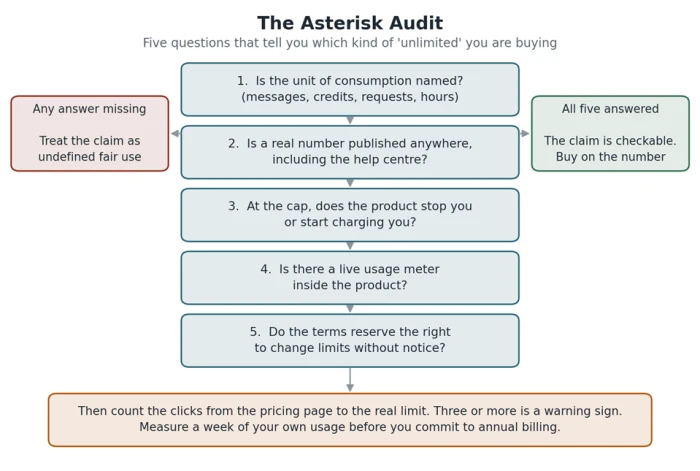
Everything above collapses into a short pre-purchase routine. Five questions tell you which level of the spectrum you are on.
The Asterisk Audit, a five-question check to run before subscribing to any plan marketed as unlimited.
Then add one measurement no vendor publishes: clicks to truth. From the pricing page, count the clicks needed to reach a specific, numeric statement of the real limit. Zero or one is a page written by people who expect to be checked. Three or more is the pattern currently being litigated.
The single best signal, though, is question four. A live usage meter inside the product is expensive to build, impossible to fake, and it makes throttling predictable rather than arbitrary. Its absence has been the most consistent complaint in every pricing backlash of the past two years, including the Kilo Code post titled "Stop selling unlimited, when you mean until we change our minds," which reached the top of Hacker News.
The number that matters more than the price
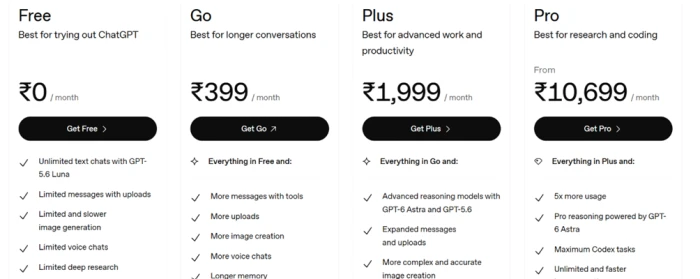
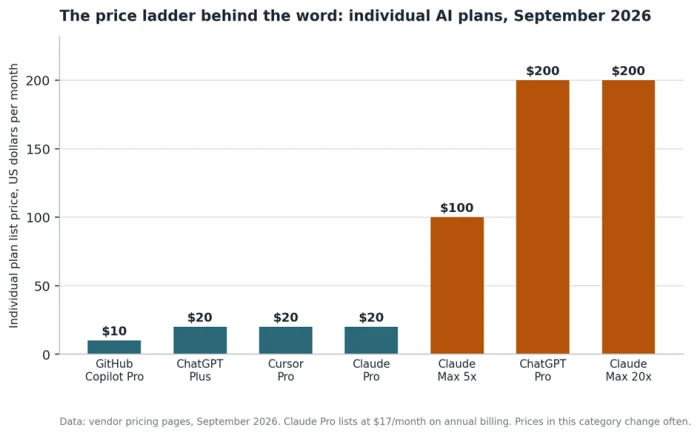
Sticker price is the least informative figure on a pricing page, because it says nothing about how many attempts it takes to get one usable result.
Individual AI plan list prices, September 2026. The spread between the entry tier and the power-user tier is 20x.
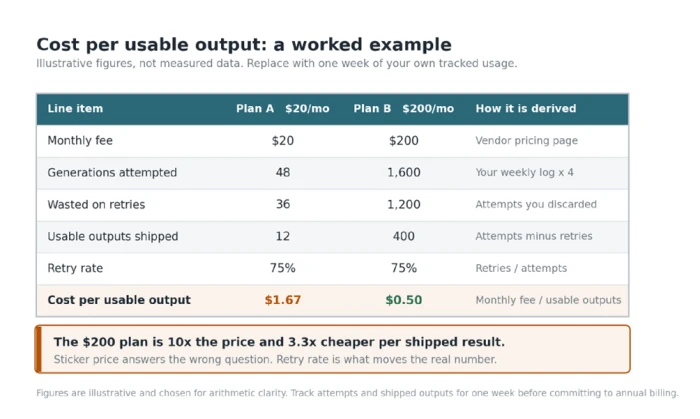
Retries are the hidden multiplier. A video clip that drifts on motion or faces gets regenerated four or five times before it ships. An agent debugging session iterates, breaks something adjacent, and iterates again. On a credit plan you pay for every miss. On a genuinely uncapped plan you pay for none of them, which is why comparing platforms on monthly fee alone produces the wrong answer.
The calculation is simple enough to run in a spreadsheet. Divide the monthly fee by the number of outputs you actually shipped, not the number you generated. A $200 plan that produces 400 usable results costs 50 cents each. A $20 plan that produces 12 usable results before hitting a wall costs $1.67 each. Run that for one week on a trial before committing to annual billing, because annual billing is where an undefined fair-use policy does the most damage.
Matching the metering model to how you actually work
Different mechanisms suit different work patterns, and the mismatch is usually what causes the frustration rather than the limit itself.
Your work pattern
Metering model that fits
What to avoid
Short, unpredictable bursts
Rolling session windows
Monthly credit pools you forget to track
Long agentic sessions
Credit or dollar pools with a visible meter
Undisclosed weekly caps
Hard ceiling on spend required
Fixed quotas with overage switched off
Usage credits enabled by default
High-volume, low-stakes output
Slow-queue unlimited tiers
Premium-model gating
Buying seats for a team
Written definitions attached to the order form
Marketing-page claims with no contractual backing
Team buyers have bargaining power that individuals do not. Before signing, ask for written answers to four things: what "unlimited" includes and excludes, where the fair-use boundary sits, what triggers throttling, and which operations are metered separately. Tie the answers to the order form rather than the marketing page. Vendors who will not put those definitions in writing have told you what the word means.
For builders: writing a claim you will not have to defend
Buyers are not the only audience for this problem. If you are writing an AI pricing page right now, three claims hold up and four do not.
The ones that hold up: name the element precisely rather than the plan. Publish a number, even a soft one, because a soft number beats an undefined threshold. Put the limitation where the claim appears rather than three clicks away, which is both the UK regulatory requirement and the exact point currently being argued in a California courtroom.
The ones that do not: undefined fair use. An asterisk carrying the weight of a material disclosure. Multipliers published without stating what they multiply. And silent repricing of a plan people have already built workflows around.
Communicating a limit change is its own skill. Advance notice, an old-versus-new comparison, a transition period, and grandfathering with a stated expiry will absorb most of the anger. So will one habit that costs nothing: always state the comparison date. A permanent increase described without reference to the promotion it replaces reads as spin even when the arithmetic is sound, which is precisely the trap Anthropic walked into in September 2026.
What "unlimited" will mean in 2027
Three things are already in motion. Hybrid pricing is becoming the default, with a subscription floor and a metered ceiling, and the word retreating to whichever operation is cheapest to serve. Litigation and consumer-authority pressure are making undefined fair use legally expensive, which points toward either published numbers or the word quietly disappearing from pricing pages. And a small group of vendors is competing on legible metering rather than on the biggest promise, selling non-expiring balances at published model rates instead of a flat plan with a hidden ceiling.
The vendors themselves are not pretending otherwise. OpenAI's head of ChatGPT, Nick Turley, has said there is no world in which pricing does not significantly evolve when the technology is changing this quickly. Read that alongside the Kahn filing and the shape of the next two years is reasonably clear.
Which leaves a practical conclusion that runs against the instinct most buyers have. The plan to be suspicious of is not the one with the lowest limit. It is the one with no number at all. A published cap you can hit is a cap you can plan around, budget for, and argue about with evidence. An unlimited claim with no denominator gives you nothing to hold when the meter moves, and on current form, the meter moves about every four months.





Discussion
Join the discussion and share your perspective.