How to Spot Fake Reviews on AI Directories (2026 Field Guide)
Learn how to spot fake reviews on AI directories in 2026. Discover the red flags, paid listings, fake ratings, “verified” badges, and our 90-second trust audit.
Fake reviews on AI directories are fabricated ratings, testimonials, or "verified" signals attached to a tool’s listing to make it look more trusted than it is. On an AI directory the review text is rarely the only thing that has been manufactured. The ranking above it can be paid for, and the badge beside it often verifies something other than what you assume. So the skill worth learning is not spotting an AI-written sentence. It is auditing the whole listing.
That distinction matters because the barrier to launching an "AI-powered" product collapsed to roughly a weekend and an API key, and directories became the shop window for thousands of these tools at once. When the storefront itself earns money from the products on its shelves, the star rating stops being a neutral fact. This guide shows you how to read past it in about ninety seconds, without paying for a detection tool.
Why AI directory reviews are a different problem from Amazon reviews
Most advice about fake reviews was written for shoppers on Amazon or Yelp. It assumes a physical product, a verified-purchase tag, and a buyer who can return the item. AI directories break all three assumptions. The "product" is often a subscription to software that may not exist in a year, there is no shipment to verify, and the directory frequently has a financial stake in the tools it lists. Three shifts, arriving together, made this its own problem.
The three shifts that changed the game in 2026
• Fake reviews got fluent and free. Language models write specific, plausible, typo-free reviews at any volume a vendor wants. The old tells (broken English, wild enthusiasm) no longer separate real from fake.
• Directories blend editorial picks with paid placement. The order tools appear in is frequently influenced by fees or affiliate deals, and the disclosure is often buried or missing.
• AI search now cites directories. When ChatGPT or Perplexity recommends a tool, it may be leaning on a directory or review platform. A manufactured rating can therefore travel into an AI answer with its context stripped away. BrightLocal’s 2026 research found 88% of AI-search users still fact-check results by checking the underlying sources and reviews, which is exactly the habit this guide builds.
Fake reviews are already illegal, and it barely protects you
Since October 21, 2024, the United States Federal Trade Commission’s Rule on the Use of Consumer Reviews and Testimonials (16 CFR Part 465) has banned fake and AI-generated reviews, reviews from undisclosed company insiders, and the suppression of genuine negative reviews. Penalties reach up to $51,744 per violation. The rule has teeth on paper. In practice, enforcement lags far behind the volume of fakes, consumers cannot sue under it directly, and a rule made in Washington does nothing about a listing published anonymously overseas. Self-defense is still the reliable protection.
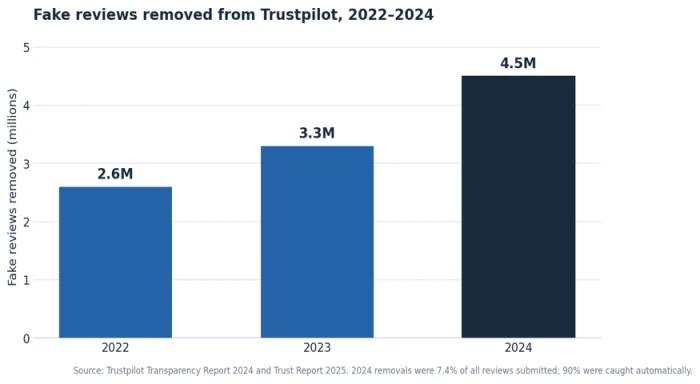
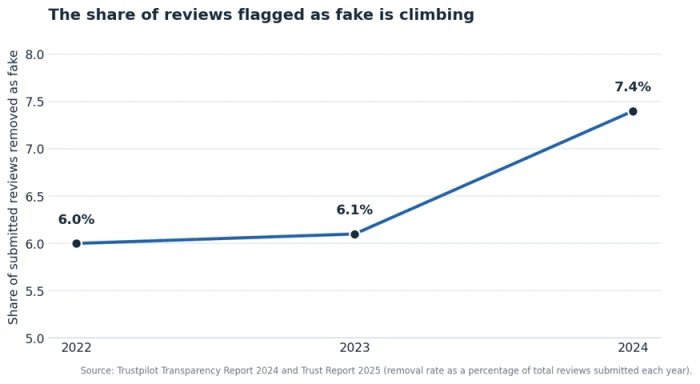
The scale, in one number: Trustpilot removed 4.5 million fake reviews in 2024 alone, about 7.4% of everything submitted to the platform that year, with 90% caught automatically by its detection systems. That is one platform, in one year. Directories with no such systems are catching a far smaller share.
Fake reviews removed from Trustpilot each year. Data: Trustpilot Transparency Report 2024 and Trust Report 2025.
The uncomfortable truth: the ranking may be for sale, not just the reviews
Before you scrutinize a single review, look at the listing’s position and its badges, because those are the parts a vendor can buy outright. A five-star rating built from fakes takes effort to fabricate. A top slot or a "verified" badge often takes only a payment. Reading the directory’s business model is the fastest way to calibrate how much any rating is worth.
Paid versus organic listings, and why you often cannot tell them apart
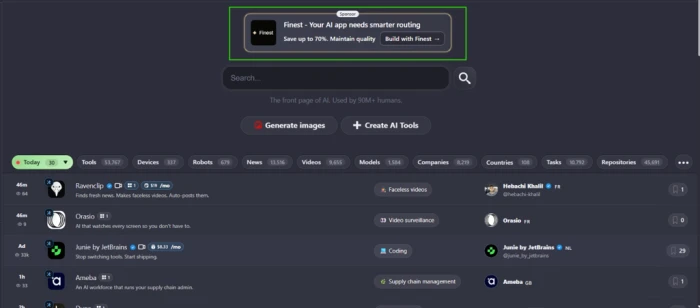
Directories monetize placement in several ways: flat fees for "featured" or "sponsored" slots, affiliate commissions that reward the tools most likely to convert, and ordering that quietly favors paying customers. Some are transparent about it. There’s An AI For That, the largest AI directory, has been described in independent audits as carrying heavy affiliate linking that makes editorial picks hard to separate from paid ones. Google’s own spam policy requires paid links to be marked as sponsored, yet many directories still do not label them, which is both a trust problem and a sign the operator cuts corners.
Signal
Likely a paid slot
Likely earned
Label on the listing
"Featured", "Sponsored", "Promoted", or a colored badge
No promotional tag; sits inside normal results
Position vs. relevance
Ranks above clearly more popular tools
Position tracks usage, recency, or votes
Link type
rel="sponsored" or nofollow on the outbound link
Standard editorial link
Disclosure
Buried, vague, or absent
Plain-language disclosure page you can find
Does a "verified" badge mean the reviews are real?
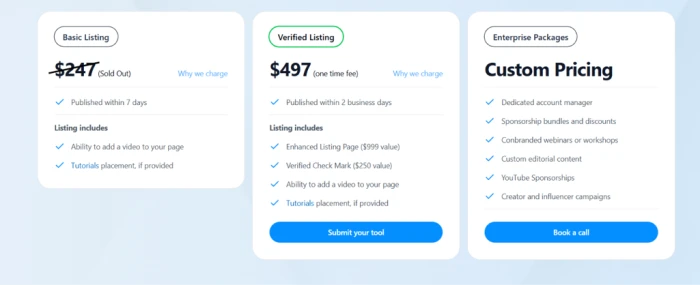
Usually not. On most AI directories, "verified" means the operator confirmed the tool’s website is live, that a submission fee was paid, or that the vendor embedded the directory’s badge on its own site. It rarely means anyone independently tested the product or audited its reviews. Futurepedia, for example, sells verified listings in the region of $247 to $497, which buys a badge, priority placement, and a video slot, not an independent quality check. Several directories run a free tier that requires you to place their badge on your site in exchange for a listing. Knowing what a badge actually certifies is the difference between a real signal and decoration.
What the badge says
What buyers assume
What it usually means
"Verified"
Reviews and claims were checked
Site is live and/or a fee was paid
"Featured" / "Top pick"
Editorially judged the best
Paid for prominence
"Badge on your site"
Independent seal of approval
Reciprocal link traded for a listing
Human-reviewed
Product was tested
A person skimmed the submission before publishing
Undisclosed sponsors and the affiliate conflict
When a directory earns a commission every time you sign up for a listed tool, its "best of" ranking carries a built-in incentive that no star rating reveals. This is legal when disclosed and a red flag when hidden. Look for an affiliate-disclosure or advertising page. If a directory publishes glowing rankings and you cannot find any statement of how it makes money, treat its recommendations as advertising until proven otherwise.
Why reading the review text no longer works
Once you have weighed the listing’s position and badges, you will be tempted to read the reviews for clues. Read them, but adjust your instincts, because the writing itself has stopped being a reliable tell.
The old tells that now betray you
For years the advice was to distrust bad grammar and generic enthusiasm. That advice has inverted. Real customers type on phones, misspell things, ramble, and complain about billing. A review that reads like clean marketing prose with a tidy structure is now slightly more suspicious than a messy one, because fluent text is exactly what a language model produces by default. Polished writing is a mild flag, not a mark of authenticity.
The few text tells that still mean something
• Praise that names nothing specific. Genuine users describe the feature that helped or the workflow that broke. Fabricated praise reaches for vague superlatives about a "game changing experience" without ever saying what the tool did.
• Identical phrasing across supposedly unrelated reviewers. Three strangers describing a tool as "intuitive and powerful" in the same rhythm is one author with three accounts.
• Claims that do not match the product. Reviews praising features the tool does not have, a classic sign of copied or templated text.
The signals that survive: audit the structure, not the sentences
The durable signals moved from the writing to the shape of the data around it. These survive whatever the text looks like, which is why they beat both your own eye and most detection tools.
Review velocity
Sort the reviews by most recent and read the dates. Organic reviews accumulate in a steady trickle as people adopt a tool over months. A cluster of glowing five-star reviews landing inside a 24-to-48-hour window, especially after a long quiet stretch, is the signature of a paid campaign or a launch-day push to game the directory.
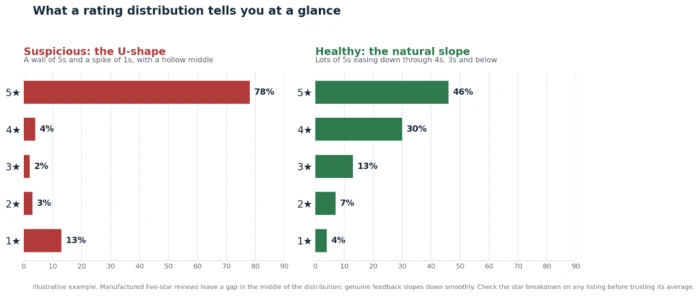
The rating distribution shape
Click the star breakdown. A healthy product shows a slope: many fives, a solid band of fours, a scattering of lower scores. Watch for a U-shape instead, a pile of five stars and a pile of one stars with almost nothing in between. That pattern often means the fives were manufactured and the ones are real users arriving afterward to set the record straight.
Reviewer profiles and history
Open two or three of the most enthusiastic reviewers. Accounts created recently, with a single review or dozens of five-star reviews for unrelated products posted in a short window, are the profile of a review farm rather than a working professional. On platforms like G2 or Capterra, check whether the reviewer’s employer and role are verified and whether the profile has any depth at all.
The four-star reviews are where the truth lives
This is the single most useful habit. Fake campaigns concentrate on five stars, and one-star reviews are often about a billing dispute or a login bug rather than the product. The four-star reviews are where real customers write the sentence you actually came for: "it is good, but the API rate limits are painful and support took four days." That is the honest texture no fabricated review bothers to invent.
Cross-source triangulation
The strongest move is to stop trusting any single source and check whether the tool’s story holds up across independent ones. Search the tool’s name on Reddit, scan its Product Hunt comments, read its most recent G2 reviews, and open its changelog. When the directory rating, the forum chatter, and the product’s own release notes agree, you have real signal. When a five-star directory listing describes a thriving product that Reddit has never heard of and whose changelog stopped a year ago, the rating is the outlier, and outliers lose.
AI-tool red flags a review cannot tell you
Fake social proof and a weak product tend to travel together, so the review audit connects directly to a product audit. A wall of five stars is worth nothing if the tool behind it is fragile or already dying.
The thin-wrapper tell
Many "AI tools" are a thin interface over someone else’s model with no proprietary data and no real moat. They collect glowing early reviews, then get flattened when the base model ships the same feature natively. Jasper is the cautionary case: reporting indicates its revenue fell sharply from around $120 million as ChatGPT closed the writing-assistant gap it had been charging for. Ask what the tool does that you could not get by prompting the underlying model yourself. If the honest answer is "a nicer interface," the reviews are describing a product with a short shelf life.
AI-washing and the review echo
Regulators spent 2024 and 2025 going after companies that inflated or invented their AI. The FTC’s Operation AI Comply produced the DoNotPay case, a "robot lawyer" that settled for $193,000 after the agency said it never tested whether its AI matched a human attorney’s work. The SEC separately fined two investment advisers, Delphia and Global Predictions, a combined $400,000 for marketing AI they had not actually built. Manufactured reviews are the amplifier for exactly this kind of vague "AI-powered" claim. When the marketing is hazy about what the model does and the reviews are uniformly ecstatic, the two are often propping each other up.
Will the tool even exist next year?
A five-star listing on an abandoned product is a warning, not reassurance. Check for a changelog updated in the last few months, a status page with real incident history, and a domain that is not about to expire. Independent tracking of failed AI tools finds that a large share simply go dark when their domain quietly lapses, with no announcement. A tool that stopped shipping updates a year ago is not a safe bet no matter how bright its rating.
Listing hijacking and inherited reputation
This trick catches careful readers because the reviews are completely genuine. They just belong to a different product. Marketplaces and some directories let vendors group product variations, and reviews follow the group. An established listing with thousands of positive reviews can be edited to sell something else, or a newly acquired tool can be rebranded on top of an older product’s reputation. The tell is in the review text: if the reviews describe a different feature set, a different price, or an older version than the tool now on the page, you are reading a hijacked listing, and its star rating means nothing. This is the one place where reading the review text pays off, not to judge its prose, but to check that it is even describing the product in front of you.
Do review-checker and AI-detector tools help?
Partially, with caveats worth stating plainly. These tools scan account ages, timing anomalies, and verified ratios faster than you can, which is genuine value. But they are detection tools chasing generation tools, a race the generators are currently winning, and a confident-looking grade is a probability estimate rather than a verdict. The market is also unstable: Fakespot, for years the most-recommended free checker, was shut down after Mozilla acquired it, leaving a gap now filled by paywalled or dated alternatives. Use a checker as a first-pass signal if you like. Never use it as the deciding vote, and remember that a tool whose business model is telling you what to buy is not a neutral oracle.
The honest shortcut: The free method that consistently outperforms paid checkers is to search the tool’s name on Reddit and read the four-star reviews. Real owners arguing about a product in a forum thread will tell you more in five minutes than a thousand ratings of unknown origin.
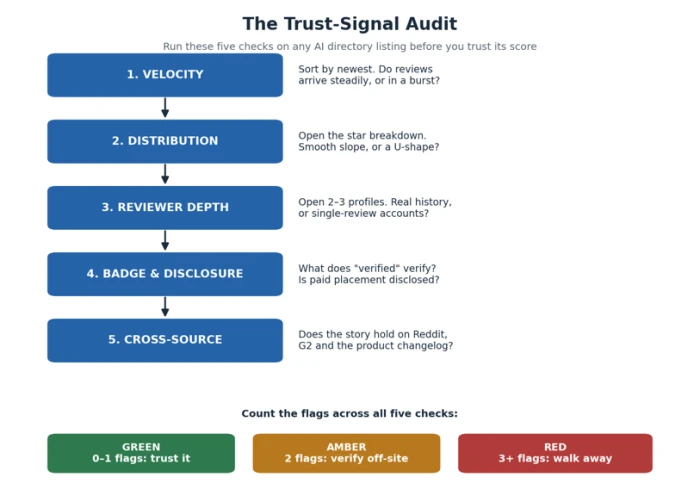
The Trust-Signal Audit: score any listing in ninety seconds
Everything above collapses into five checks you can run on any AI directory listing before you trust its score. Count the flags. One is noise. Two means verify off-site before you commit. Three or more means walk away.
A worked example
Picture two listings for AI meeting-note tools. "NoteFlow AI" shows 340 reviews, 96% of them five stars, almost all posted in one week last quarter, from accounts with no other history, carrying a "Verified" badge and a sponsored tag, with no Reddit footprint and a changelog last touched eleven months ago. "ClarityScribe" shows 210 reviews accumulated steadily over two years, a normal slope of fours and fives with some critical threes, reviewers whose profiles list real employers, an active changelog, and a lively Reddit thread debating its pricing.
Run the audit and NoteFlow trips four flags: burst velocity, a distorted distribution, hollow reviewer profiles, and a paid badge with no cross-source support. ClarityScribe trips none. The star ratings alone barely separate them. The structure separates them instantly.
What to do when you spot a fake
1. Report the listing to the directory and, for a US-based tool, to the FTC. Complaint volume is one signal regulators use to prioritize enforcement.
2. Prefer tools that offer a real free trial or a refund window over ones that only offer testimonials. A trial is something you can verify; a review is something you have to trust.
3. Weight the tool’s own recent product activity and independent forum discussion above any directory badge.
When the recommendation comes from an AI, not a directory
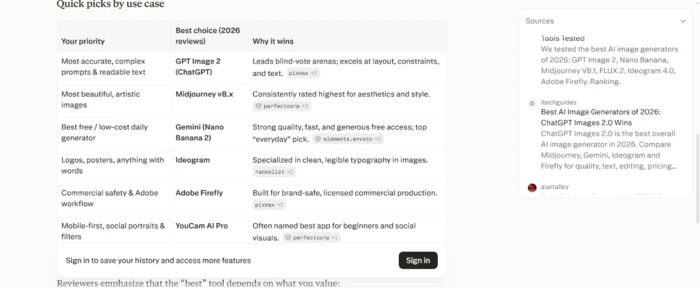
The stakes changed once AI assistants started answering "what is the best tool for X" directly. Perplexity leans heavily on third-party review platforms and forums; ChatGPT and Google’s AI answers pull from directories, comparison sites, and Reddit to differing degrees. A manufactured directory rating can therefore surface inside an AI recommendation with the citation flattened into a confident sentence, so you never see the burst of one-week reviews behind it.
The defense is the same audit, moved one step earlier. When an AI assistant recommends a tool, open the sources it cites and run the five checks on them. "Check the sources the AI cited" is simply the 2026 version of "read the four-star reviews." The tools change; the habit of trusting agreement across independent sources over any single confident claim is what keeps holding up.
The pattern underneath all of this is worth holding onto: a review is an assertion, and a rating is a pile of assertions, but a refund window, an active changelog, and a candid forum thread are closer to guarantees. The vendors who manufacture reviews are spending money to fake the cheap signals precisely because the expensive ones, real usage and real accountability, are the hard ones to fake. Spend your attention there.



Discussion
Join the discussion and share your perspective.