Open Weights vs Open Source: The Difference That Actually Matters (2026)
Open weights vs open source explained for 2026. Learn the key differences in licenses, training data, code, redistribution, audits, and AI regulations.
A model gets announced as open source. Your team downloads the weights, fine-tunes them on internal data, and ships. Nine months later a customer's procurement team asks who reviewed the license, and the answer is nobody, because everyone assumed open source meant what it has meant since 1998.
That assumption is wrong more often than it is right.
Open weights means you get the finished model. You can download it, run it on your own hardware, quantize it, and fine-tune it. Open source means you also get the recipe: the training code plus enough detail about the data to rebuild the model and audit what went into it. Almost every model currently marketed as open source belongs in the first category.
The distance between those two sentences decides what you are legally allowed to ship, what your auditors can verify, and which regulatory duties land on you instead of on your vendor. What follows walks that difference from definition to decision, and gives you a test you can run against any model card in about ten minutes.
Why the label keeps slipping
The confusion is not sloppy journalism. It is an incentive.
Openness in AI carries real rewards: reputational credit, developer goodwill, and in Europe a partial exemption from regulatory paperwork. The EU AI Act attaches concessions to models released under a free and open-source licence, without pinning the term down with the precision an engineer would want. Researchers Andreas Liesenfeld and Mark Dingemanse named the consequence open-washing in a 2024 paper presented at the ACM Conference on Fairness, Accountability, and Transparency. After surveying dozens of models that billed themselves as open, they found that several large vendors adopt the vocabulary of openness while shielding the substance from scientific and regulatory scrutiny.
So the word does work the release has not earned, and the burden of checking lands on the buyer.
What model weights actually are
Weights are the learned parameters of a trained neural network: the billions of numbers that determine how a model turns an input into an output. Publishing them lets anyone run the model and adapt it. It reveals nothing about what the model was trained on, how that data was filtered, or which post-training choices shaped its behaviour. Possession of weights is an access fact, not a transparency fact.
What open source actually requires
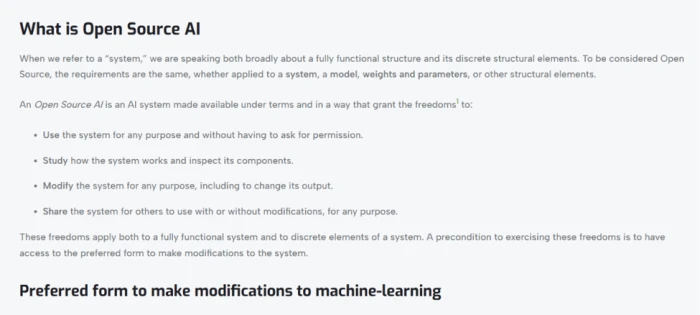
The Open Source Initiative, steward of the Open Source Definition since 1998, published version 1.0 of its Open Source AI Definition on 28 October 2024. It grants four freedoms inherited from free software: use the system for any purpose without asking permission, study how it works, modify it, and share it.
To make those freedoms usable, the definition requires what it calls the preferred form for making modifications. For an AI system that means three things released together:
• the model parameters, including weights and intermediate checkpoints
• the code used to train the model, process its data, and run inference
• data information detailed enough that a skilled person could build a substantially equivalent system, covering provenance, selection, labelling, and filtering
Weights alone satisfy exactly one of those three.
The clauses that quietly break each freedom
Four license patterns show up repeatedly and each one disqualifies a release:
• A field-of-use restriction such as "not for use in X industry" breaks the freedom to use for any purpose.
• A withheld training pipeline breaks the freedom to study.
• A ban on using model outputs to train other models breaks the freedom to modify and share.
• A user or revenue threshold that converts a free grant into a negotiation breaks the freedom to use without permission.
Why the OSI stopped short of demanding the raw data
The definition accepts data information rather than the dataset itself, because much of the material behind modern foundation models is encumbered by copyright, contracts, or privacy law. The Free Software Foundation and the Software Freedom Conservancy both objected, arguing that without the actual data a downstream user cannot meaningfully modify the system. The OSI's counter-argument is pragmatic: a maximalist bar would cede the conversation entirely to vendors who release nothing at all.
Both positions are documented and defensible. Choose one and state which you are applying, because your classification of a given model may depend on it.
Openness is a spectrum, not a switch
The binary framing is the second-largest source of error after the vocabulary itself. A 2026 study applied a fourteen-criterion openness grid to 189 models drawn from the Open Source AI Index and clustered them statistically. Five profiles emerged rather than two: open washing, easy access, open weight, open science, and open source. Open washing was characterised by partial disclosure centred almost entirely on weights, while the open source cluster combined shared weights with broad disclosure of training data sources, training code, and documentation sufficient for reproducibility.
Policy has moved the same direction. In June 2026, G7 Digital and Technology Ministers published a framework calling for shared language around AI openness and explicitly rejecting binary open-or-closed classification. Five tiers describe the market far better than two:
Tier
Weights
Training code
Data information
License
Open source AI
Published
Published
Sufficient
OSI-grade
Open science
Published
Usually published
Partial
May not conform
Permissive open weight
Published
Withheld
None or thin
Apache 2.0 or MIT
Restricted open weight
Published
Withheld
None
Custom community terms
Source-available / API-only
Gated or none
Withheld
None
Non-production or none
Table 1. The openness spectrum. Most models described publicly as open source sit in rows three and four.
What you gain, and what you quietly give up
Tier labels only matter because they map to capabilities. Here is what each one actually buys you:
Capability
Open source AI
Open weight
API-only
Run on your own hardware
Yes
Yes
No
Fine-tune and quantize
Yes
Usually
Limited
Redistribute a derivative
Yes
License-dependent
No
Retrain from scratch
Yes
No
No
Audit the training data
Yes
No
No
Verify provenance for a regulator
Yes
Partial
Vendor attestation only
Table 2. Access is where open weights stop. Verification is where open source begins.
The losses are concrete rather than philosophical. Suppose you suspect a particular data source degraded a model's behaviour on legal reasoning. With an open-weight release you cannot remove that source, because you can neither inspect the training set nor rerun the pipeline. Your only lever is post-hoc fine-tuning, which papers over the problem instead of fixing it. The same limit applies to bias audits, backdoor detection, and any claim of reproducibility you might need to defend in front of a regulator.
None of that makes open weights a bad deal. Self-hosting, data residency, adaptation, and freedom from a vendor silently swapping models under your API endpoint are genuine wins. They are simply a different set of wins from the ones the phrase open source has historically promised.
The eight-question openness audit
The next step is turning all of this into something repeatable. Run these eight questions against any model card, LICENSE file, and technical report. They take about ten minutes and produce a defensible verdict.
1. Are the full weights published, or gated behind an access request?
2. Is the license OSI-approved, or a custom document written by the vendor?
3. Does the license restrict any field of use?
4. May you redistribute a fine-tuned derivative, and under what naming obligations?
5. Is the training code published, or only inference code?
6. Is there data information sufficient to rebuild an equivalent system?
7. Are intermediate checkpoints and evaluation tooling available?
8. Does any clause revoke or renegotiate your grant above a threshold?
Scoring
Eight yes answers means open source AI. Questions 1 to 4 answered yes with 5 to 7 answered no means permissive open weight. A no on question 2, 3, or 8 means restricted open weight regardless of how the release was announced. Anything gated at question 1 is source-available at best.
Where the answers hide: the LICENSE file rather than the README, the acceptable-use policy linked from the license, and the technical report appendix.
Where today's models actually land
Applying that audit to the current field produces results that surprise most teams.
Is Llama open source?
No. Meta publishes downloadable parameters under the Llama Community License, a custom document with an acceptable-use policy and a commercial threshold: organisations above 700 million monthly active users must request a separate license, which Meta can decline. That fails the freedom to use without asking permission. The Free Software Foundation and the OSI have both reached that conclusion. Llama is restricted open weight, and it remains a capable, widely deployed model. The label is the only thing that is wrong.
Is DeepSeek open source?
Partly, and the nuance matters. DeepSeek released R1 code and models under the MIT license, which is as permissive as licensing gets. But the training pipeline and dataset were not published, so an independent team cannot reproduce the model or audit what shaped its behaviour. The correct description is permissively licensed open weight.
Is gpt-oss open source?
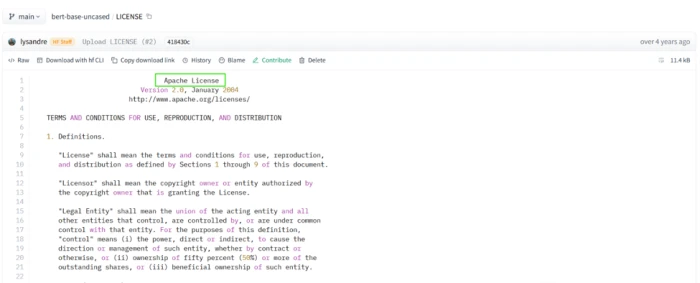
Same answer. OpenAI's gpt-oss models ship under Apache 2.0, which grants broad commercial rights and an explicit patent grant that enterprise counsel tend to prefer. Training code and data information were not released. Permissive license, open-weight system.
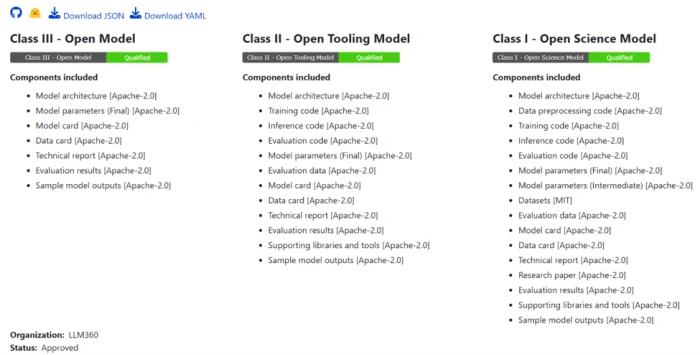
Models that clear the full bar are rare and mostly come from research institutions. The Allen Institute for AI's OLMo family publishes weights, training code, checkpoints, and evaluation tooling under Apache 2.0 alongside the dataset used for pretraining. EleutherAI's Pythia suite and LLM360's Amber and CrystalCoder sit in the same category. These are the reference points for what open source AI looks like when a lab means it.
The clauses that bite in production
Definitions become expensive at the point of redistribution. Three failure modes account for most of the damage.
The first is derivative relicensing. Fine-tuning a model with a restrictive base license does not free you from that license, and you cannot relabel the result under Apache 2.0 simply because you did the fine-tune. Researchers behind the Linux Foundation's Model Openness Framework flagged exactly this pattern: models derived from restrictively licensed foundations being republished under permissive licenses, which the original terms do not permit.
The second is threshold and revocation clauses. A cap that seems irrelevant today becomes a live issue after an acquisition or a viral launch. Legal teams need to see the trigger even when the number looks distant.
The third is the absence of a license altogether. The same Model Openness Framework research found that 64.67 percent of models and 72.13 percent of datasets on the Hugging Face Hub carried no license at all. No license does not mean permissive. It means no grant of rights was ever made, and building on that artifact is legally worse than building on a restrictive one.
Why this became a regulatory question
As discussed above, the EU AI Act is part of why the vocabulary is contested. It is also where getting the classification wrong has the sharpest consequence.
What Article 53(2) exempts, and what survives
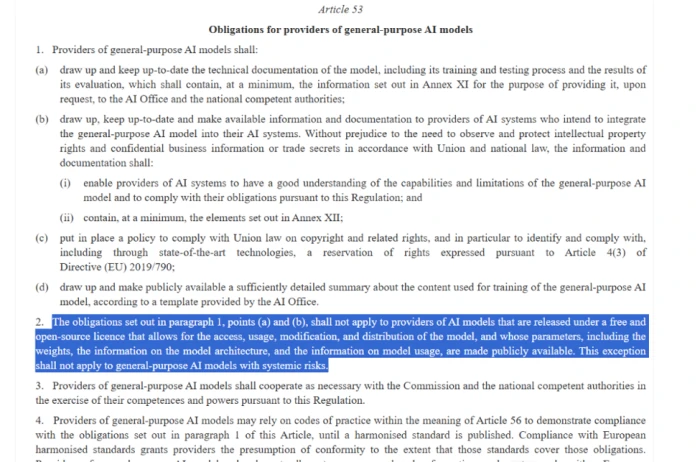
Article 53(1) places four baseline obligations on providers of general-purpose AI models: Annex XI technical documentation, Annex XII information for downstream providers, an EU copyright compliance policy, and a published summary of training content. Article 53(2) disapplies the first two for models released under a free and open-source licence permitting access, use, modification, and distribution, where the parameters, architecture information, and usage information are all publicly available.
Guidance from the AI Office sets three cumulative conditions: the licence must permit all four activities, the weights and architecture and usage information must be public without access gates, and the provider must not monetise the model directly or indirectly. Fail any one and the exemption does not apply.
Two duties the exemption never removes
The copyright compliance policy and the training-content summary apply to every provider regardless of licensing. A provider with freely downloadable weights and no published training-content summary is still in breach. The exemption also disappears entirely for models classified as carrying systemic risk, which pulls in the full Article 55 obligation set.
Washington took the opposite approach
US policy has moved toward promotion rather than restriction. The 2025 AI Action Plan called for support of open-source and open-weight models, better compute access for startups and academics, and help for smaller businesses adopting open models, with the NTIA tasked to convene stakeholders. In July 2026, a coalition including Nvidia, Microsoft, Meta, IBM, Mistral AI, Hugging Face, Mozilla, and more than twenty other organisations urged the administration to avoid premature restrictions on open-weight AI.
Does choosing open cost you capability?
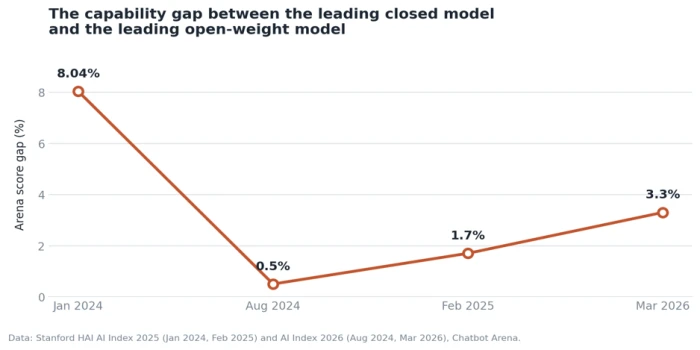
Less than it used to, and the trend is not a straight line. Stanford's AI Index tracks the Chatbot Arena gap between the leading closed model and the leading open-weight model. In January 2024 the closed leader was ahead by 8.04 percent. By August 2024 the gap had collapsed to 0.5 percent. It then reopened, reaching 3.3 percent by March 2026.
Data: Stanford HAI AI Index 2025 and 2026, Technical Performance chapters. Arena measures human preference, not cost, safety, or every capability.
The practical reading is that raw capability rarely decides this anymore. A few percentage points of Arena preference matter less than license terms, inference cost at your utilisation rate, and whether your compliance team can evidence what the model does. The full Stanford HAI AI Index 2026 sets out the methodology behind these figures.
Transparency is moving the wrong way
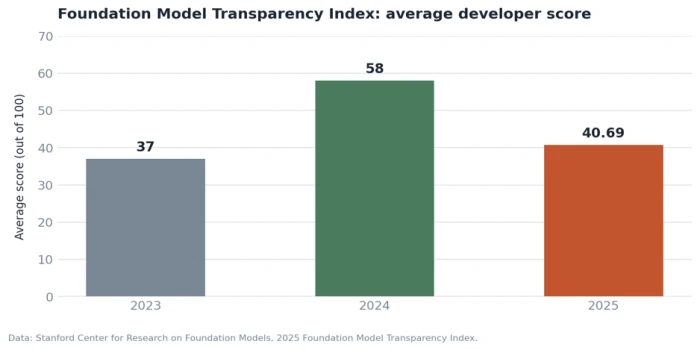
While capability converged, disclosure went backwards. Stanford's Center for Research on Foundation Models scores major developers on how much they publish about training data, compute, deployment practice, and downstream impact. The average rose from 37 in 2023 to 58 in 2024, then fell to 40.69 in 2025, erasing two years of progress.
Data: Stanford Center for Research on Foundation Models, 2025 Foundation Model Transparency Index.
The AI Index pairs that with a starker number: of 95 notable models released in 2025, 80 shipped with no training code at all, against four with open-source training code. Individual scores diverged sharply, with IBM at 95 and the lowest scorers at 14. The 2025 Foundation Model Transparency Index paper breaks the scoring down by indicator.
Read those two charts together and the picture is uncomfortable. Open-weight models are close enough to the frontier to be a serious production choice, at the same moment that the information needed to evaluate any model responsibly is thinning out. The label on the announcement is carrying more weight precisely as it becomes less reliable.
Deciding, and then saying it precisely
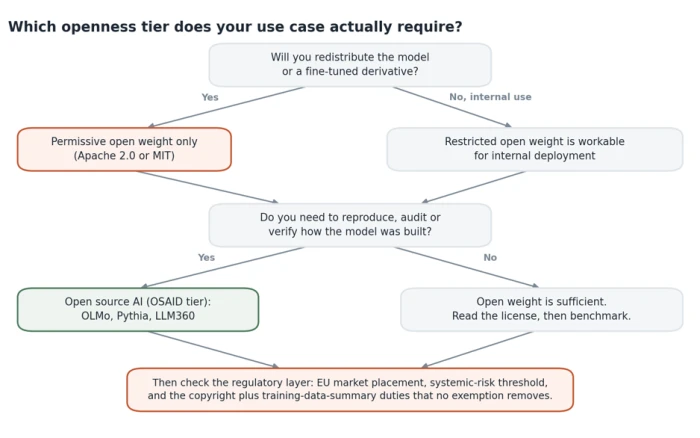
Put the audit and the regulatory layer together and the choice resolves quickly for most teams.
A four-step path from use case to required openness tier.
The last piece is language. Vague vocabulary is how the original problem entered your organisation, so replace it deliberately in design docs, vendor reviews, and model registries:
• Permissively licensed open weight for Apache 2.0 or MIT weights with no published pipeline.
• Restricted open weight for custom community terms with usage or scale conditions.
• Source-available for gated weights or non-production licenses.
• Open source AI reserved for releases that clear all three components.
Four phrases instead of one overloaded word. That precision is what stops a marketing claim from becoming a compliance finding two quarters later.
Which leaves one habit worth building into every model evaluation you run: read the license on the model card, not the label on the announcement. The announcement is written by marketing. The license is the part a court reads.


Discussion
Join the discussion and share your perspective.