The Rise of AI Agents: From Chatbots to Autonomous Systems
Explore the rise of AI agents in 2026 - from chatbots to autonomous systems, real-world use cases, reliability limits, security risks, MCP, A2A and autonomy.
Two numbers from 2026 refuse to agree with each other.
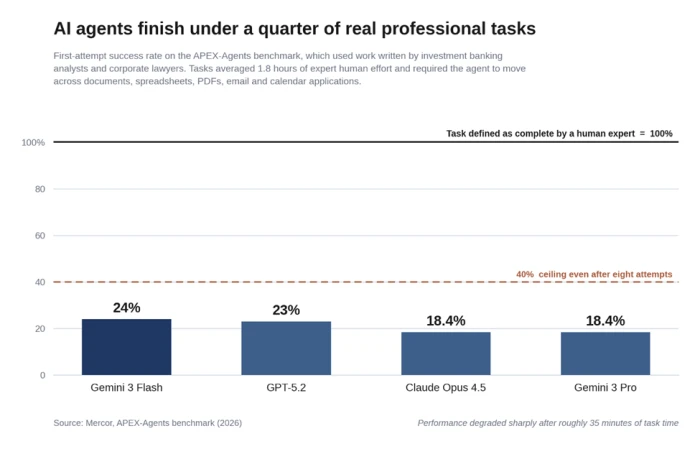
The first says 79 percent of companies have already adopted AI agents, and 93 percent of IT leaders expect to introduce autonomous agents within two years. The second comes from Mercor's APEX-Agents benchmark, which handed frontier models real work produced by investment banking analysts and corporate lawyers. The best model finished 24 percent of those tasks on the first attempt.
Both figures are accurate.
Together they describe the strangest stretch artificial intelligence has had since ChatGPT arrived. Companies are wiring autonomous software into procurement, payroll, clinical documentation and security operations at speed, while the systems doing that work fail roughly three quarters of professional tasks the first time they attempt one.
This article follows how software that could only answer questions learned to take actions, what changed underneath to make that possible, where agents genuinely earn their cost, and why a large share of deployments quietly collapse. The story starts sixty years before anyone said the word agentic.
Sixty Years of Machines That Could Only Talk
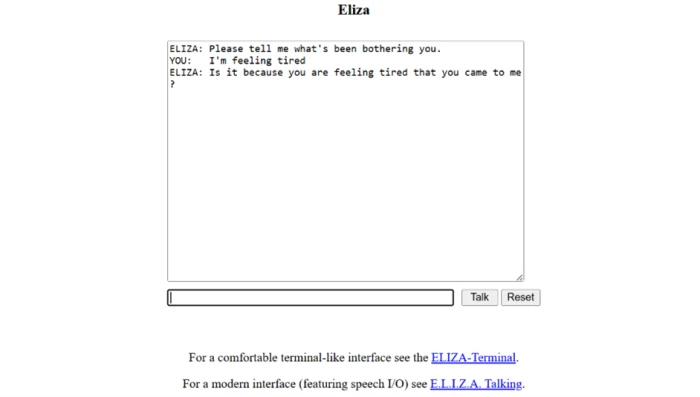
In 1966 an MIT professor named Joseph Weizenbaum wrote a program called ELIZA. It imitated a psychotherapist by spotting keywords in a sentence and turning them back into questions. Say you felt tired, and ELIZA asked why you felt tired. Behind the curtain sat keyword detection and a set of response templates. Nothing understood anything.
What happened next mattered more than the code. Weizenbaum's own colleagues asked for private sessions with the program. Some declined to accept that it was mechanical.
He gave the pattern a name that stuck: the ELIZA effect, the human habit of reading intelligence into systems that only shuffle surface symbols. Hold on to it. It returns in the closing section of this article.
Three generations followed ELIZA. Each got better at language. Each stayed behind the same wall.
Generation
Years
Examples
What it could do
Where it stopped
Pattern matching
1966 to 2010
ELIZA, PARRY, A.L.I.C.E.
Matched keywords to scripted replies
No memory, no reasoning
Intent classification
2011 to 2021
Siri, Alexa, Dialogflow
Mapped phrasing onto predefined intents
Broke on anything unanticipated
Generative chat
2022 to 2023
ChatGPT, Claude
Produced open-ended language on any topic
Read-only. It described actions without taking them
Agentic systems
2023 onward
Claude Code, Agentforce
Plans, calls tools, remembers, self-corrects
Reliability across long tasks
Every generation before the fourth shared one boundary. The software could describe the world. It could not touch it.
The Day the Chatbot Grew Hands
Function calling changed that in 2023. Models gained the ability to emit a structured call instead of prose, which meant a request like "book me a flight" could produce an actual API request rather than a paragraph about how flights are booked.
Developers noticed within weeks. AutoGPT and BabyAGI appeared in spring 2023, wrapping a language model in a loop: set a goal, plan a step, call a tool, read the result, plan again. The demos went viral. Production results did not follow. Loops broke after a few turns, agents invented tool parameters that did not exist, and most teams quietly reverted to one-shot prompting because it was the only shape that held together.
By 2024 the ingredients were all on the shelf. Function calling worked. Vector memory was widely deployed. Orchestration loops were public code. What was missing was reliability, which gets its own section later on.
What arrived first was a clearer definition of what an agent even is.
What Separates an Agent From a Chatbot
The word agent gets attached to almost anything with a model behind it, so precision helps. An AI agent is a software system that receives a goal, breaks it into steps, chooses and calls tools to carry out those steps, keeps a record of what it has done, and adjusts when results come back wrong.
A chatbot responds. An agent acts. The industry shorthand for the difference is read-only versus read-write.
Chatbot
Copilot
AI agent
Workflow bot
Triggered by
A message
A request in context
A goal
A fixed rule
Plans multi-step work
No
Sometimes
Yes
Fixed script only
Calls external tools
Rarely
Assists the user's tools
Yes, on its own
Yes, deterministically
Memory across sessions
No
Limited
Yes
Not applicable
Unexpected input
Fails
Asks the user
Adapts and retries
Breaks
Human oversight
Every turn
Every action
At checkpoints
On exception
One distinction is worth guarding. Calling four APIs in a fixed order is a pipeline, however much intelligence sits inside each call. The defining feature of an agent is autonomous choice about what happens next. A good number of products marketed as agents in 2026 are pipelines with better copywriting.
Inside an Autonomous Agent
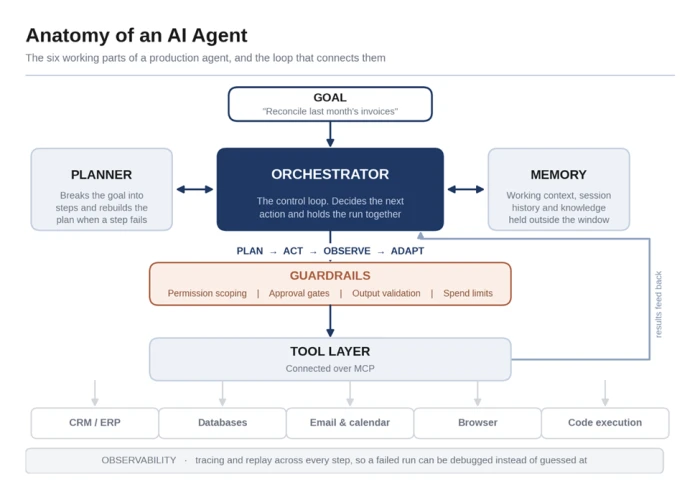
Strip the marketing away and a production agent has six working parts.
• Orchestrator. The control loop that decides the next action and holds the run together.
• Planner. Breaks a goal into steps and rebuilds the plan when one of them fails.
• Memory. Working context for the current task, plus session history and retrieved knowledge held outside the context window.
• Tool layer. The APIs, browsers, databases and code execution the agent is permitted to reach.
• Observability. Tracing and replay, so a failed run can be debugged instead of guessed at.
Most teams overbuild the first version. Roughly 80 percent of production AI deployments in 2026 are a single agent connected to several tools, not a mesh of specialists negotiating with each other. Multi-agent systems are harder to debug and harder to justify to whoever signs the invoice.
Which brings us to the layer that made single agents dramatically more capable.
The Plumbing That Made 2026 Different
Before late 2025, connecting an agent to a company's CRM meant a bespoke integration. Every tool, every team, every time. Two open standards ended that.
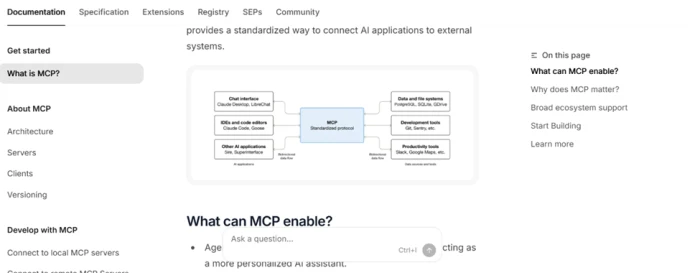
MCP, the Model Context Protocol, was created by Anthropic and donated to the Linux Foundation's Agentic AI Foundation in December 2025. It standardises how an agent connects to tools and data sources. By February 2026 the Python and TypeScript SDKs together crossed 97 million monthly downloads, and every major model provider had adopted it.
A2A, the Agent-to-Agent protocol, came from Google in April 2025 and moved to Linux Foundation governance that June. It solves a different problem: how one agent discovers and delegates to another. An agent advertises its capabilities through an Agent Card, accepts tasks, and returns results without exposing its internal reasoning. More than 50 partners signed on, among them Atlassian, MongoDB, PayPal, Salesforce, SAP, ServiceNow and Workday.
The mental model that survives contact with real projects: MCP gives an agent its hands, and A2A lets agents talk to one another.
Adding a new tool to an agent went from a multi-day integration job to a configuration entry. That shift, more than any single model release, is why 2026 looks unlike 2024.
Where Agents Are Already Paying for Themselves
The deployments that work share a shape. High volume, narrow scope, short chains of steps, and actions that can be undone if they go wrong.
Deployment
Measured result
Reported by
Salesforce Agentforce, customer support
Over 380,000 support interactions handled, 84 percent resolved without a human, 2 percent escalated
Salesforce
AtlantiCare clinical documentation assistant
42 percent reduction in documentation time, around 66 minutes returned per clinician per day, 80 percent adoption across 50 test providers
AtlantiCare
Fortune 500 financial reporting
Reporting cycle cut from 15 days to 35 minutes, cost per report from 2,200 dollars to 9 dollars
Salesforce customer case
North American retailer, inventory
Quarterly inventory losses reduced from 5.4 million dollars to 1.6 million dollars
Vendor case study
Read those numbers with one caution attached. Most come from the companies selling the software, which does not make them false, but does mean the failures are absent from the sample. The independent picture is less flattering, and it is where this article goes next.
The Arithmetic Nobody Prints in the Brochure
Here is the most useful piece of maths in the entire field, and it appears in almost none of the marketing.
Reliability compounds multiplicatively. An agent that is 85 percent reliable on any given step succeeds from end to end about 20 percent of the time across a ten-step task. Nothing is broken. 0.85 raised to the power of ten is 0.197.
That equation explains the distance between a polished demo and a disappointing quarter better than any benchmark does. Demos are short. Real work is long.
The benchmarks agree with the arithmetic. APEX-Agents, mentioned at the top of this article, used tasks averaging 1.8 hours of expert human effort, requiring agents to move across documents, spreadsheets, PDFs, email and calendar applications. Gemini 3 Flash led at 24 percent. GPT-5.2 followed at 23 percent, with Claude Opus 4.5 and Gemini 3 Pro at 18.4 percent. Given eight attempts, the best agents topped out near 40 percent. Performance degraded sharply after roughly 35 minutes of task time.
Academic work points the same way. A 34-task benchmark built by researchers at the Chinese University of Hong Kong and Singapore Management University found average completion near 50 percent across popular agent frameworks, with failures split between planning errors and execution errors, alongside answers that were simply wrong. On the WebArena benchmark, the strongest single-agent result reached 61.7 percent against human performance of 78 percent.
A 2026 paper from Princeton makes the sharper argument. Mean task success rate, the metric everyone reports, hides the thing that matters. It cannot distinguish an agent that fails predictably on certain tasks from one that fails at random, and it scores a formatting error and a deleted file identically. Their finding across 24 months of model releases: accuracy improved while reliability barely moved.
Enterprises are feeling this already. Gartner projects that more than 40 percent of agentic AI projects will be cancelled by the end of 2027, citing escalating costs and unclear business value alongside inadequate risk controls. Only around 21 percent of organisations report a mature governance model.
Set the two Gartner forecasts beside each other. Forty percent of enterprise applications will embed task-specific agents by the close of 2026, up from under 5 percent in 2025. Forty percent of agentic projects will be cancelled within roughly a year of that.
The Attack Surface Nobody Had in 2023
An agent holding credentials is a different security object from a chatbot holding a text box. It reaches email, billing systems, cloud APIs and shell environments, and it takes instructions from content it reads.
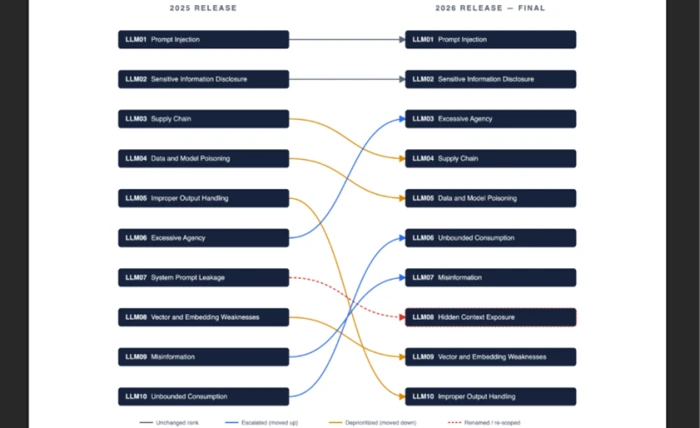
OWASP published its Top 10 for Agentic Applications in December 2025, assembled with more than 100 contributors and drawn from incidents observed in live systems rather than from theory. The recurring failure modes:
• Goal hijacking through indirect prompt injection. Instructions hidden in an email, a support ticket, a document or a repository file redirect the agent while it continues to look on task.
• Tool misuse. Overprivileged agents doing legitimate-looking damage with credentials they should never have held.
• Memory and context poisoning. Corrupted persistent state quietly shaping every decision that follows.
• Rogue agents. Compromised agents that persist across sessions and impersonate other agents.
• Supply chain compromise in the skill layer. The newest category, and the fastest growing.
That last category has hard numbers behind it. In June 2026 a security researcher published a deliberately malicious agent skill that reached more than 26,000 agents while every public scanner cleared it. A follow-up scan of 142,836 live skills found 17,822 of them, 12.4 percent covering 6.7 million installs, depending on at least one untrusted external instruction source.
The mitigations are unglamorous and well understood: least-privilege tool scoping, human approval on anything irreversible, sandboxing with behavioural monitoring, and kill switches that have been tested.
The World Economic Forum framed the underlying principle in March 2026, arguing that autonomy and authority should be treated as deliberate design variables, calibrated to the context an agent operates in and the damage a mistake would cause. Which raises the practical question of how much autonomy to hand over in the first place.
The Autonomy Ladder
Autonomy is not binary, and treating it as binary is how projects end up in Gartner's cancellation column. Six rungs, and it pays to know which one you are actually buying.
Level
Name
The agent does
The human does
L0
Reactive
Answers questions
Everything else
L1
Assisted
Drafts and suggests
Reviews and executes
L2
Supervised execution
Executes single steps once approved
Approves each action
L3
Checkpointed autonomy
Runs multi-step workflows
Approves at defined checkpoints
L4
Bounded autonomy
Owns a whole process inside set limits
Sets the limits and audits
L5
Full autonomy
Sets and pursues its own sub-goals
Governs outcomes only
Most credible production deployments in 2026 sit at L2 or L3. L4 exists in narrow domains with high volume and low blast radius. L5 is a slide in a pitch deck.
Four rules follow from everything above.
• Scope by step count rather than ambition. The compounding maths from the previous section should decide what you automate first.
• Build the evaluation set before you build the agent. Task-specific, with a written taxonomy of the ways it is allowed to fail.
• Make the surrounding systems agent-ready. Integration is the bottleneck, not model capability. An agent that cannot reach your ERP securely becomes technical debt.
• Put humans at checkpoints instead of inside every loop. The first scales. The second defeats the purpose of the project.
What I Keep Coming Back To
The image that stayed with me while researching this is Weizenbaum's colleagues asking for privacy with a program that did nothing except rearrange their own sentences back at them.
Sixty years on, the machines have genuinely changed. An agent that files a purchase order or closes a support ticket is doing something ELIZA could never approach. The read-write shift is real, the protocol work is real, and an 84 percent autonomous resolution rate in a support queue is real money on a real balance sheet.
What has not changed is us.
We still read capability into these systems faster than the evidence supports, and the price of that habit has gone up considerably. A chatbot that misunderstands you writes a bad paragraph. An agent that misunderstands you sends the payment.
If I were deploying agents this year, I would spend less time asking what the model can do and more time asking what it can do wrong, how quickly I would find out, what it would cost to undo, and who answers for it when it happens. The teams I have watched succeed are unromantic about all of this. They pick boring tasks, they instrument everything, and they treat each increase in autonomy as a decision that needs evidence behind it.
The capability curve is the easy part. The judgement gap is where the next two years get decided.





Discussion
Join the discussion and share your perspective.