A vendor tells you their tool “uses RAG to cut hallucinations, running on a fine-tuned foundation model with a big context window.” Five of those words are jargon, and half the room nods along anyway. That scene now plays out in meeting rooms everywhere. The tools arrived faster than the language to talk about them, and the gap leaves capable people quietly guessing.
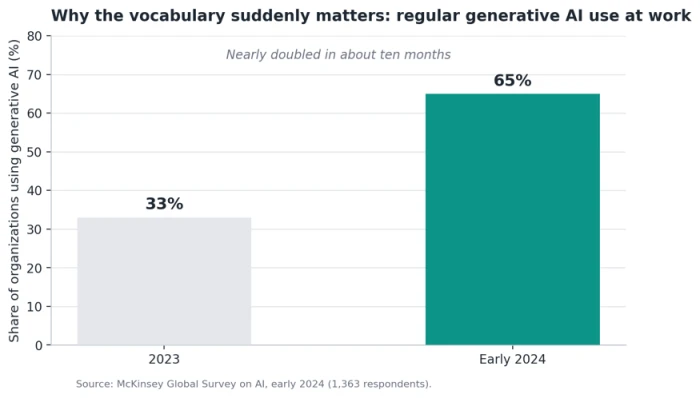
The numbers show why the pressure is real. McKinsey’s Global Survey on AI found that regular generative AI use at work climbed from about a third of organizations in 2023 to 65 percent in early 2024, close to a doubling in under a year.
This glossary closes the gap. Every term below comes with a plain-English definition, a short analogy where one helps, and a real example of where you will meet it. The words are grouped by how they actually relate to each other, so you walk away with a mental model instead of a pile of flashcards. Read straight through, or jump to the word you keep hearing.
How this glossary is organized
The terms fall into six groups that track how AI works in practice: the foundations underneath everything, the generative models most people now call “AI,” the language of prompting, the fast-growing world of agents, the ways these systems fail, and the rules taking shape around them. Each group leans on the one before it, so the order is the point.
The map: how the core terms fit together
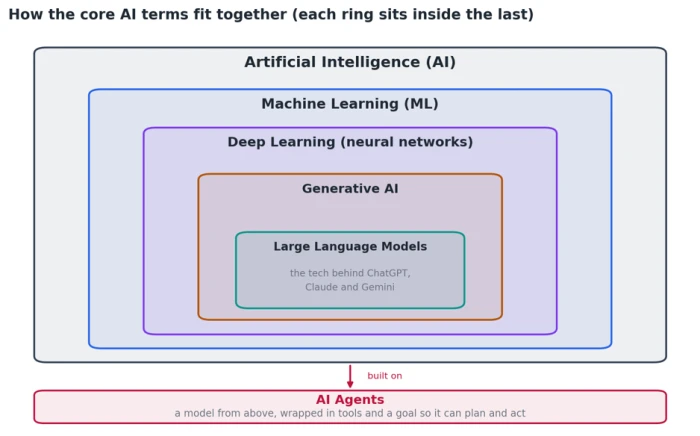
Before any single definition, one picture prevents a lot of confusion. The biggest words are mostly nested inside each other rather than sitting side by side as equals.
Artificial intelligence is the widest circle: any software doing tasks we link with human thinking. Machine learning is the slice of AI that learns patterns from examples instead of following hand-written rules. Deep learning is the slice of machine learning built on many-layered neural networks. Generative AI is the part of deep learning that produces new content, and large language models are the kind of generative AI trained on text. Agents are the newest layer, a model wrapped in tools and a goal so it can take action on its own. Hold that nesting in mind and the rest of the vocabulary stops feeling random.
The foundations
These older terms predate the current wave, and they still describe what happens under the surface of every shiny new tool.
• Artificial intelligence (AI): software built to do things we used to assume needed a person, such as recognizing a face or catching fraud in a bank feed. It imitates the result of thinking without thinking the way we do.
• Machine learning (ML): the approach behind almost all modern AI. Rather than a programmer writing every rule by hand, the system studies many examples and works out the patterns itself. Show it thousands of labeled photos and it learns to tell a cat from a dog.
• Deep learning: machine learning that stacks neural networks in layers, the advance that made image recognition and language models practical.
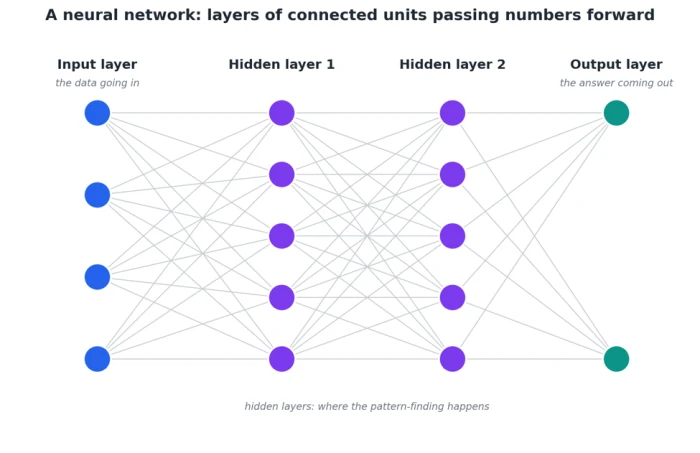
• Neural network: a web of simple connected units, loosely inspired by brain cells, that passes numbers forward and adjusts its connections as it learns.
• Training data: the examples a model learns from. Their quality sets the ceiling on everything the model can later do.
• Model: the trained result, the saved patterns that turn an input into an output.
• Parameters: the internal numbers a model tunes during training. Counts reach into the billions, and a higher count loosely signals more capacity to learn.
• Inference: the moment you actually use a trained model to get an answer. Training is the studying; inference is sitting the exam.
Machine learning itself comes in a few flavors. Supervised learning trains on examples that carry the right answer. Unsupervised learning hunts for structure in data with no labels attached. Reinforcement learning improves by trial and error, nudged along by rewards.
The four words people trip over most are the broadest ones, because marketing throws them around loosely. Here is the difference in one view.
Term
What it covers
Everyday example
Artificial intelligence
Any system doing human-like tasks
A spam filter sorting your inbox
Machine learning
AI that learns from data
Netflix suggesting your next show
Deep learning
ML using many-layered neural networks
Face unlock on your phone
Generative AI
Deep learning that creates new content
ChatGPT drafting an email
Generative AI and large language models
When most people say “AI” in 2026, this family is what they mean. It is also where the newest and most-searched terms live.
• Generative AI: models that produce new text, images, audio, video or code, rather than only sorting or scoring content that already exists.
• Large language model (LLM): a model trained on enormous amounts of text to predict the next chunk of writing. That one trick proves enough to draft, summarize, translate and answer questions. ChatGPT and Claude both run on LLMs.
• Transformer: the neural-network design introduced in 2017 that made LLMs possible. It reads a whole passage at once and weighs which words matter to which.
• Token: the unit a model reads and writes, usually a word fragment rather than a whole word. “Fantastic” might split into “fan,” “tas” and “tic.” Usage is billed and capped by the token.
• Context window: how much a model can hold in mind at once, measured in tokens. Your prompt, any files you attach, the retrieved documents and the reply it writes all count against the same budget.
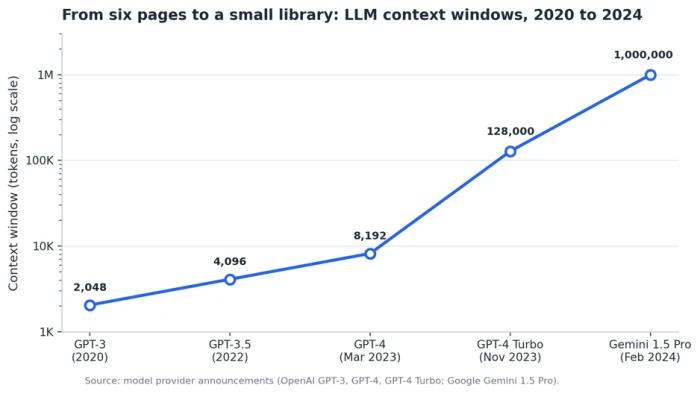
Context windows tell the clearest story about how fast this field moved.
GPT-3 could hold about 2,048 tokens in 2020, roughly six pages of text. By February 2024, Google’s Gemini 1.5 Pro reached one million tokens, enough to read a small stack of novels in a single pass. That jump changed what these tools can do with long documents, and it is why “context window” became a spec that buyers now ask about by name.
• Foundation model: a large model trained broadly once, then adapted to many jobs. The GPT and Claude families are foundation models.
• Embedding: a way of turning words or images into lists of numbers so that similar meanings land near each other. It is how search by meaning works.
• Temperature: a dial for randomness. Low temperature gives steady, predictable answers; high temperature gives more variety and surprise.
• Multimodal: a model that handles more than text, for instance reading an image and describing what it sees.
• Reasoning model: a newer class that spends extra computing time working through a problem step by step before answering, which lifts performance on math and code.
• Knowledge cutoff: the date a model’s training data stops. Anything that happened later is invisible to it unless the tool can search the web.
One pair from this family causes constant mix-ups, so it is worth pinning down.
Parameters
Tokens
What it is
The model’s internal knobs, fixed during training
The pieces of text going in and coming out
When it matters
Describes how big the model is
Describes how long your request is
Rough analogy
The size of the brain
The words in the conversation
Talking to AI: prompting
A model only helps as much as you can ask it to. This group covers the words for getting good answers out.
• Prompt: whatever you type or say to the model. It carries your instruction, your context and your question in one message.
• Prompt engineering: the craft of writing prompts that produce reliable results. Closer to writing a clear brief than to chanting magic words.
• System prompt: standing instructions set behind the scenes that shape a model’s tone and rules for a whole conversation.
• Zero-shot and few-shot: asking with no examples versus handing over a couple of worked examples so the model copies the pattern you want.
• Chain-of-thought: asking the model to show its reasoning step by step, which often improves the final answer on tricky problems.
• Retrieval-augmented generation (RAG): the model looks up relevant documents first, then answers using them, so replies stay tied to real sources instead of memory. It is how a chatbot can quote your own company handbook back to you.
• Fine-tuning: extra training of a general model on your own examples so it specializes in your style or task.
RAG and fine-tuning aim at overlapping problems, which is exactly why people confuse them. The split below is the fastest way to keep them straight.
RAG
Fine-tuning
What it does
Feeds the model fresh documents at question time
Retrains the model on your own examples
Best for
Facts that change often
A fixed style or a repeatable skill
Analogy
An open-book exam
Sending the model away to study
AI that acts: agents
The shift of 2025 and 2026 is the move from AI that writes to AI that does. The vocabulary changed to match.
• AI agent: software that takes a goal and works toward it across several steps, deciding what to do, doing it, checking the result and adjusting. Ask one to “book a dentist for next Tuesday morning” and it can check the calendar, find a slot and fill in the form.
• Copilot or AI assistant: an assistant built into a tool that suggests while you keep control, like autocomplete that finishes your sentence in a code editor or a document.
• Tool use and function calling: a model reaching outside itself to run a search or call an app instead of answering from memory alone.
• Model Context Protocol (MCP): an open standard introduced by Anthropic in late 2024 that gives models a common way to plug into outside tools and data sources.
• Human-in-the-loop: a design where a person reviews or approves before the AI’s action takes effect, reserved for higher-stakes decisions.
Three of these words get used as if they mean the same thing. They actually describe different amounts of independence, from a suggestion you can ignore to a system that runs the whole errand.
Term
How independent
Example
Copilot
Suggests, you decide
Code autocomplete in your editor
Assistant
Answers and helps on request
A chatbot you ask questions
Agent
Plans and acts on its own
A tool that books the whole trip
When AI gets it wrong
Knowing the failure modes matters as much as knowing the features, because failure is what tells you whether to trust an output.
• Hallucination: confident, fluent output that is simply false. The model fills a gap with a plausible guess, such as inventing a citation or a statistic that was never real. It is a built-in behavior of how these systems work, not a rare glitch.
• Bias: systematic skew in outputs, often inherited straight from skewed training data.
• Guardrails: the filters and rules that keep a model’s answers safe and on task.
• Jailbreak and prompt injection: two kinds of attack. A jailbreak coaxes a model past its own safety rules. Prompt injection hides instructions inside content the model reads, so an outsider quietly hijacks the request.
• Deepfake: synthetic audio or video that convincingly shows a real person doing something they never did.
• Red teaming: deliberately attacking your own system to find its weak spots before anyone else does.
Hallucination may be the single most useful term here for a non-specialist, because it changes how you read every answer. A model is not a database looking up facts. It is a pattern machine producing the most likely next words, which is why it can be smooth and wrong in the same breath. Retrieval, human review and a habit of fact-checking exist largely to keep that tendency in check.
The rules taking shape around AI
The final group is the language of governance, which is moving from academic to mandatory as real laws land.
• Artificial general intelligence (AGI): a hypothetical system matching human ability across almost any task. It does not exist yet, and experts disagree on whether or when it will.
• Narrow AI: AI built for one job, which describes every system running today.
• Responsible AI and alignment: the practice and the research aimed at making AI systems behave the way people actually intend.
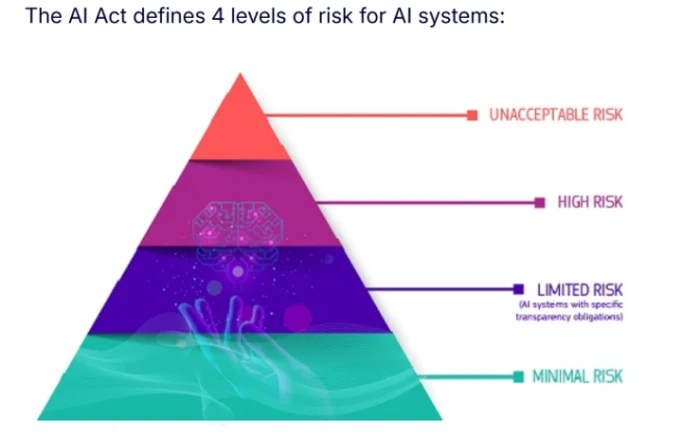
• EU AI Act: the European Union’s law on AI, the first broad binding rulebook of its kind. It sorts systems by risk level and sets duties for each, with its earliest bans taking effect in February 2025.
• NIST AI Risk Management Framework: a voluntary United States framework for managing AI risk, widely cited as a reference far beyond government.
• AI literacy: the working understanding staff need to use AI knowingly, and, under the EU AI Act, now a legal duty for many organizations.
These are also the terms you will need soonest if you work in a regulated field, because compliance teams have started using them in earnest. For the definitions that carry legal weight, the primary text is the Regulation itself, and the plain-English versions here are a starting point rather than legal advice.
Why the list keeps changing
The vocabulary shifts because the technology keeps changing shape. The earliest terms described single models learning from data. The middle wave described what those models could generate. The newest words, such as agents and tool use, describe whole systems that pair a model with the software and goals it needs to act. Learn the map rather than memorizing a frozen list, and each new term that surfaces will slot into a place you already understand. So the next time someone says a product “uses RAG on a fine-tuned model with a large context window,” you will know which ring of the diagram each word sits in, and whether the claim is genuinely impressive or simply dressed up.
The Bottom Line
You don't need to memorize every word in this glossary to hold your own. You need the shape of it. Once you can see that AI contains machine learning, which contains deep learning, which contains the generative models behind ChatGPT and Claude, most new terms announce where they belong the moment you hear them.
Keep three habits and the vocabulary stops being intimidating. Anchor each new word to the map instead of learning it in isolation. Treat every confident answer as a draft until you've checked it, since hallucination is built into how these systems work. And watch which family a term comes from, because that tells you whether someone is describing how a model learns, what it can produce, or what it can now go off and do on its own.
The words will keep changing. The map underneath them changes far more slowly. Learn that, and the next unfamiliar term is one you can place, question, and use, rather than nod along to.



Discussion
Join the discussion and share your perspective.