10 Cold Email Templates That Don't Sound Like AI (2026 Swipe File)
10 cold email templates that sound human, not AI-generated. See proven examples, AI-writing tells, editing tips, and prompts for getting more replies in 2026.
A data-backed swipe file, plus the nine patterns recipients use to spot generated outreach.
A B2B team ran 10,000 sends off one polished, AI-drafted template last year. The copy was clean. The grammar was perfect. Reply rate: 0.3%.
They did not change the offer. They rewrote the opening line for each vertical, dropped one real detail into each segment, and the same list produced a 4.1% reply rate. Same product, same buyers, thirteen times the response.
That gap is what this article is about.
Below you get the data on why generated outreach stopped working, the specific patterns recipients use to identify it, a four-pass editing method, and 10 templates written to survive a three-second scan.
Short version. A cold email reads as machine-written when it opens with filler, reaches for brochure vocabulary, hedges every claim, and repeats the same paragraph shape four times over. It reads human when it names one detail you could only know by looking, and asks for something the recipient can answer in a single line.
The floor dropped out of cold email
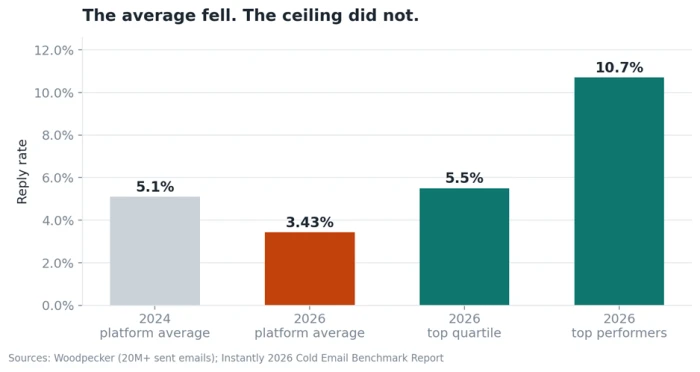
Woodpecker analysed more than 20 million sent cold emails and found the platform-wide average reply rate fell from 5.1% in 2024 to 3.43% in 2026. Instantly's 2026 benchmark report, built on a separate dataset of billions of sends, landed on the same 3.43% figure.
The ceiling did not move. Top-quartile senders still reach 5.5%, and the top performers clear 10.7%.
So the distribution stretched. Average senders got worse while the best got no worse at all. Both reports name the same causes: inbox saturation, tighter Gmail and Outlook enforcement, and a flood of low-effort automated outreach that trained recipients to delete on sight.
One number cuts through the rest.
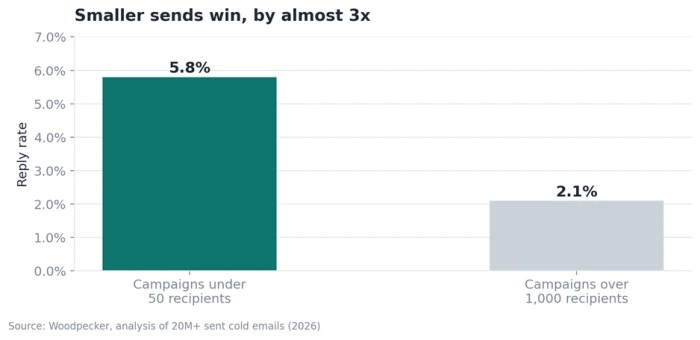
Woodpecker found that campaigns sent to fewer than 50 recipients averaged a 5.8% reply rate. Campaigns over 1,000 recipients averaged 2.1%.
Sending less produces more. That inverts how most outbound teams are staffed and measured, and it is the first clue about why AI-written email underperforms: the tools made volume cheap at the exact moment volume stopped working.
The section below covers what recipients do once they notice.
Recipients can tell, and the cost lands on you
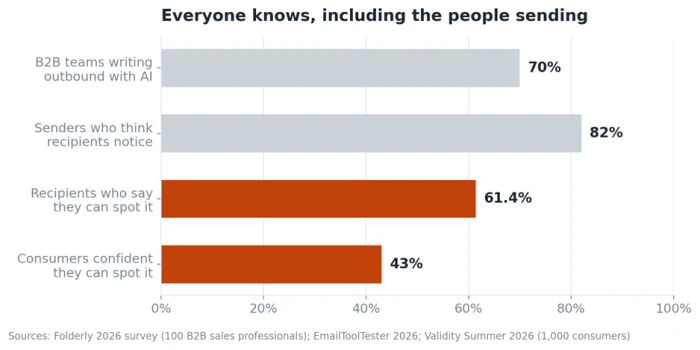
Folderly surveyed 100 B2B sales professionals in 2026. Seventy percent now write outbound with AI. Eighty-two percent believe recipients can spot it.
They are approximately right. EmailToolTester's 2026 survey found 61.4% of recipients say they can identify an AI-written cold email. Validity's Summer 2026 survey of 1,000 consumers put the figure at 43% who feel confident they could.
The sharpest evidence comes from outside sales entirely.
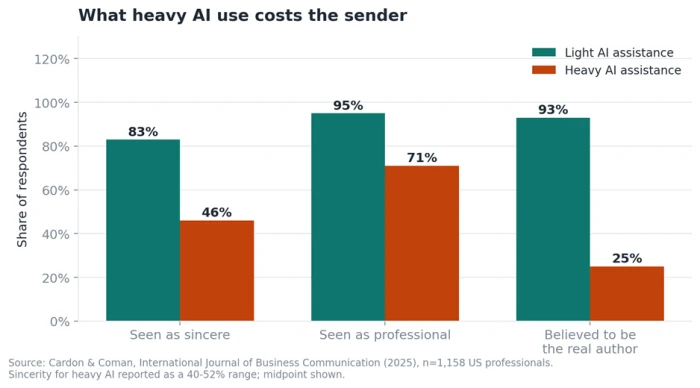
Peter Cardon and Anthony Coman, at the University of Southern California and the University of Florida, surveyed 1,158 full-time American professionals for a study published in the International Journal of Business Communication in 2025. Participants read a workplace message written with varying levels of AI assistance, then rated the person who sent it.
Sincerity fell from 83% under light AI assistance to somewhere between 40% and 52% under heavy assistance. Perceived professionalism dropped from 95% to roughly 71%. The belief that the named sender had actually written the message collapsed from 93% to 25%.
Now here is the finding that should change how you edit.
The heavily AI-assisted messages were rated as effective. In several conditions, slightly more effective than the lightly assisted versions. The words tested fine. The sender did not.
Read that against a cold email. Your prospect has no relationship with you yet, so the impression they form of you as a person is the only asset the email is building. A competent generated paragraph can score well as writing and still cost you the reply, because the recipient concludes you sent the identical thing to 900 other people.
Which raises the practical question the next section answers: what exactly are they seeing?
The nine tells
Recipients rarely articulate why an email feels generated. They pattern-match in about three seconds. These are the patterns they are matching against.
Tell
What it looks like
Replace it with
1. The filler opener
"I hope this email finds you well."
Nothing. Delete the line and open on the specific.
Something you can point at: a post, a number, a job ad
6. Punctuation polish
Dashes everywhere, zero contractions, flawless commas
"You're" instead of "you are"
7. Hedged claims
"This may potentially help improve efficiency"
The claim, stated plainly, or nothing
8. The disguised ask
"Do you have 15 minutes on Tuesday?"
A question answerable in one line
9. Zero friction
Nothing specific enough to be wrong
A detail only someone who researched would have
Tell 9 is the one people miss. AI drafts are safe. They contain no claim that could be checked and found incorrect, and that absence of risk is itself the signature. Someone writing to one named person takes small risks: quoting a number, guessing at a problem, admitting they might have the wrong read on it.
The words to delete on sight
These appear here as a deletion list, not as writing advice to follow. Search your draft for each one.
The section below turns the table into an edit you can run in under two minutes.
The four-pass human edit
Keep the AI draft. Comparison data across 2026 datasets consistently shows the same hierarchy: AI-drafted email finished by a human outperforms fully automated sends and outperforms unassisted writing on both reply rate and inbox placement. What follows is the pass order that matters.
Pass 1: Anchor. Put one verifiable specific into the first sentence. A funding round, a headcount change, a tool visible in their stack, a line from something they published. If you cannot find one in four minutes, the prospect is not researched enough to email yet.
Pass 2: Strip. Run the nine tells above against the draft. Delete rather than soften. A hedged version of a bad sentence is still a bad sentence.
Pass 3: Break the rhythm. Read it aloud. Where you run out of breath, split the sentence. Where two consecutive sentences share a length, merge them or cut one. Add a contraction.
Pass 4: Shrink the ask. Replace any meeting request with a question the recipient can answer in one line without opening a calendar.
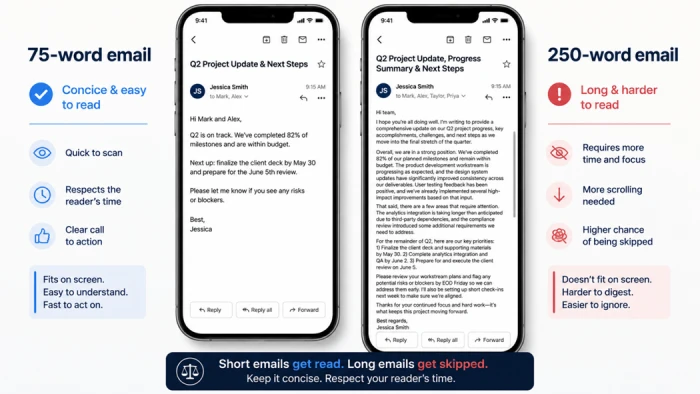
Then check the length. Growth List's 2026 analysis puts the highest-responding range at 50 to 125 words, with reply rates falling 30% to 40% past 200 words. More than half of cold emails are opened on a phone, where 125 words fills roughly one screen and 300 words demands a scroll.
Every template in the next section is already through all four passes.
10 cold email templates that don't sound like AI
Each template holds under 125 words. The bracketed fields are the only parts you change, and every bracket asks for a fact rather than an adjective. If you catch yourself filling a bracket with "impressive" or "innovative", you have rebuilt the problem described two sections up.
1. The funding trigger
Subject: your Series A and the hiring that follows
Hi [First name],
Saw the [round size] round closed in [month]. Congratulations.
Most teams at that stage add [number] reps over the next two quarters, and ramp time roughly doubles because onboarding still lives in people's heads.
We fixed that for [named customer] before their Series B.
Is ramp already on your list this quarter, or is it further out?
[Your name]
Why it passes: The opener is checkable against public news, the claim carries a number, and the close asks about timing rather than availability.
2. The job-ad trigger
Subject: the [role title] req
Hi [First name],
You've had a [role title] open since [month]. That usually means the budget landed late or the last person left mid-project.
Either way, [specific consequence] is sitting with someone who already has a full plate.
We cover that gap in about [timeframe] while the search runs.
Worth a reply if the req is still open?
[Your name]
Why it passes: Naming two possible causes instead of one signals you thought about their situation rather than pattern-matched it.
3. The stack switch
Subject: [tool name] question
Hi [First name],
Noticed you're running [tool]. Question rather than a pitch.
How are you handling [specific known limitation of that tool]? Every team we speak to running [tool] at [company size] hits it around month six.
If you've solved it, I'd like to hear how. If you haven't, I'll send what worked for [customer].
[Your name]
Why it passes: Offering to learn from them inverts the usual power dynamic, and the month-six detail is the kind of thing only a practitioner knows.
4. The thing you actually read
Subject: your point about [specific topic]
Hi [First name],
Your [post or talk] on [topic] made an argument I've been having with people for a year: [restate their point in your own words].
Where I'd push back is [specific disagreement].
We build [one-line description] for teams working through exactly that.
No pitch attached. Curious whether you've changed your mind on [aspect] since.
[Your name]
Why it passes: Restating their argument proves you read it. Disagreeing proves a human wrote the email.
5. The wrong-person ask
Subject: wrong person?
Hi [First name],
I think I have the wrong contact.
We help [company type] cut [specific metric] by [number]. At [their company] that would land with whoever owns [function].
If that isn't you, who should I be talking to?
[Your name]
Why it passes: Forty-one words, one question, zero pitch. Even a redirect is a reply, and a reply protects your sender reputation.
6. The one-line problem
Subject: [specific number] hours
Hi [First name],
[Team type] at companies your size lose roughly [number] hours a month to [specific task].
That's [converted cost] a year.
We take it to [lower number]. [Customer name] will confirm it.
Is that figure roughly right for your team, or am I off?
[Your name]
Why it passes: Asking whether your own number is wrong is something no automated sequence does. It invites a correction, which is the easiest reply to write.
7. The 40-word ask
Subject: quick one
Hi [First name],
Do you own [specific process] at [company]?
If so, I have a [asset] that cut it by [number] for [customer]. Happy to send it across, no call needed.
[Your name]
Why it passes: Removing the meeting removes the reason to ignore it.
8. The competitor result
Subject: what [competitor] changed last quarter
Hi [First name],
[Competitor] moved [metric] from [old number] to [new number] in [timeframe]. I know because we ran it with them.
Their setup looked close to yours: [one shared characteristic], [second shared characteristic].
Want the two-page breakdown of what changed? I'll send it either way.
[Your name]
Why it passes: "I'll send it either way" removes the transaction, which is the single fastest way to stop sounding like a sequence.
9. Follow-up: add something
Subject: (reply on the original thread)
Hi [First name],
Following up with something useful rather than a nudge.
[Link or attachment], which covers [specific thing relevant to their situation]. Page [number] is the part that applies to [their company].
Still happy to answer [original question] if it's live.
[Your name]
10. Follow-up: the close-out
Subject: closing the loop
Hi [First name],
I'll stop here.
If [specific problem] climbs your list this year, my details are below and I'll pick the thread back up whenever.
One thing before I go: [single useful observation about their market, given freely].
[Your name]
Follow-ups earn their slot in the sequence. Instantly's 2026 data attributes 42% of all replies to follow-up messages rather than the first send, which makes templates 9 and 10 worth more than most of the eight above them.
One draft, rewritten
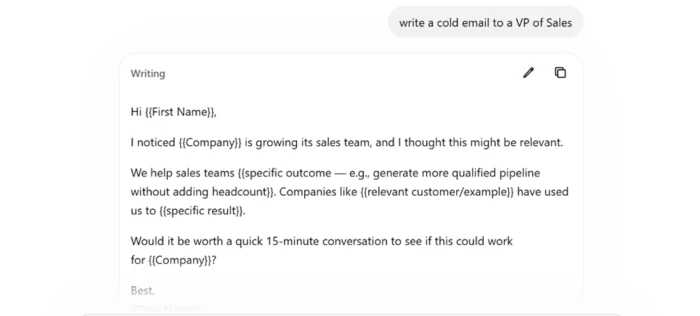
Here is a default model output for a sales-tool pitch, followed by the same email after the four passes.
Before (147 words)
Subject: Unlock Your Sales Team's Full Potential
Dear Sarah,
I hope this email finds you well. My name is Alex and I'm reaching out from Acme, where we provide a robust platform that helps sales teams streamline their workflows.
I came across your impressive work at Northwind and was struck by your company's innovative approach to customer engagement. I believe there may be an opportunity for us to collaborate.
Our solution has helped organizations like yours improve efficiency, reduce manual work, and drive revenue growth. Many of our clients see significant results within the first quarter.
Would you be open to a brief 15-minute call next week to explore how we might be able to support your goals?
Looking forward to hearing from you.
Best regards, Alex
After (74 words)
Subject: your SDR ramp time
Hi Sarah,
Northwind posted four SDR roles in March. That usually pushes average ramp past 90 days.
We took Contoso from 94 days to 51 by moving onboarding docs into the CRM itself, so reps learn inside the tool they already have open.
Is ramp actually hurting right now, or is the hiring covering it?
Alex
What changed
• The subject line names their problem instead of promising an outcome
• The opener is a fact anyone can check against their careers page
• One claim, two numbers, one named customer, zero adjectives
• The close is a question the recipient can answer in six words
Six of the nine tells appear in the first version. Count them.
The prompt that prevents most of this
Describing your tone to a model produces press-release output. Showing the model your actual writing works better, because voice is a behaviour and any description of a behaviour misses most of it.
Paste 10 emails you have genuinely sent, then run this:
Here are 10 emails I wrote. Match their sentence length, punctuation habits and sign-off.
Draft a cold email to [name] at [company], who [verifiable fact].
Rules: 80 words maximum. No greeting beyond "Hi [name]". Never use robust, seamless, streamline, innovative, or the phrase "I hope this email finds you well". No lists of three items. Include one claim with a number in it. End with a question the recipient can answer in a single sentence without checking a calendar.
Write a subject line about their situation, not about my product.
The constraint list does work that a tone description cannot. Add a line to it every time you catch a new pattern in your own drafts, and the file compounds.
Keep the human read before every send. That single habit is what separates the two performance tiers charted in Figure 1.
The thing that outranks all of it
Tone decides whether an opened email gets a reply. Neither tone nor template decides whether the email arrives.
In the Folderly survey, 79% of B2B sales professionals reported discovering that a prospect never received their email at all. Comparison data across 2026 datasets puts the spam-flag rate for fully automated sends at roughly three times that of human-edited sends running on identical infrastructure. Woodpecker found verified lists pull about double the reply rate of unverified ones.
The order of operations, before you touch a single template:
1. Send from a secondary domain, never your primary
2. Configure SPF, DKIM and DMARC on it
3. Warm the mailbox for 14 days before the first real send
4. Verify the list
5. Cap daily volume per mailbox
6. Then write
A perfect email in a spam folder scores zero.
Cut the list before you cut the copy. The campaign-size finding from Figure 2 holds under every other variable tested: 50 well-chosen recipients out-reply 1,000 loosely chosen ones by almost three to one. Every template above is worth more to a segment of 40 people who share one trigger than to a list of 4,000 who happen to share a job title.



Discussion
Join the discussion and share your perspective.