What Agentic Workflow Automation Actually Means (Not the Hype)
Learn what agentic workflow automation really means, how it works, where it outperforms traditional automation, and how to avoid costly implementation failures.
Every few years a phrase escapes the engineering blogs and lands in boardroom slide decks, where it loses its edges. “Agentic workflow automation” is the current example. Vendors attach it to products that are little more than chatbots. Analysts warn that a large share of the projects built on it will be scrapped. Buyers hear a promise of software that thinks for itself and quietly wonder whether any of it is real.
It is real, but narrower and more demanding than the marketing suggests. This guide strips the term back to what it actually describes, shows how one of these systems runs step by step, places it honestly against the automation you already use, and tells you where it fails. By the end you should be able to look at any “agentic” pitch and judge whether there is a real agent underneath it.
The short version
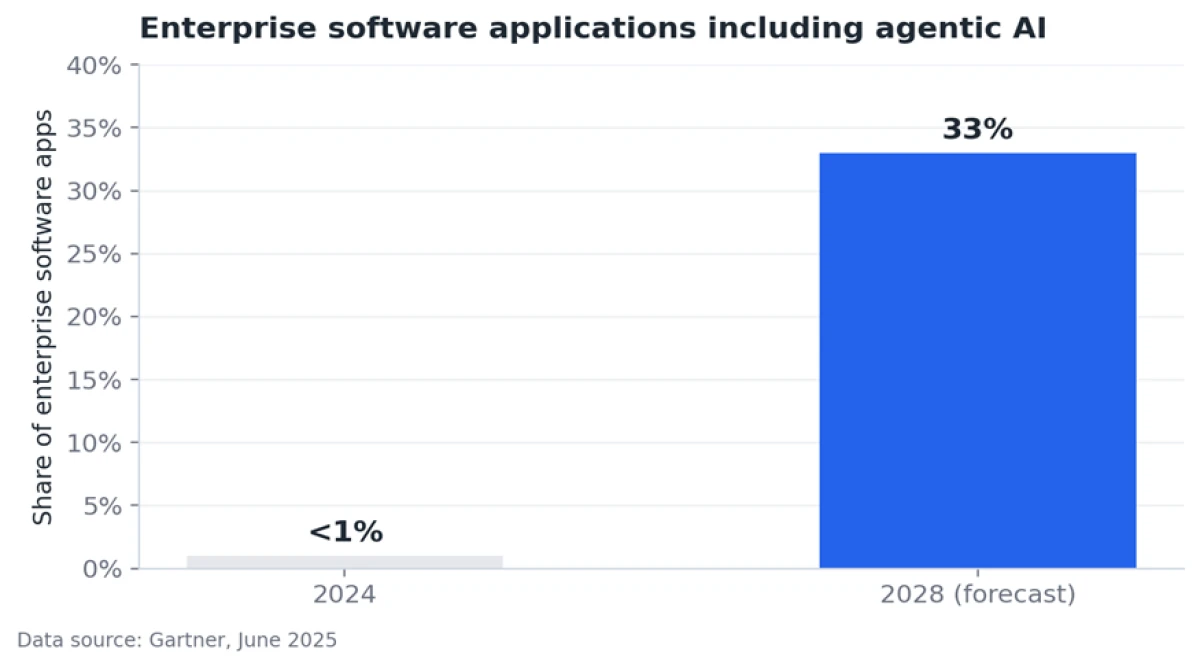
Agentic workflow automation is software that pursues a goal by planning its own steps, using tools to act, and adjusting as it goes, instead of following a fixed script. It sits above rule-based automation on a spectrum of autonomy. Gartner expects agentic AI inside 33% of enterprise software applications by 2028, yet also predicts more than 40% of agentic AI projects will be canceled by the end of 2027. The winners are the teams that pick bounded, measurable problems and build in governance from day one.
What agentic workflow automation actually is
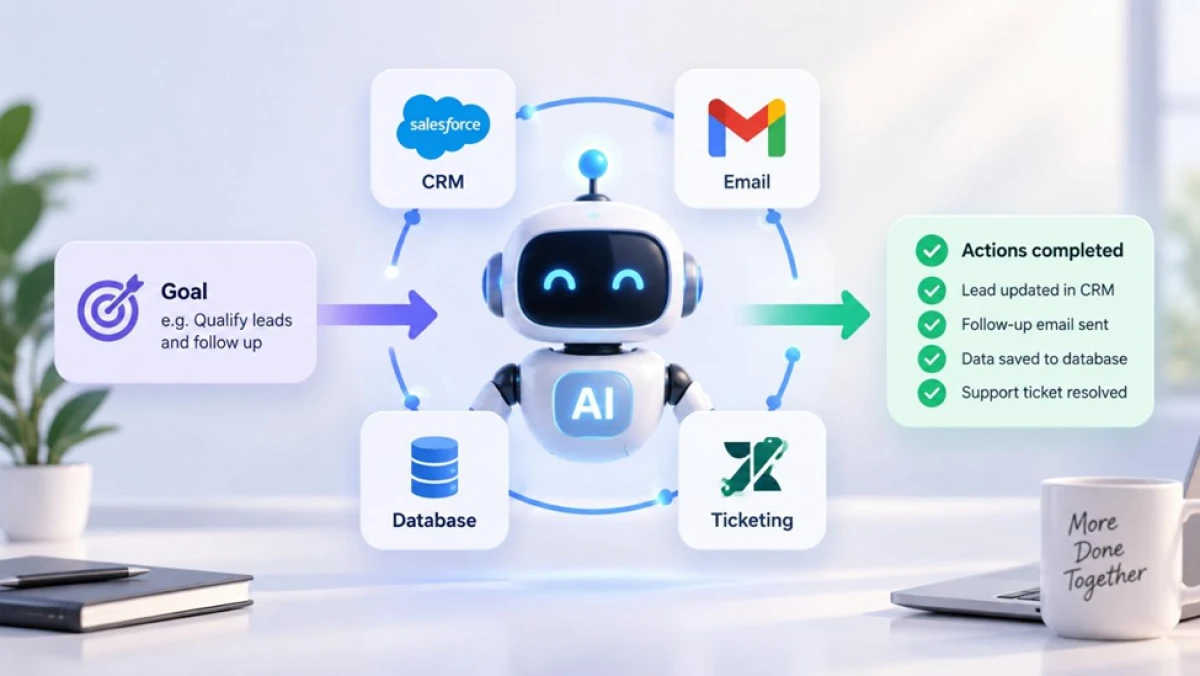
Agentic workflow automation is the use of AI systems that autonomously plan, carry out, and adapt a sequence of steps to reach a defined goal, without a person specifying each step in advance. Traditional automation follows a path you draw for it. An agentic system is given the destination and works out the route, handling variation and multi-step complexity that a pre-written flow cannot.
The distinction lives in one word: goal. A scripted automation executes instructions. An agentic workflow interprets an objective, decides what to do, checks whether it worked, and tries again if it did not. That loop of decide, act, and observe is the whole idea. Everything else is detail.
What it is not: “agent washing”
The fastest way to understand the real thing is to name the fake. Gartner uses the term “agent washing” for the rebranding of existing products, such as AI assistants and robotic process automation, without adding meaningful agentic capability. A chatbot that answers questions is not an agent. A macro that clicks through a fixed screen sequence is not an agent. Draping either in the word “autonomous” does not change what it does.
A genuine agentic system shows three behaviors that a rebranded assistant cannot fake: it reasons through an ambiguous request, it decides among possible actions rather than running one fixed branch, and it verifies its own output and corrects course. If a demo never shows the system choosing differently when conditions change, you are likely looking at automation wearing a new label.
Workflow, agent, or agentic AI? Untangling the terms
Four terms get used as if they mean the same thing. They do not, and the confusion is why so many conversations about this technology talk past each other. Here is the clean version.
• Agentic AI is the umbrella. It covers any system where AI drives goal-directed behavior with limited human direction.
• An agentic workflow orchestrates AI models and tools through a structure you design, with the model making decisions at defined points. You own the control flow; the model owns the judgment inside it.
• An autonomous agent goes further. The model directs its own process and chooses its own tools as it goes. You own the goal and the guardrails, not each branch.
• Agentic process automation (APA) is the enterprise platform layer that packages the above with orchestration, integrations, human approvals, and governance so the whole thing runs reliably at scale.
Anthropic, in its widely cited engineering guide Building Effective Agents, draws the same line: workflows are systems where models and tools are orchestrated through predefined code paths, while agents are systems where the model dynamically directs its own process. Its advice is blunt and worth keeping in mind before you build anything: find the simplest solution first, and add autonomy only when the problem genuinely needs it.
The autonomy spectrum
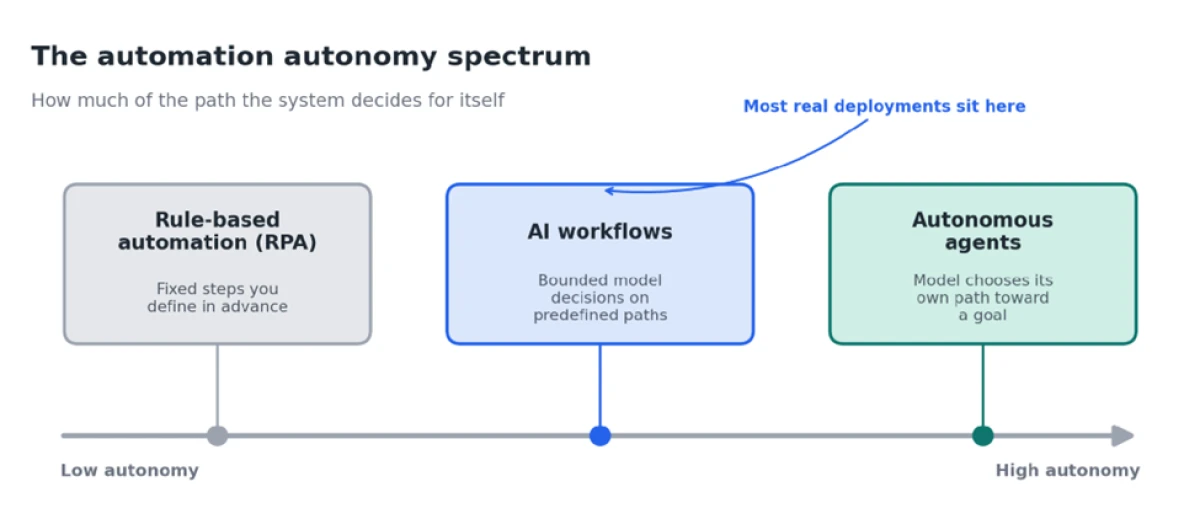
These categories are easier to hold in your head as points on a single line running from zero autonomy to full autonomy. On the left, rule-based automation does exactly what it is told. In the middle, AI workflows let a model make bounded decisions on rails you lay down. On the right, agents set their own path toward a goal. Most real deployments sit in the middle, and that is usually the right place to be.
How an agentic workflow actually works
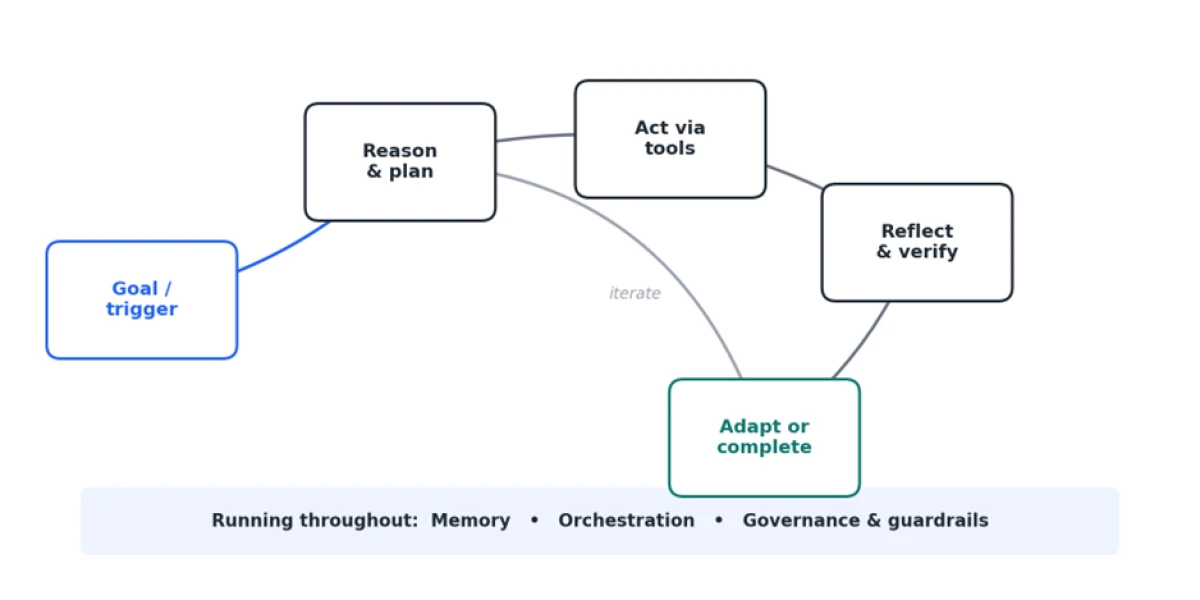
Under the branding, an agentic workflow is a loop. Where a scripted automation produces its result in a single straight pass, an agentic one cycles: it acts, looks at what happened, and lets that observation shape the next move. That is closer to how a person handles an unfamiliar task than to how a spreadsheet macro runs.
A single pass through the loop tends to move through these stages:
• Trigger and goal. An event or a request in plain language starts the workflow and sets the objective, for example “resolve this billing dispute.”
• Gather context. The system pulls the account history, relevant documents, and current system state it needs to reason well.
• Reason and plan. It breaks the goal into steps, identifies which tools and data each step needs, and orders them.
• Act through tools. It calls APIs, updates records, drafts messages, or queries systems to carry out each step.
• Reflect and verify. It checks the result against the goal, catches errors, and decides whether to continue, retry, or escalate.
• Adapt or complete. Based on what it found, it revises the plan and loops back, or finishes and hands off.
The parts that make the loop run
That loop depends on a handful of components working together. A reasoning-and-planning engine, usually a large language model, decomposes the goal. Tool use connects the model to the outside world, since a model on its own can draft a refund but cannot issue one. Memory carries context across steps so the system does not forget what it already learned. A reflection step scores the work and feeds corrections back in. Around all of it sit two layers that separate a demo from a production system: orchestration, which coordinates the pieces, and governance, which decides what the agent is allowed to touch and when a human must sign off.
The agentic loop: a goal enters, the system reasons, plans, acts through tools, reflects, and either adapts or completes, with memory, orchestration, and governance running throughout.
The design patterns that make a workflow “agentic”
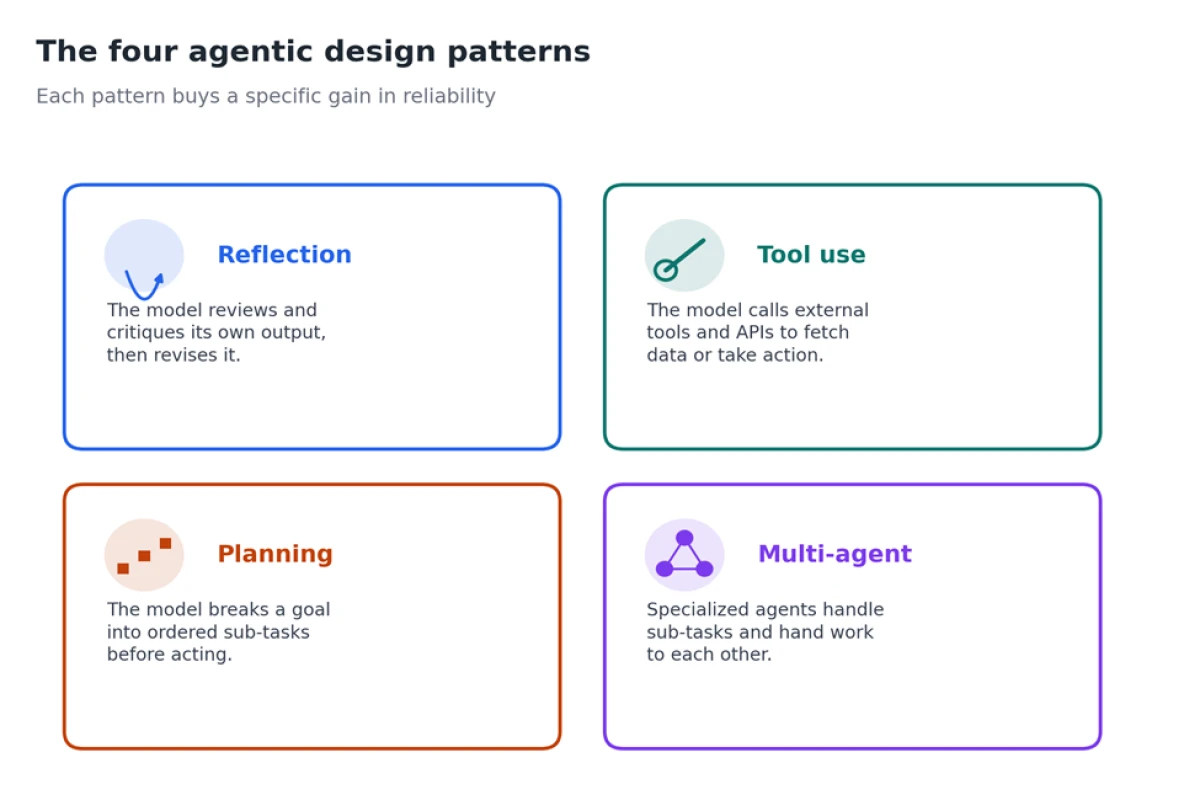
The loop above is not one technique but a family of them. Four patterns, popularized by Andrew Ng and now standard vocabulary, describe most of what production systems do. They are worth knowing because each one buys a specific gain in reliability, which is the currency that actually matters once a workflow leaves the demo stage.
Pattern
What it does
Why it improves reliability
Reflection
The model reviews and critiques its own output, then revises it.
Catches errors before they reach the user, raising output quality without more human review.
Tool use
The model calls external tools and APIs to fetch data or take action.
Lets the system act on the real world and check facts instead of guessing from memory.
Planning
The model decomposes a goal into ordered sub-tasks before acting.
Turns a vague objective into traceable steps you can inspect and debug.
Multi-agent
Specialized agents handle sub-tasks and hand work to each other.
Divides complex work by expertise, though it adds coordination cost that only pays off when the task is genuinely complex.
A fifth idea ties these together in practice. In the ReAct pattern the system alternates between reasoning about what to do next and doing it, rather than planning everything up front or acting without thought. Most teams start with tool use, add reflection once the loop is stable, and reach for planning or multi-agent designs only after they can trace and evaluate what the system does. Complexity you cannot observe is complexity you cannot trust.
Agentic workflows versus RPA and chatbots
The clearest way to see what agentic automation adds is to line it up against the two things people most often confuse it with. Robotic process automation runs fixed, rule-based steps at high speed. Chatbots answer and assist but do not act on their own. Agentic workflows reason, decide, and take action toward a goal.
RPA / rule-based
Assistive chatbot
Agentic workflow
Control model
Fixed script you define
Responds to prompts
Pursues a goal, picks its own path
Unstructured input
Struggles
Reads it, limited action
Reads and acts on it
Handles exceptions
Breaks, needs a human
Escalates
Reasons through or escalates cleanly
Maintenance
Rewrite when the process changes
Retrain on new content
Adapts to change within its goal
Predictability
High and auditable
Moderate
Lower; needs tracing and guardrails
Best fit
Stable, repetitive, high-volume tasks
Q&A and drafting
Ambiguous, multi-step, cross-system work
When RPA is still the right tool
Agentic does not mean better for everything. If a process can be described as a fixed sequence of structured steps with deterministic rules, that is RPA territory, and paying a language model to reason through it adds cost, latency, and unpredictability for no gain. Payroll runs, compliance form submissions, and scheduled report generation are exactly where rule-based automation shines. The honest test is simple: automate the predictable, reserve agents for the judgment. In practice the strongest operations run both, with reliable scripted steps carrying out the crisp execution and an agent supplying the reasoning that coordinates them.
Where agentic workflows earn their keep
Agents land in production wherever the work is ambiguous, takes more than one step, and has to touch outside systems. The use cases that hold up share a clear goal, a small set of tools, and a way to bail out when confidence drops. A few domains have moved past experiment into real deployment:
• Customer support. Tier-1 ticket resolution is the most common entry point, because the data is structured, the success metric is clear, and the cost of a mistake is contained.
• IT operations. Autonomous ticket resolution, intelligent routing, and incident remediation reduce ticket volume by reasoning across systems rather than following a decision tree.
• Finance and procurement. Invoice and exception handling, plus vendor and contract workflows, connect data that legacy manual processes leave scattered.
• Sales and fraud. Lead qualification and transaction monitoring both suit agents, which can weigh messy signals and flag only what needs a human.
Notice the common thread. None of these are chosen because they are flashy. They are chosen because the work involves genuine judgment across steps, the outcome is measurable, and a wrong move can be caught before it does damage. That last condition matters more than the first two, which brings us to the part of the story the product pages tend to skip.
The reality check: where it fails
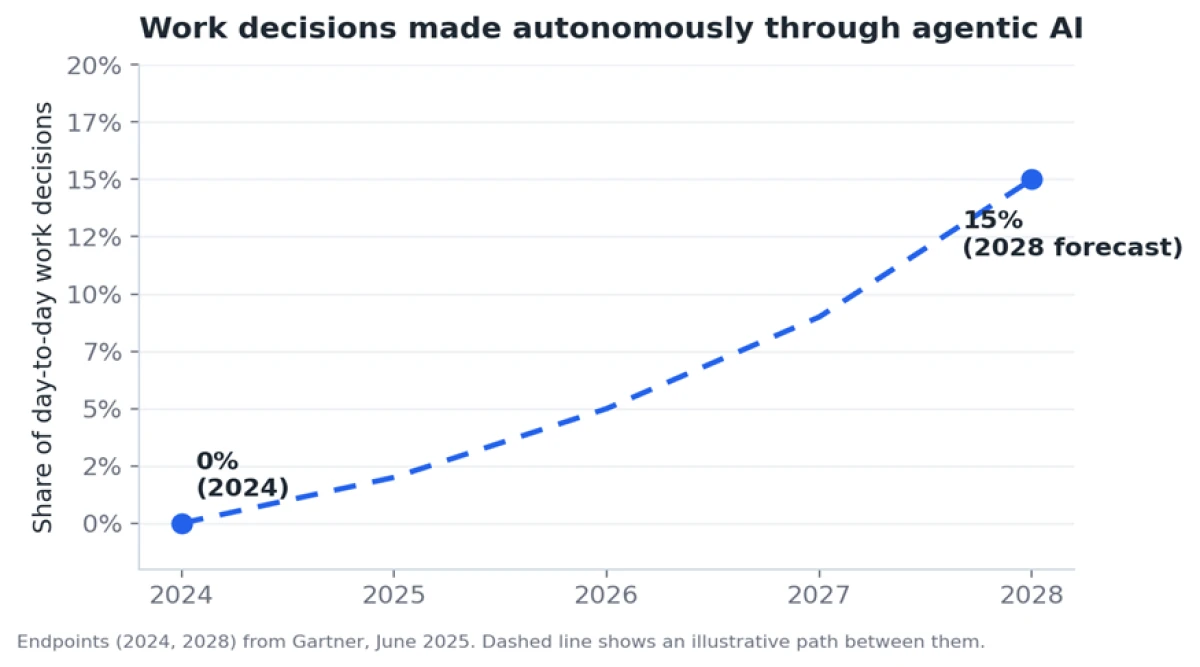
The adoption forecasts are genuinely large. Gartner expects agentic AI to be embedded in 33% of enterprise software applications by 2028, up from less than 1% in 2024, and predicts at least 15% of day-to-day work decisions will be made autonomously through agentic AI by 2028, up from none in 2024.
Agentic AI is forecast to move from the margins of enterprise software to roughly a third of it within four years. Data source: Gartner, June 2025.Autonomous decision-making climbs from zero toward 15% of day-to-day work decisions by 2028. Endpoints are Gartner figures; the path between them is illustrative. Data source: Gartner, June 2025.
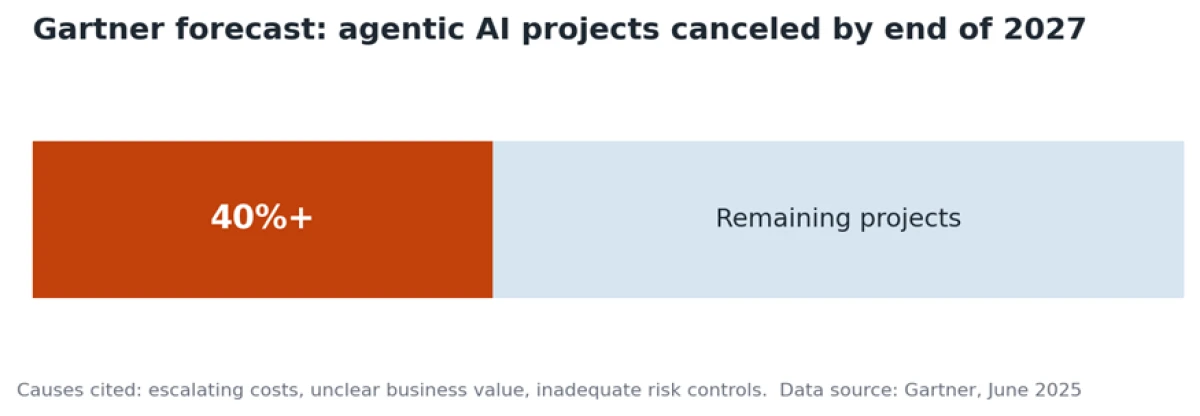
The same forecast carries a warning that vendor pages rarely feature. Gartner predicts more than 40% of agentic AI projects will be canceled by the end of 2027, blaming escalating costs, unclear business value, and inadequate risk controls. Its analyst Anushree Verma described most current projects as early-stage experiments driven by hype and often misapplied, which blinds organizations to the real cost and complexity of deploying agents at scale.
More than 40% of agentic AI projects are forecast to be canceled by the end of 2027. Data source: Gartner, June 2025.
Two numbers that look contradictory, a third of software going agentic and nearly half of projects dying, describe different futures of the same market. A near-term shakeout of hype-driven pilots and a longer-term structural shift can happen at once. The projects that get canceled tend to share a pattern: they succeed in a scripted demo and collapse in production, where integration, data access, and accountability were never worked out. Errors also compound, since each autonomous step can carry forward the mistake of the one before it.
Reliability and governance, the part that separates survivors
The teams whose projects survive treat governance as infrastructure, not paperwork added at the end. Four practices show up again and again. Human-in-the-loop approval sits at the points where a wrong action would be expensive. Observability and tracing record what the agent did and why, so failures can be diagnosed instead of guessed at. Scoped permissions limit which tools and data each agent can reach. An evaluation loop compares each version of the workflow against the last, catching regressions before users do. None of this is glamorous, and all of it is what stands between a promising pilot and a system you can put in front of customers.
Should you use it? A short decision framework
Understanding the technology is only useful if it helps you decide. Before building an agentic workflow, run the candidate process through a few plain questions. The more you answer yes, the stronger the case:
• Does the work involve ambiguous inputs, like email or documents, rather than clean structured fields?
• Does it take several steps, with decisions that depend on what earlier steps found?
• Does it need to reach across more than one system to get done?
• Does it require judgment that fixed rules cannot capture?
• Is the outcome measurable, so you can prove whether it worked?
• Is the blast radius bounded, with a clear point where the agent hands off to a person?
A useful rule of thumb
Use agents where decisions are needed, automation for routine workflows, and assistants for simple retrieval. If a process is predictable, script it. If it needs reasoning across systems and you can measure the result and contain the risk, an agentic workflow can earn its cost.
When not to build one
Skip the agent when the process is stable and rule-based, when the cost of a wrong action is high and cannot be contained, or when you cannot yet trace and evaluate what the system does. Building a production agent on proof-of-concept architecture, wiring it into systems you have not mapped, or rolling it out everywhere at once are the failure modes behind that 40% cancellation figure. A broken process handed to an agent does not get fixed. It gets executed faster, with fewer people watching.
The one distinction to carry with you
Strip away the vocabulary and a single question tells you whether “agentic” is real in front of you: does the system choose its own path toward a goal, or does it run a path someone drew for it? Everything in this guide, the spectrum, the patterns, the comparison tables, the failure data, reduces to that. A rebranded chatbot runs your path. A genuine agentic workflow, pointed at ambiguous and multi-step work, with governance built in and a measurable outcome to prove itself against, chooses its own. Judge every pitch by that line, and the hype stops being confusing. It becomes easy to sort.
The Bottom Line
Agentic workflow automation is neither the autonomous workforce the loudest pitches promise nor the empty buzzword the skeptics dismiss. It is a specific capability with a narrow zone of real value: ambiguous, multi-step work that crosses systems, where the outcome is measurable and the risk of a wrong move is contained. Inside that zone it does things older automation cannot. Outside it, a rule-based script or a simple assistant will beat it on cost, speed, and predictability.
For anyone deciding what to do next, the practical path is smaller than the hype implies. Pick one process that clears the candidate checklist. Wire it up with tracing from the first day so you can see what the agent does and why. Put a human approval step where a mistake would be expensive. Measure the result against the manual baseline before you expand. Teams that move this way are the ones whose projects survive the shakeout Gartner describes; teams that start with a grand autonomous vision and no way to observe it are the ones supplying the 40% cancellation figure.
The market will sort itself out along the same line that sorts individual pitches. The systems that last will be the ones that chose a real problem, proved their value in numbers, and earned more autonomy by demonstrating they could be trusted with it. Judge your own projects by that standard, start narrow, and let results decide how far the autonomy extends.






Discussion
Join the discussion and share your perspective.