RAG Explained Without the Jargon: How AI Looks Things Up Before It Answers
RAG explained in plain English: learn how AI retrieves trusted information before answering, how it works, RAG vs fine-tuning, use cases, and key limitations.
In 2023, a New York lawyer asked an AI chatbot to find court cases that supported his argument. It produced a tidy list, complete with names, dates, and quotes. The problem: the cases did not exist. The AI had invented them, and the lawyer filed them in a real federal court before anyone noticed. It became one of the most-cited cautionary tales about generative AI, and it points straight at the idea this article is about.
You have probably seen the letters RAG show up in every other AI explainer, usually wrapped in words like embeddings, vector databases, and semantic search. This guide strips all of that away. No paywall, no computer science degree, and no assumed knowledge. By the end you will understand what RAG is, how it actually works, when to use it instead of the alternatives, and where it quietly breaks. Give it about ten minutes.
What Is RAG, in One Plain-English Sentence?
The short answer
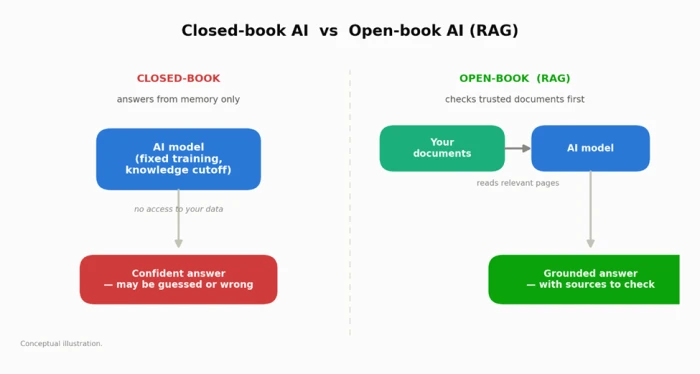
Retrieval-Augmented Generation (RAG) is a technique that lets an AI look information up in a trusted set of documents before it answers, instead of relying only on what it memorised during training. In practice, it turns a closed-book test into an open-book one.
That is the whole idea. The acronym breaks into three plain words: Retrieval (find the right information), Augmented (add it to your question), and Generation (write the answer using what was found). Hold on to one image as you read: the AI is a smart assistant that, before speaking, quietly flips to the right page of a book you gave it.
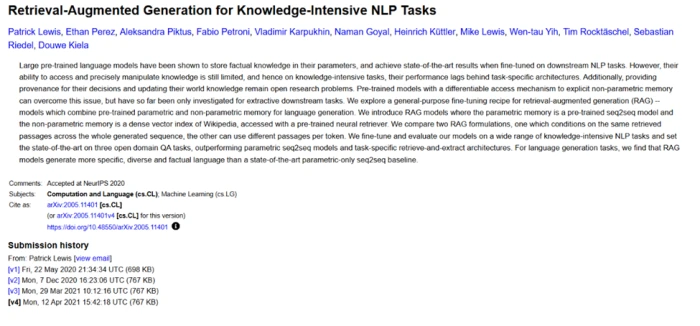
The term was coined in a 2020 research paper led by Patrick Lewis, then at Facebook AI Research (now Meta AI), with co-authors from University College London and New York University. Their system set new state-of-the-art results on three open-domain question-answering benchmarks and produced more specific and factual language than a model working from memory alone. Six years on, Lewis leads a RAG team at the AI company Cohere, and the technique underpins most AI tools that answer questions about private or current data.
The Problem RAG Solves: Why Confident AI Gets Things Wrong
Before the solution makes sense, the problem has to. A standard large language model, the kind behind ChatGPT, Gemini, or Claude, has two blind spots that cause most of its mistakes.
Hallucination: when AI makes things up
A language model does not store facts the way a database does. It stores patterns of language, and it is built to produce fluent, plausible text. When it does not know something, it does not stop. It fills the gap with words that sound right, which is exactly what happened to that lawyer. This behaviour has a name: hallucination. The output looks authoritative and can be completely fabricated, and the model gives you no signal about which is which.
The knowledge cutoff: why AI does not know recent or private things
Every model is trained on data up to a fixed point in time, its knowledge cutoff. Ask about anything after that date and the model is guessing. It also never saw your world at all: your company's refund policy, last quarter's numbers, the contract you signed on Tuesday. None of that was in its training data, so it cannot know it, however confidently it answers.
Retraining a model to fix this is expensive and slow, and it would go stale again the moment your data changed. RAG takes a different route. It leaves the model untouched and instead changes what the model can see at the moment you ask.
The Open-Book Exam, and a Sharper Way to Picture It
Closed-book versus open-book
Picture two students sitting the same exam. One answers purely from memory. If they studied the wrong chapter or forgot a detail, they guess, and their guesses sound just as certain as their facts. That is a normal chatbot. The second student sits an open-book exam and can flip to the right page before answering. Same brain, far better accuracy, because they can check before they commit. That is RAG.
A closer fit: the new hire with the company handbook
The library analogy is everywhere, and it has a weakness: it makes RAG sound like general web search. A tighter picture is a sharp new employee on day one. They are clever and articulate, but they know nothing about your company. So you hand them the staff handbook and say, "Check this before you answer anyone." They still think and phrase things themselves. They just ground every answer in the document you trust. That is what RAG does with your PDFs, your records, and your internal pages, and it is why almost every "chat with your documents" tool is a RAG system underneath.
How RAG Works, Step by Step
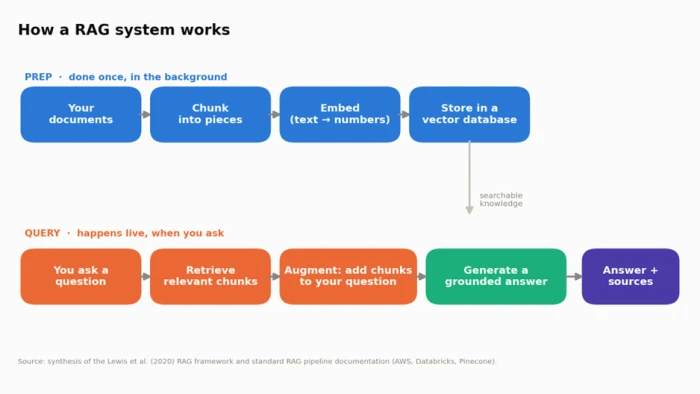
The mechanics split into two phases. One happens quietly in the background, once. The other happens live, every time you ask a question. The diagram below shows both paths, and the rest of this section walks through each box in plain English.
First, the prep work (done once, in the background)
Everything starts with your source material: documents. PDFs, web pages, support tickets, spreadsheets, whatever holds the answers. You cannot hand a 400-page manual to an AI for one small question, so the first job is to cut those documents into small, manageable pieces. This is called chunking, and a chunk is usually a paragraph or a few sentences. The intuition is simple: to answer "what is the return policy?", you want the one paragraph that covers returns, not the entire manual.
Next, each chunk is turned into numbers through a step called embedding. An embedding is a list of numbers that captures the meaning of a piece of text, so that two chunks about the same topic end up with similar numbers even if they use different words. No math is required on your side; a model does it for you. Those numbered chunks are then filed in a vector database, a store built to search by meaning rather than by exact keyword. Ask it about "time off" and it can surface a chunk that only ever says "annual leave," because the two mean the same thing.
Then, when you ask a question (this happens live)
Now the interesting part. You type a question. The system embeds your question the same way it embedded the chunks, then runs a similarity search (often called semantic search) to pull the handful of chunks whose meaning is closest to what you asked. That is the retrieval step.
Those retrieved chunks are then slipped into the prompt, alongside your original question, as background context. This is the augmentation step, and it usually happens invisibly. The bundle has to fit inside the model's context window, the amount of text the model can read at once, which is why chunking and pulling only the most relevant pieces matters. Finally comes generation: the model writes an answer using the supplied chunks, and because it is working from real text rather than memory, it can point back to the source. Basing the answer in supplied evidence is called grounding, and it is the single biggest reason RAG answers are more trustworthy than memory-only ones.
RAG in Action: One Question, Traced End to End
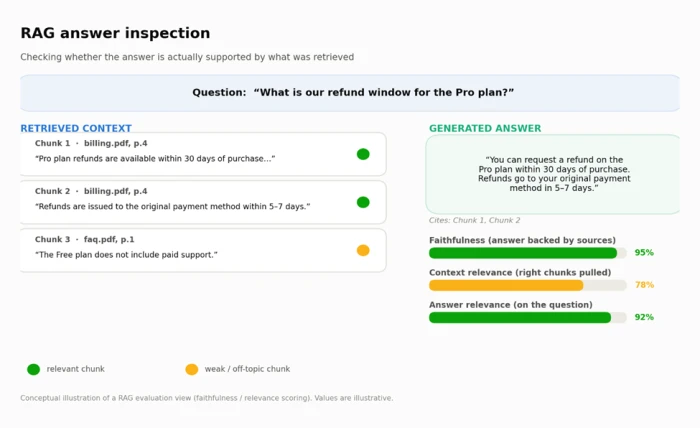
Take a question a real support bot might face: "What's our refund policy for customers on the Pro plan?"
A plain model answers from memory. It has never seen your policy, so it produces something that sounds like a refund policy, maybe "30 days, no questions asked," which may be flatly wrong. A RAG system takes a different path. It searches your vector database, finds the two or three chunks from your billing documentation that mention Pro plan and refunds, adds them to the prompt, and only then answers. The reply reflects your actual policy, and it can cite the page it came from. Same question, same model, opposite reliability, and the only thing that changed was what the AI was allowed to read first. (This is a worked illustration, not a specific company's policy.)
A Plain-English Glossary of Every RAG Term
Every term from the walkthrough, in one place, one line each. Bookmark this section; it is the fastest way to decode any other RAG article you read next.
● Chunk: a small piece of a document, usually a paragraph, so the AI can grab just the relevant part.
● Embedding: a list of numbers that captures the meaning of a piece of text, so similar meanings sit near each other.
● Vector database: a store that holds those embeddings and searches by meaning instead of exact words.
● Semantic (similarity) search: finding the chunks whose meaning is closest to your question, not just those sharing keywords.
● Retrieval: pulling the most relevant chunks for a given question.
● Augmentation: adding those chunks to your question as context before the model answers.
● Context window: the total amount of text a model can read in one go.
● Grounding: basing the answer on supplied evidence rather than the model's memory.
● Hallucination: a confident, fluent answer that is simply made up.
What People Actually Use RAG For
The theory lands faster once you see where it already runs. Most of these are tools you have likely used without knowing RAG sat underneath.
● Customer support bots that answer from a company's real help centre and policies, not generic guesses.
● "Chat with your PDF" apps that let you ask questions of a contract, a research paper, or a manual.
● Internal knowledge search, where staff ask plain-language questions across scattered wikis, drives, and tickets.
● Research and analyst assistants that pull from current filings or news so answers reflect this week, not last year.
RAG vs Fine-Tuning: Which Does What?
The one-line difference
RAG changes what the model can see. Fine-tuning changes how the model behaves. RAG is for knowledge that changes; fine-tuning is for behaviour that should stay fixed.
Fine-tuning retrains the model on your examples so new behaviour is baked into its weights. That is powerful for locking in a consistent tone, format, or specialised skill. It is the wrong tool for facts that move. One team documented fine-tuning a model on their product docs, then updating their pricing page, and watched the model keep quoting the old prices for weeks, because the facts were frozen into the weights at training time.
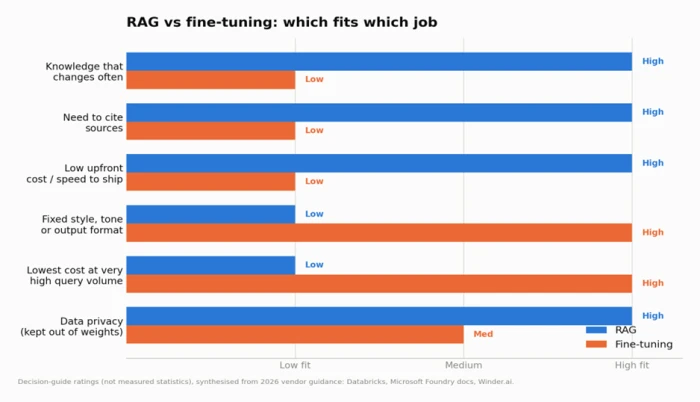
The chart below maps the two approaches against the decisions teams actually weigh. Read it as guidance, not as measured benchmarks.
Two patterns fall out of that comparison. RAG wins whenever information changes, sources must be cited, or you need to ship quickly and cheaply, which covers a large share of real applications. Winder.ai's 2026 decision framework argues RAG is the correct first choice for roughly 80 percent of enterprise language-model applications, precisely because you can swap documents without retraining and can attribute every answer. Fine-tuning wins when behaviour must stay fixed: a locked output format, a house style, or a narrow task where a small fine-tuned model can replace an expensive large one.
The strongest production systems in 2026 rarely pick one. They fine-tune for behaviour and layer RAG on top for knowledge, a hybrid that a UC Berkeley method called RAFT (Retrieval-Augmented Fine-Tuning) formalised. So the real question is not which tool is better; it is where each piece of intelligence should live: stable behaviour in the weights, changing knowledge in retrieval.
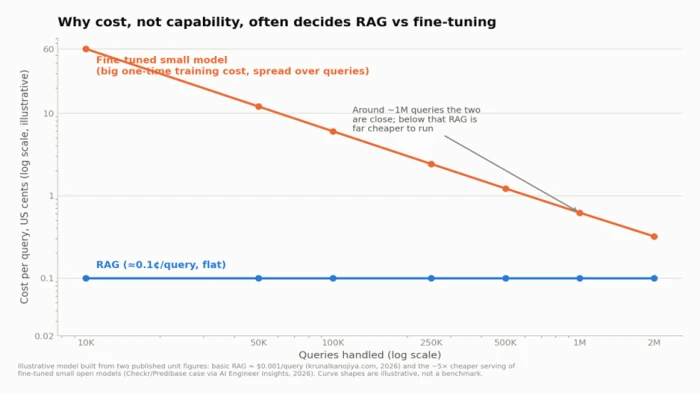
Cost is where the choice stops being abstract. A basic RAG query runs at a fraction of a cent, with no large upfront outlay, while fine-tuning carries a heavy one-time training bill that only pays off when it is spread across a very large number of queries. The next chart illustrates that trade-off using published unit figures.
Where RAG Breaks (The Honest Part Most Guides Skip)
RAG reduces hallucination. It does not abolish it, and treating it as a magic fix is how teams get burned. The failure modes are predictable, which means they are manageable once you know them.
● Retrieved does not mean true. If a wrong or outdated chunk gets pulled in, the model will faithfully repeat the wrong thing, now with false confidence. Fix: keep source documents clean and current.
● Garbage sources, garbage answers. RAG is only as good as the library behind it. Messy, contradictory, or stale docs produce messy answers. Fix: curate and version your knowledge base.
● Bad chunking hides the answer. Cut documents in the wrong places and the key sentence gets split across two chunks, so retrieval misses it. Fix: test different chunk sizes on real questions.
● Retrieval can simply miss. If the closest chunks are not the right ones, the model answers from a weak context. Fix: add reranking, which reorders retrieved results to push the best ones to the top.
● Over-trusting citations. A cited source is not automatically a correct one; the citation only shows where the text came from. Fix: keep sources visible so people can check, and evaluate the system regularly.
Is RAG Still a Thing in 2026? Agentic RAG and Long Context
A fair question, because model context windows have grown enormous, and some argue you can now just paste everything into the prompt and skip retrieval. For a single small document, sometimes you can. At any real scale it falls apart: stuffing millions of tokens into every request is slow and costly, it still cannot see private or freshly updated data unless you supply it, and it gives you no clean way to cite which source an answer came from. Those are the exact problems RAG was built to solve, so it has not gone away.
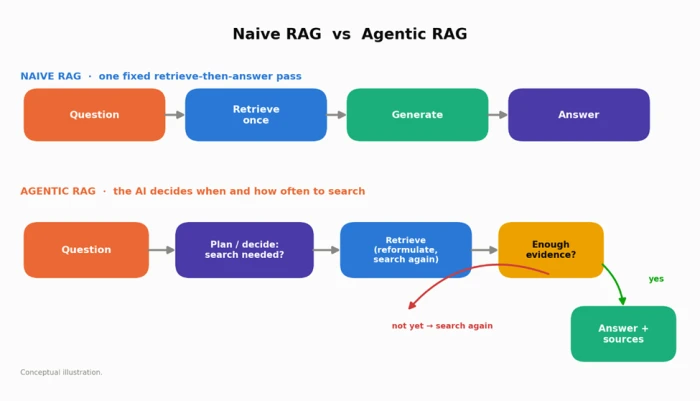
What has changed is that RAG grew up. The newer pattern is agentic RAG, where the AI does not run a single fixed retrieve-then-answer loop. It decides when to search, can search more than once, can reformulate its own query if the first results are weak, and can pull from several sources before committing to an answer. It is the difference between a student who checks the book once and one who keeps flipping back until the answer holds up.
The One-Sentence Takeaway
Strip away every acronym and RAG comes down to a single instruction you would give any smart, careful assistant: look it up in a source I trust before you answer. That one habit is what turns a fluent guesser into a system that is current, grounded in your own data, and able to show its work, and it is why the technique a small team named almost by accident in 2020 now sits underneath most of the AI tools that have to be right.



Discussion
Join the discussion and share your perspective.