Ask a chatbot to write your sales page or an image model to design a logo, and a fair question follows: is the result yours? The honest answer splits in two. In the United States, no one holds copyright in work a machine produced on its own, because copyright law requires a human author. You can still use and usually sell that output, because the rights that matter here come from the tool's terms of service, not from copyright. Ownership and usage are separate questions, and most of the confusion around who owns AI-generated content comes from treating them as one.
The short answer is two answers
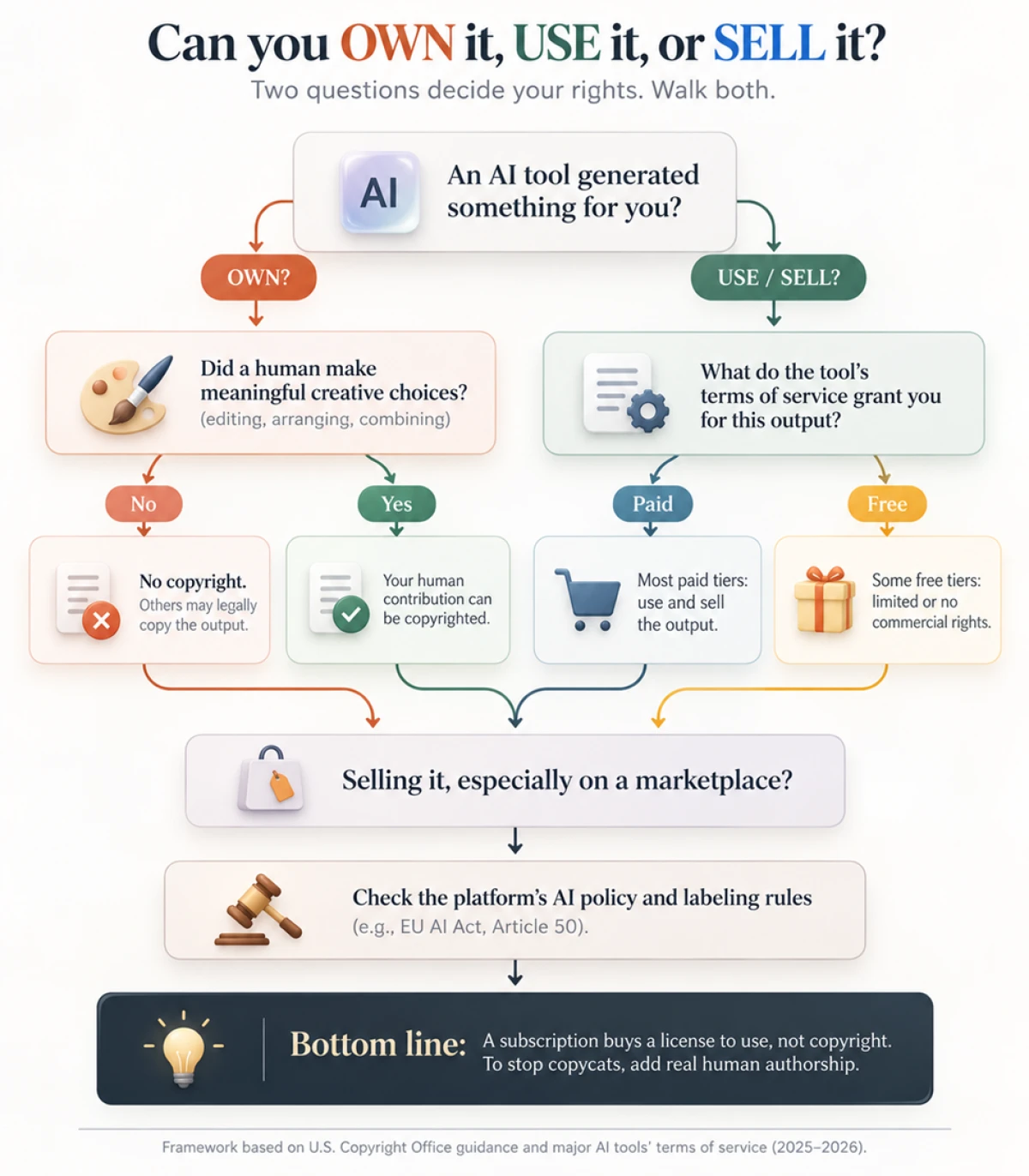
Two different systems decide your rights, and they do not always agree. The first is copyright law, which asks whether a human created the work. The second is the contract you accepted when you signed up, which asks what the company lets you do with what you make. A single image can be free for you to sell while also being impossible to copyright. Both statements can be true about the same file at the same time.
Once you separate those two questions, the rest gets easier. The next step is to see what each one actually protects, because that decides everything from a logo you paid for to a blog post a client wants to own.
"Own" and "use" are not the same thing
What copyright ownership actually means
Copyright is the right to copy a work, sell it, adapt it, and stop other people from doing those things without permission. It attaches automatically the moment a person fixes an original idea in some form, with no registration needed for the right to exist. The sticking point for AI is the human part. The U.S. Copyright Office treats human authorship as the foundation of protection, so output a system generated without meaningful human input has no author to point to, and no copyright. You cannot register it, and you cannot stop a competitor from reusing the identical result.
What usage rights actually mean
Usage rights are a separate matter, set by private contract. The tool's terms state whether you may publish the output or sell it to a client. Most major tools now grant broad usage rights to the person who generated the output, which is why businesses can build on AI results they will never own in the copyright sense. The catch is that these rights carry conditions and can change. A paid-plan requirement or a ban on using outputs to train a rival model can sit quietly inside the same agreement.
Why "no copyright" does not mean "hands off"
Here is the part that trips people up. If a pure AI output cannot be copyrighted, it sits closer to the public domain than to private property. You are free to use it, but so is everyone else, because there is no exclusive right to enforce. A rival could lift the exact image you generated and owe you nothing. The practical fix, which we come back to near the end, is to add enough human creativity that the finished work carries protection you can defend.
Can you copyright AI-generated content?
The human-authorship rule
On January 29, 2025, the U.S. Copyright Office published the second part of its report on copyright and artificial intelligence. The conclusion was blunt: copyright protects human expression, and output generated without sufficient human control over its creative choices does not qualify. The Office declined to invent new rights for machine-made work, holding that existing law already answers the question. You can read its guidance at copyright.gov/ai.
The test it settled on is the degree of human control, not how predictable the result was. Giving the machine detailed instructions does not transfer authorship if the system still makes the expressive decisions.
Prompts alone are usually not enough
Writing a prompt, even a long and specific one, generally will not make you the author. The Office reached exactly this view in the registration of "Zarya of the Dawn," a comic whose images were made in Midjourney. The applicant had written and refined many prompts, yet the Office found the individual images were not human-authored, because the model, not the person, decided how they looked.
Editing and arrangement can qualify
The door is not closed. When a person selects, arranges, edits, or combines AI output with real creative judgment, that human contribution can be protected. In the same Zarya decision, the Office registered the comic's human-written text and the creative way the panels were arranged, while refusing protection for the raw images. Heavy editing or reworking can push a piece across the line into something you own.
What the court cases signal
The other landmark involves Stephen Thaler, who tried to register an image called "A Recent Entrance to Paradise" and listed his AI system as the author. The Copyright Office refused, and the courts upheld that refusal, reaffirming that a human has to stand behind the work. The through-line across every decision is simple to state. A machine can assist a creator; it cannot be one.
What the terms of service actually give you
By now the pattern is clear. Copyright rarely hands you ownership of raw AI output, so the terms of service do the heavy lifting. This is where the tools diverge, and where reading a single clause can save you a legal headache later.
How to read an ownership clause in a minute
Four things decide most of it. Look for who the output is assigned to, whether commercial use is allowed, whether the free and paid tiers differ, and whether the company trains on your data with an option to opt out. Two phrases should stop you cold: any sign the provider keeps ownership of what you create, or any rule that locks commercial use behind a specific paid plan.
Text and chat tools
For written work and code, the big names are generous. OpenAI's terms assign the output of ChatGPT and DALL-E to the user, with broad commercial use. Anthropic's Claude also assigns outputs to you; its consumer plans can use your chats to improve the models unless you opt out, while its API and enterprise tiers do not train on your data by default. Google does not claim ownership of what you create with Gemini, and Microsoft takes the same position on Copilot output. The ownership question for text tools is mostly settled in your favor. The data question, covered shortly, is where the real differences hide.
Image and audio tools
Visual and audio tools are stricter, and the tier you choose matters more.
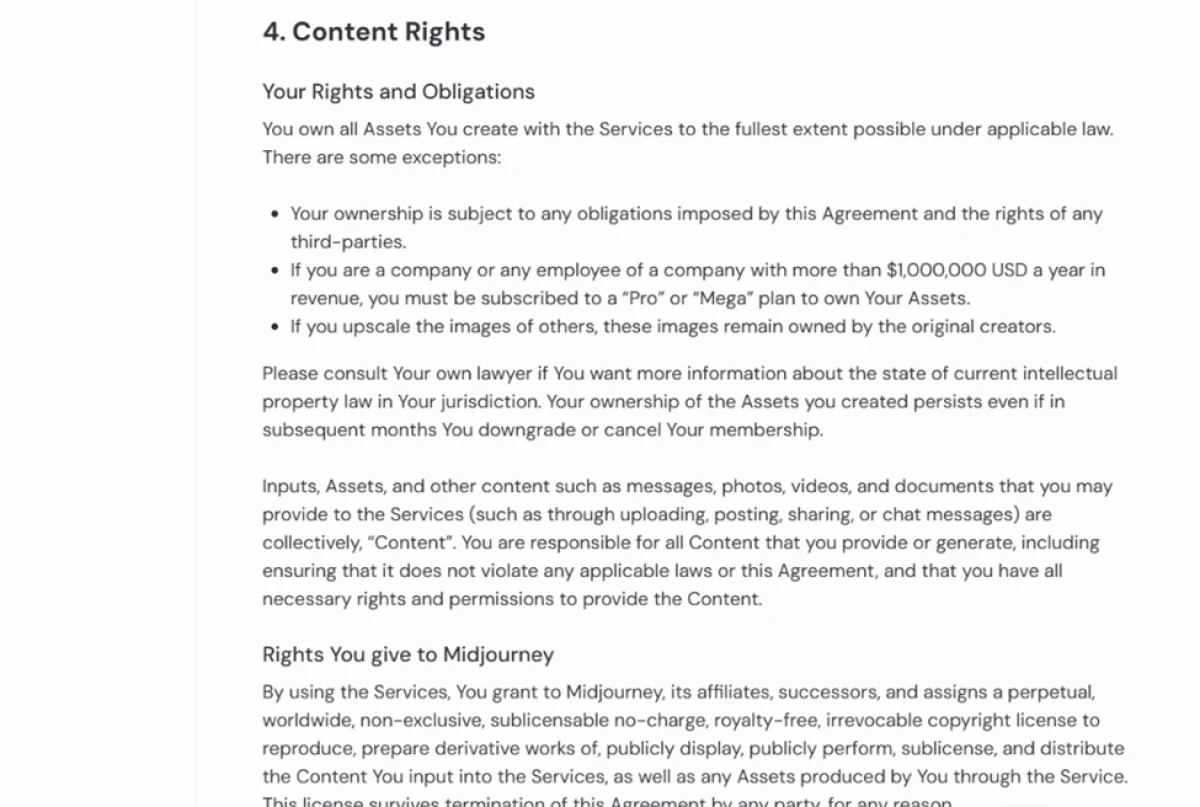
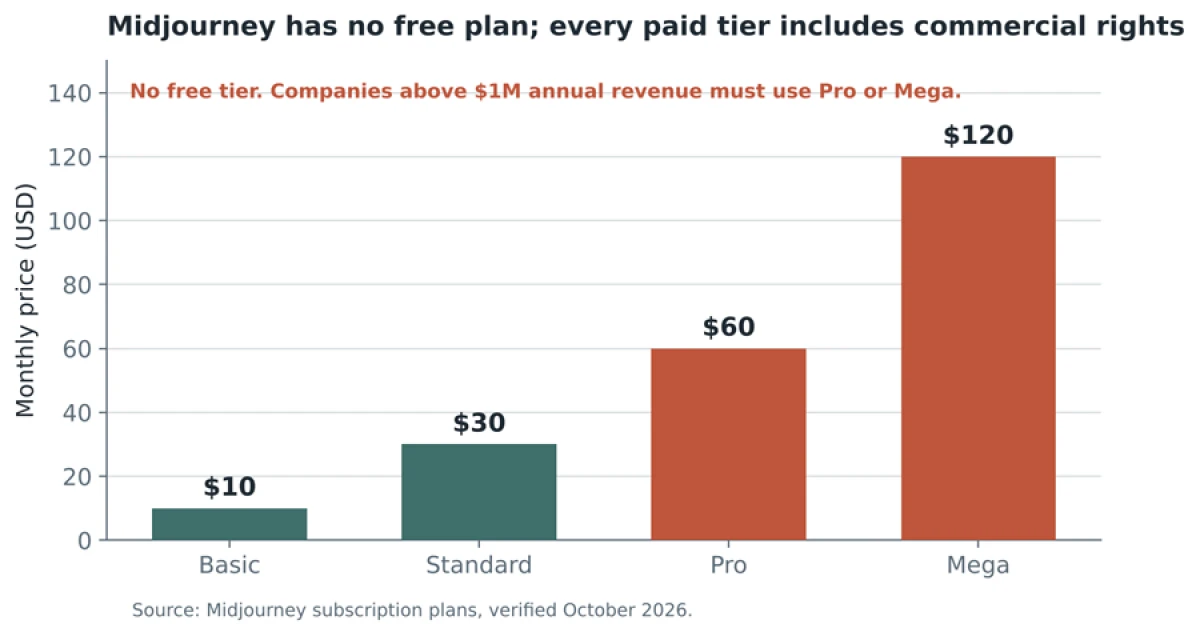
• Midjourney grants commercial rights and output ownership to paying subscribers. There is no free plan anymore, and any company earning over one million dollars a year must be on the Pro or Mega tier to use the images commercially.
• Adobe Firefly was built for commercial safety. It is trained on licensed Adobe Stock and public-domain material, and Adobe offers intellectual-property indemnification on its paid and enterprise plans, which makes it the lower-risk pick for client and brand work.
• Stable Diffusion lets you use outputs commercially under its model license but offers no indemnification, so the legal risk sits entirely with you.
• Suno, for music, gives free users no commercial rights at all, while paid subscribers can use their tracks commercially.
The free-tier trap
The free plan is where ownership quietly breaks. On several tools, anything you generate without paying may belong to the company, or may carry a non-commercial-only license. Midjourney removed its free option entirely, so there is no accidental free-tier output to misuse. The lesson holds across the market: check the tier, not the logo. The same brand can give you full commercial rights on one plan and almost none on another.
Tool
Output ownership
Commercial use
Trains on your data
Indemnification
ChatGPT / DALL-E
You own it
Yes, all tiers
Consumer: yes (opt-out); API: off by default
Enterprise only
Claude (Anthropic)
You own it
Yes, all tiers
Consumer: yes (opt-out); API/Enterprise: no
Enterprise / negotiable
Gemini (Google)
You own it
Yes
Consumer may train; business/API limited
None dedicated
Midjourney
Paid tiers own it
Paid only; $1M+ needs Pro/Mega
Images public unless Stealth (Pro/Mega)
None
Adobe Firefly
You own it
Yes
Licensed + public-domain training data
Paid / enterprise (IP indemnity)
Stable Diffusion
You own it
Yes, under license
Self-hosted = full control
None
Who owns your prompts and your data?
Ownership of the output is only half the story. What happens to what you type in matters as much, especially for confidential work.
Do they own your prompts?
Generally, no. The major providers let you keep your inputs. The sharper question is what they do with those inputs after you hit enter.
Are you being trained on?
Consumer free tiers often use your conversations to improve the underlying models unless you switch that off. Business and enterprise tiers, along with most API access, usually do not train on your data by default. If you are pasting client material or anything sensitive, that distinction decides which plan you should be on. The opt-out exists on most consumer tools; the default setting is the thing to check.
Can you sell or use AI content commercially?
This is the question most people actually came for. Selling AI output is legal in the major markets, but clearing one gate does not clear them all.
Two gates, sometimes three
Think of it as checkpoints. The first is copyright status, which decides whether you can stop others copying you. The second is the tool's license, which decides whether you are allowed to sell at all. A third appears when you sell through a platform, because that marketplace sets its own rules. You can hold a valid commercial license and still be blocked by a marketplace policy that treats AI content differently.
Selling AI art and other media
You can sell most AI-generated images or music if you hold the tool's commercial license and the output does not copy someone's protected work. What you usually cannot do is stop a competitor from generating something similar. Adding your own edits strengthens two things at once: your copyright claim and your distance from everyone else using the same model.
Disclosure and labeling
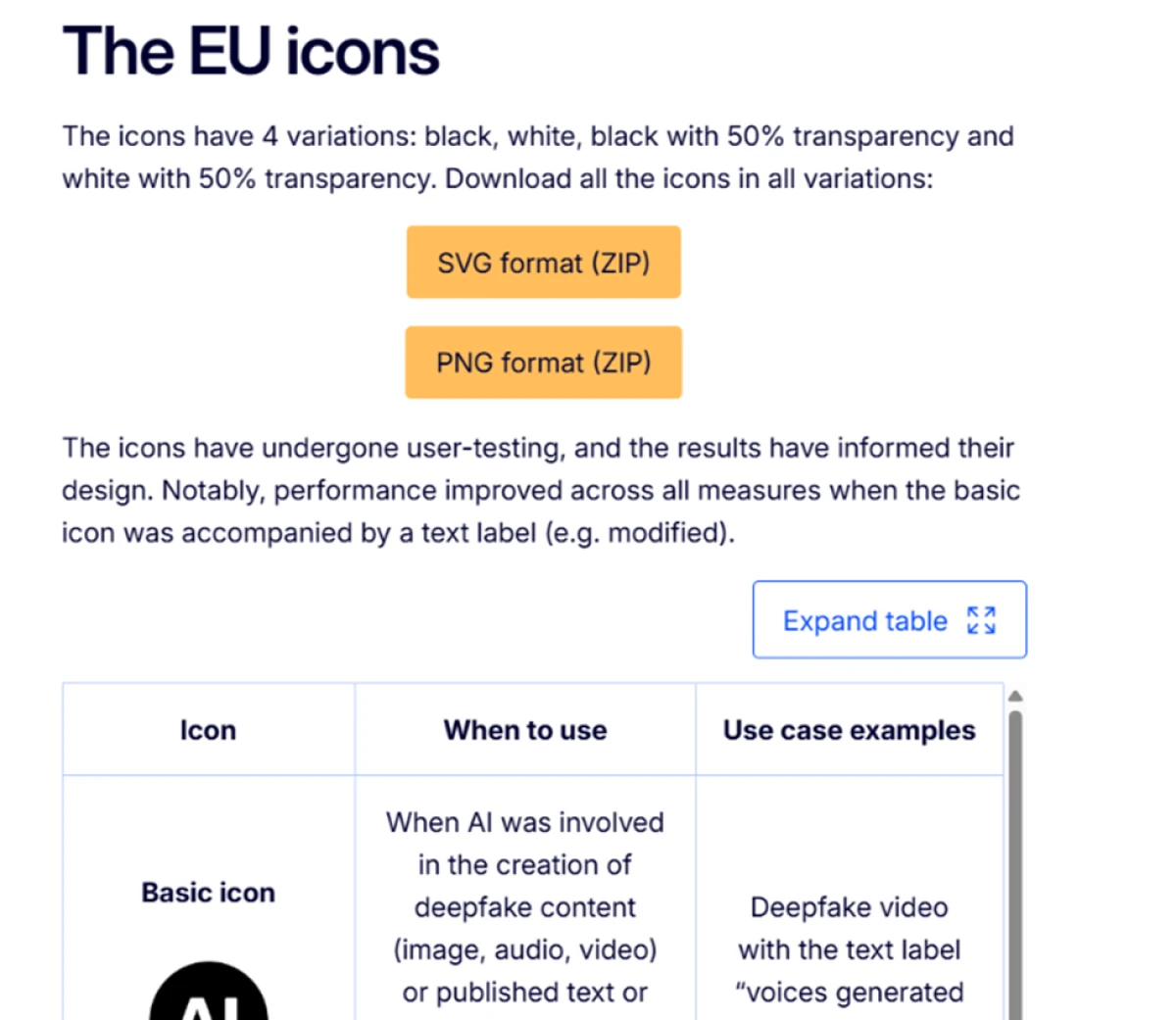
Rules on telling people that content is AI-made are tightening. The EU AI Act's Article 50 took effect on August 2, 2026, requiring providers to mark AI-generated content in a machine-readable way and deployers to disclose certain deepfakes and AI-generated text on matters of public interest. The European Commission's guidance sits at digital-strategy.ec.europa.eu. Stock platforms such as Adobe Stock and Shutterstock already require AI labels on submissions, and individual marketplaces add their own expectations on top of the law.
The risk nobody warns you about
So far the risks have been about what you can keep. The larger exposure runs the other way: the chance that your AI output infringes someone else's rights.
When output resembles someone else's work
Models learn from enormous datasets, and sometimes an output lands close to a protected image or piece of music. If that happens and you publish it, the infringement claim can reach you, not only the platform that made the tool.
Who covers you if you are sued
This is where indemnification earns its keep, and where the tools split sharply. Adobe offers IP indemnity on paid and enterprise Firefly plans, meaning it will defend covered claims. Stable Diffusion offers none. For a client campaign or anything brand-critical, the indemnity clause is often the single most valuable line in the agreement.
The 2026 litigation that shapes your terms
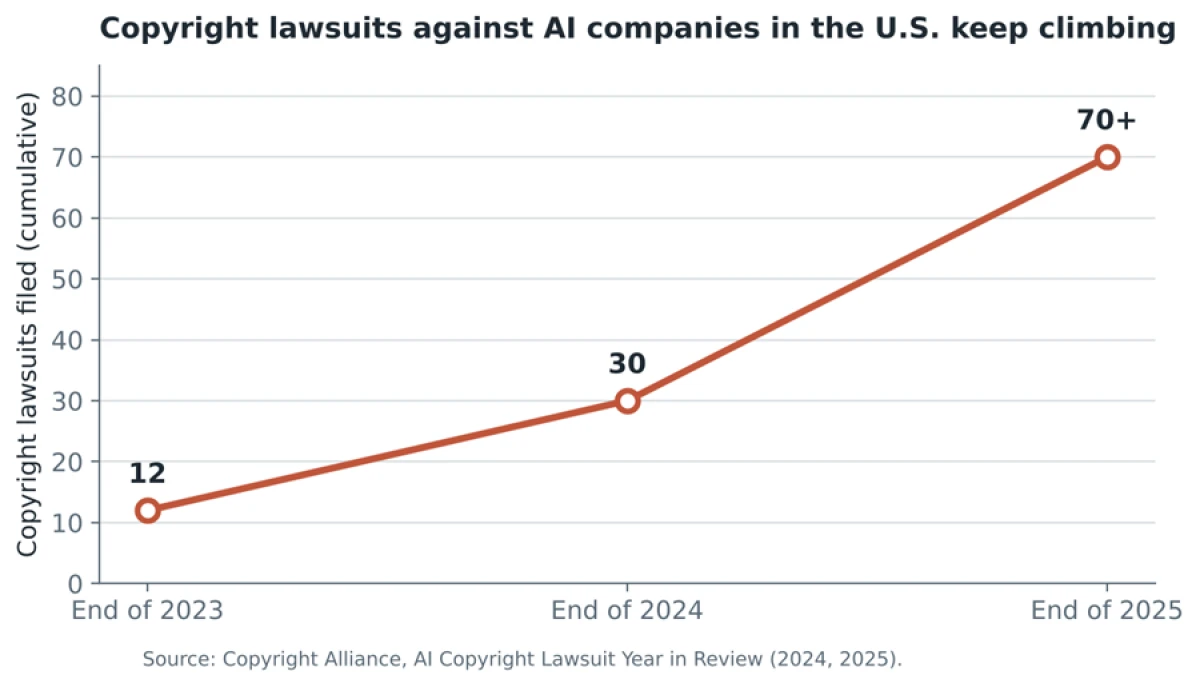
The legal ground is moving fast, and the numbers show it. Copyright suits against AI companies in the United States climbed from about a dozen in 2023 to more than seventy by the end of 2025.
In September 2025, Anthropic agreed to pay at least 1.5 billion dollars to settle a class action brought by authors over pirated books used in training, roughly 3,000 dollars for each of about 500,000 works. Lawyers for the authors called it the largest publicly reported copyright recovery on record. A 2025 ruling went against an AI company's fair-use defense in a training-data case brought by Thomson Reuters against Ross Intelligence, and in the New York Times litigation a court ordered OpenAI to preserve millions of ChatGPT logs. These cases target the platforms rather than ordinary users, yet they shape the indemnities and training policies you will be offered next.
Ownership by use case
The rules land differently depending on what you do. Here is how the two-question framework plays out for the people who ask about it most.
Freelancers and agencies
Clients often ask you to warrant that you own the deliverable and can hand over full rights. Pure AI output cannot be copyrighted, so you cannot cleanly assign copyright you never held. The workable path is to add substantial human work, keep a record of it, and write the contract to promise what you can actually deliver: your human contributions and a valid license to use the output, rather than a copyright that does not exist.
Founders building AI into a product
Investors now ask how much of a product was made with AI and whether the company owns it. Weak answers surface in due diligence. Audit the terms of every AI tool in your stack and document the human work behind your core assets. Update IP policies that were written before generative tools existed.
Bloggers and SEO teams
Content you shape and edit can be protected; raw machine output cannot. Adding original reporting, first-hand testing, or your own analysis does two useful jobs. It gives the piece a copyright footing, and it lifts the quality that search engines and readers reward.
Creators selling art and merchandise
Use a paid plan that grants commercial rights, add your own creative edits before you sell, and label the work where a platform or law requires it. Go in expecting that you cannot stop others from copying a raw generation, and price and position the work accordingly.
Does it depend on where you live?
Copyright is national, so the same AI image can have a different status in two countries. The headline split is worth knowing before you publish across borders.
A four-country snapshot
• United States: purely AI-generated work gets no copyright; a human author is required.
• United Kingdom: a long-standing provision protects computer-generated works and assigns authorship to the person who made the arrangements for creation, which is more generous on paper than the U.S. position, though its future is under government review.
• European Union: the focus is transparency through the AI Act, while copyright still centers on human creativity.
• India: copyright law is built around human authorship, and AI policy is still being debated without a settled rule.
The common direction is unmistakable. Human authorship is becoming the shared test, even as the details vary by country.
How to own more of your AI work
The fix for weak ownership is mostly in your hands, and it does not take a lawyer for everyday cases.
Add meaningful human authorship
Edit, rearrange, rewrite, and combine. Make expressive choices the model did not make for you, because those choices are what the law can protect.
Document your process
Keep your prompts, drafts, edits, and the terms you agreed to, each with a date. That record supports both a copyright claim and the clean chain-of-title a client or investor will ask about.
Pick the right tool and tier
Pay for the tier that grants commercial rights, and favor tools that indemnify you when the work is client-facing or brand-critical.
Handle contracts and disclosure
Promise only what you hold and assign your human contributions in writing. Disclose AI use wherever a platform or the law now expects it.
The people who get burned are not the ones who used AI. They are the ones who assumed a monthly subscription bought them copyright, when all it bought was permission to use. The output you can defend is the output you changed. Add your own judgment to what the machine hands back and keep a record of it, and the question of who owns AI-generated content stops being a worry and becomes a decision you control.
The Verdict
So, who owns what an AI tool generates for you? In plain terms: you can use and sell most of it, but you rarely own the copyright, and that gap closes only when a human adds real creative work. A paid subscription buys you permission to use, not a copyright to enforce.
For anything that matters to your business, treat ownership as a checklist rather than an assumption. Read the tool's terms before you rely on the output, pay for the tier that grants commercial rights, add and document genuine human edits on the assets worth defending, and favor a tool that will indemnify you when the work is client-facing. That moves you from hoping the output is yours to knowing exactly what you hold.
The law here is still being written, with fresh rulings and settlements landing through 2026. Keep your eye on the terms you accept and the human effort you can prove, because those two levers stay in your hands no matter how the court cases turn out.



Discussion
Join the discussion and share your perspective.