PolyBuzz AI vs Character AI: Which One Actually Wins in 2026?
Compare PolyBuzz AI vs Character AI in 2026. Explore chat quality, memory, avatars, pricing, moderation, privacy, pros, cons, and which AI chatbot is best.
I had been using Character AI for close to two years when a conversation stopped mid scene and the app asked me to prove I was an adult. Not a checkbox. A selfie.
That prompt is the reason this comparison exists. The moment Character AI began gating open ended chat behind an identity check, a name I had been scrolling past for months started appearing in every thread about alternatives. PolyBuzz.
So I spent real time inside both apps, then went further and pulled every price from the two companies' own pages rather than trusting the affiliate posts that dominate this search. What follows is the split between them, including the parts neither company puts on its landing page.
The quick verdict
Detail comes further down. Here is the decision.
Choose Character AI if long form roleplay is the point. Its characters hold a personality across hundreds of messages better than anything PolyBuzz currently manages, and its creation tools go deeper.
Choose PolyBuzz if you want generated avatars, switchable chat models, and an app that has not asked for your government ID.
Both start free. Neither is actually uncensored, whatever the marketing suggests, and the moderation section below sets out what each one blocks.
Two origin stories, two different attitudes
Character AI is the incumbent. It was founded in November 2021 by Noam Shazeer and Daniel De Freitas, two former Google engineers who had worked on LaMDA. It opened to the public in September 2022 and now hosts more than 10 million user created characters. Its reputation was built on dialogue that reads as written rather than generated.
PolyBuzz AI took the opposite route to scale. Mobile first, ad supported, aggressive on features. It is built by Cloud Whale Interactive Technology, has been on Google Play since June 2023, and has passed 52 million downloads. It also carries a High Maturity content rating on Android, which tells you plenty about the audience it courts.
The rebrand from Poly.AI to PolyBuzz happened in early 2025, which is why older reviews and newer ones can read like descriptions of two separate products.
Character AI
PolyBuzz
Parent company
Character Technologies, Menlo Park
Cloud Whale Interactive Technology
Public launch
September 2022
June 2023 on Google Play
Characters claimed
10 million plus
20 million plus
Under 18 open chat
Blocked since November 2025
Teen Mode, self declared
Desktop
Full web app
Browser only, no PC client
Paid entry point
$9.99 per month
$9.9 per month at the price shown
The first ten minutes on each app
Signup tells you who each app was built for.
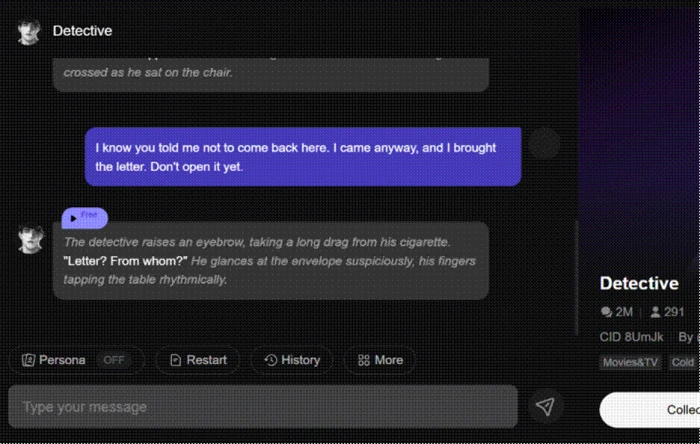
Character AI drops you in front of a search bar and a feed of community characters. It is a text environment and the interface has barely shifted in years. Pick a character, start typing, the model answers.
PolyBuzz opens with cards. Characters arrive as illustrated tiles with voices already attached, sorted into categories, and the app steers you into persona setup early. People who switch over often say the persona system is easier to configure than the Character AI equivalent.
PolyBuzz runs its own models, so there is no key to paste and nothing to configure before the first message lands.
One limitation to know upfront: PolyBuzz has no desktop client. The company confirms you cannot install it on a PC, and desktop users get the browser version instead.
Ads are the other early difference. Both free tiers serve them, and Character AI now runs them mid chat by default, which a lot of long time users treat as the moment the free experience stopped being pleasant.
The rule change that reshaped both apps
Character AI did not tighten its rules because it wanted to. It was pushed.
Families sued the company over teen harms, most prominently in the case of 14 year old Sewell Setzer. A federal court declined to treat the chatbot as protected publisher speech and allowed it to be treated as a product for liability purposes. In January 2026, Character AI and Google settled five family lawsuits. Terms were not disclosed. The company also agreed to fund an independent AI safety lab as part of that resolution.
Before those settlements landed, Character AI had already banned open ended chat for anyone under 18. That took effect on 25 November 2025.
Legislation arrived on the same timeline. California's SB 243 became effective on 1 January 2026, and New York's AI companion law placed similar duties on platforms in this category. Pennsylvania's attorney general then sued Character AI in May 2026, alleging that bots on the platform presented themselves as licensed medical professionals, including one that supplied a state investigator with a fabricated medical license number.
PolyBuzz has faced none of this publicly. That is the single biggest reason its content rules still feel looser, and it reflects a gap in legal exposure rather than a difference in principle. Keep that in mind whenever you read the word unrestricted on its pages, because the state laws above apply to the whole category and not only to the company that got sued first.
What the age check actually feels like
The system runs in two phases and most adults only ever meet the first.
• Character AI's own model estimates your age from account age, login history, in app behavior, and some third party signals.
• If nothing looks unusual, you never see a prompt at all.
• Flagged accounts are handed to Persona, an outside verifier, which defaults to face based age estimation and can escalate to a government ID.
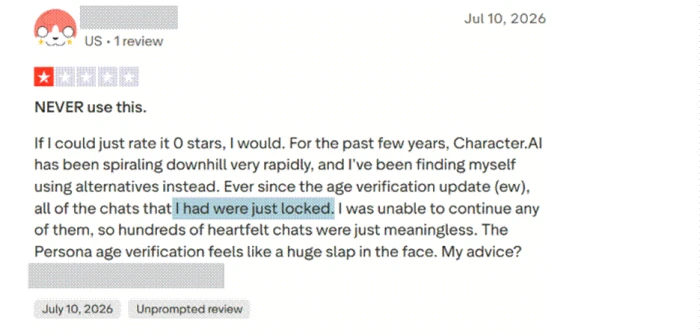
• Refuse or fail it, and the account drops into a restricted mode where the chat input is effectively locked.
The friction is not theoretical. Adults with younger looking faces getting stuck in view only mode has become a recurring complaint on the platform's own subreddit, and the recovery path is slow enough that people give up and leave. That moment is where most PolyBuzz signups come from.
PolyBuzz asks for nothing comparable. Its help pages describe graded modes for different age groups and a dedicated Teen Mode for younger users. No selfie. No document upload.
What each platform actually blocks
Both companies are moderating. They are moderating different things, and almost nobody explains the difference.
Character AI polices the conversation itself. Its filter moved away from simple keyword matching to an intent aware system, which means indirect or suggestive framing can trip it where a blunt phrase once slipped through. Verified adult accounts meet a looser version of it. Paying for c.ai+ does not switch it off, and the company has never claimed otherwise.
PolyBuzz polices distribution. Its help pages say public display of adult content is prohibited and that recommended content passes through layered automated screening backed by human review. User created characters get flagged with a Violation label for content involving pornography, minors, inappropriate language, or sensitive topics, and a flagged character becomes visible only to the person who made it while its avatar reverts to a placeholder.
Read that carefully, because it explains the reputation gap. PolyBuzz is stricter about what the community can see and looser about what happens inside a private chat. Character AI is the reverse.
That is why calling either app uncensored is wrong, and why the two feel so different in the first hour.
The conversations, side by side
This is where Character AI still earns its subscription.
Its creation flow gives you a name, a short description, a long description, and a definition box where you paste example exchanges to teach the character how it speaks. That last field is why Character AI bots keep their voice through a complicated plot. Ask for a metaphor and one generally comes back.
PolyBuzz attacks the same problem from the other end. Rather than one strong model, it hands you a menu.
Its membership page lists seven named models, running from Standard at the entry level up to newer additions unlocked on higher tiers. Switching model mid story visibly changes the tone of the reply, which is a useful dial or an inconsistency depending on how much continuity you need.
The trade shows up in pacing. Character AI reads like a novel being written slowly. PolyBuzz reads like a fast group chat with someone fully committed to the bit.
Memory, where both companies concede the weakness
Neither platform is good at this, and to their credit both say so in public.
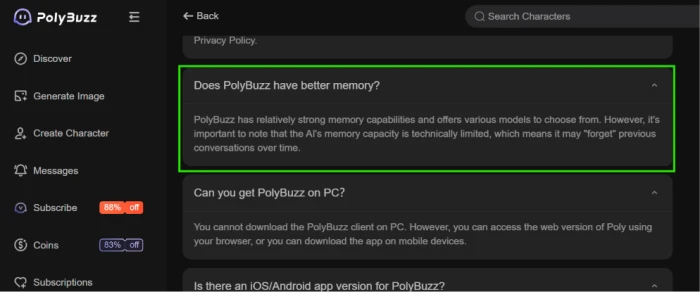
PolyBuzz states in its own FAQ that memory capacity is technically limited and that characters may forget earlier conversation over time. Paying users report exactly that, including subscribers who bought a tier specifically for longer recall.
Character AI advertises better memory as a Plus benefit on its official pricing table without putting a number on it. PolyBuzz splits the feature across tiers, with Long Memory on the entry plan and Permanent Memory held back for the higher ones.
Run this test before you pay either company:
• Give the character a specific detail at message five, something like the name of a fictional hometown.
• Ask about it again at message 30, then 75, then 150.
• Note the exact message number where the detail disappears.
• Repeat the identical script on the other platform.
That number is the only memory benchmark worth having, because it is measured against how you actually use the app instead of how a pricing page describes it.
Libraries, and the migration nobody mentions
PolyBuzz claims more than 20 million characters against Character AI's 10 million plus. The gap matters less than it sounds.
Volume is not curation. A bigger library on PolyBuzz means more scrolling past near duplicates before you find a character worth an hour of your evening. Character AI's community is smaller and older, and its best characters have been sharpened by years of use.
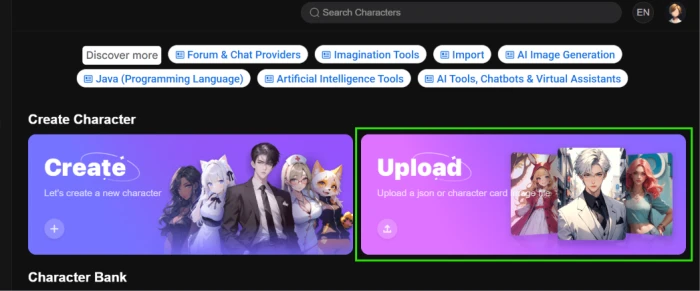
Now the detail sitting in PolyBuzz's own help pages that its rivals never surface: the web version accepts character cards and JSON files, with stated support for imports from Character.AI, Pygmalion, TavernAI, and several other formats.
If you built characters on Character AI and assumed that leaving meant abandoning them, that assumption is wrong.
Voice, avatars, and moving pictures
This is the clearest feature gap between the two, and it runs in PolyBuzz's favor.
PolyBuzz generates character avatars and animated Live Photos, and its membership tiers grant daily extra avatar generation attempts: 20 on the entry plan, 30 on each of the two above it. Coins extend voice chat duration and unlock generated scenes. Character AI has no equivalent image pipeline for characters.
Voice is closer. Character AI bundles unlimited voice calls into its Plus plan. PolyBuzz members get unlimited voice listening on the chat page, but extended voice chat draws down coins, which is where the spending quietly begins.
What each one actually costs
Every figure below comes from the two companies' own pricing pages, checked in July 2026. Both lean on heavy promotional discounts, so treat the sale numbers as a snapshot rather than a fixed rate.
Character AI
The free tier keeps unlimited messaging and full access to characters, alongside mid chat ads and a virtual currency called Charms that meters actions such as swipes and go-ons.
c.ai+ is listed at $9.99 per month, or $94.99 per year against a $119.88 list price, a 20 percent saving. The official feature table promises better memory, ad free chats, access to the newest models, no slow mode, unlimited voice calls, higher limits on muted words and swipes, chat customization, a bonus on Charms packs, plus early feature access and a subscriber community.
PolyBuzz
PolyBuzz runs three membership tiers. Basic sits at the bottom, Ultimate at the top, with Premium between them. At the time of checking, its membership page displayed $9.9 per month and $99 per year, which it presents as $8.25 per month, both shown against far higher struck through prices.
Coins are sold separately, and this is where PolyBuzz gets expensive:
Coin pack
Sale price
Listed as
1,000 coins
$2.49
$6.23
3,000 coins
$4.99
$18.70
8,000 coins
$8.49
$49.80
20,000 coins
$19.90
$125.00
Coins pay for regenerating replies, inspiration replies, Live Photo generation, unlocking moments, and rounds on the premium models. A heavy PolyBuzz user can burn more on coins in a month than a Character AI subscriber spends in a year, which inverts the free and unlimited pitch entirely.
Character AI's cost is predictable. PolyBuzz's is not.
Privacy, and what you hand over
The two platforms ask you to trust them with different things.
PolyBuzz says chats are confidential and that neither character creators nor the company can reach the conversation content between a user and a character. Its Google Play listing separately discloses that certain data types are shared with third parties, so read the policy rather than the FAQ summary.
Character AI's exposure is front loaded. Clearing verification can mean sending a selfie or a government ID to Persona. The company says it does not store those files on its own servers, and Persona encrypts them and deletes them after processing. Privacy researchers have still flagged the obvious risk in pooling millions of identity documents into one system.
One platform wants your ID. The other wants you to trust a policy document. Pick the risk you mind less.
Which one belongs on your phone
You write long, plot heavy stories
Character AI, still. The definition box and its dialogue consistency have no match here, and the model switching described earlier works against continuity across a long narrative.
You are an adult stuck in verification limbo
PolyBuzz, for now. It asks for no document and its restrictions sit looser. Understand that the gap exists because PolyBuzz has not yet been sued or legislated into the same corner, and that the laws covered above apply to every companion app rather than to one company.
You want to see your characters
PolyBuzz. Generated avatars, scene art, and animated Live Photos have no Character AI counterpart, and watching a character get rendered changes how a scene lands. Budget for coins.
You are a parent checking on a teenager
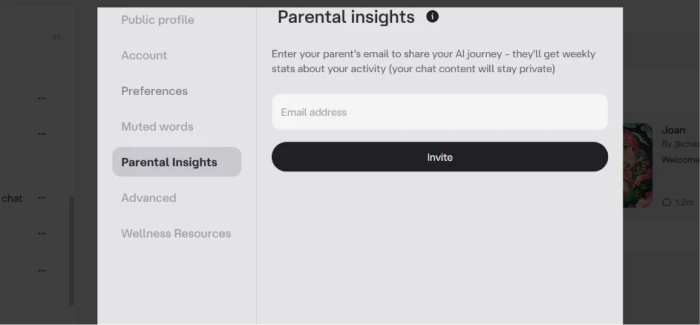
The two apps are not comparable here. Character AI blocks open ended chat for under 18 accounts outright, enforces it with age estimation, and offers a Parental Insights tool that surfaces account activity to a guardian. PolyBuzz leans on a self declared Teen Mode with no identity check behind it, and its Android listing carries a High Maturity rating. If a 15 year old has one of these installed, the one that will actually stop them is the one that asks for a face.
Final verdict, and my scorecard
Nine categories, scored out of 10 after using both accounts side by side. Weight them however you like. The totals matter less than the shape of the gap.
Category
Character AI
PolyBuzz
Dialogue quality
9
7
Memory retention
5
5
Library quality (not size)
8
6
Character creation depth
9
6
Visuals and avatars
3
9
Voice
7
8
Content freedom
4
7
Ease of getting in
4
9
Cost predictability
9
4
Total
58 / 90
61 / 90
PolyBuzz wins on points and loses the thing I care about.
Three points is inside the margin of my own bias, so read that total as a tie rather than a result. What the scorecard actually shows is that the two apps barely compete. PolyBuzz sweeps everything about access and presentation. Character AI sweeps everything about writing. Their only genuine tie is memory, which both companies undersell for the same reason.
My accounts stayed open on both, and my time did not split evenly. Character AI still gets the long evenings when I want a story that holds together. PolyBuzz gets the twenty minute gaps.







Discussion
Join the discussion and share your perspective.